
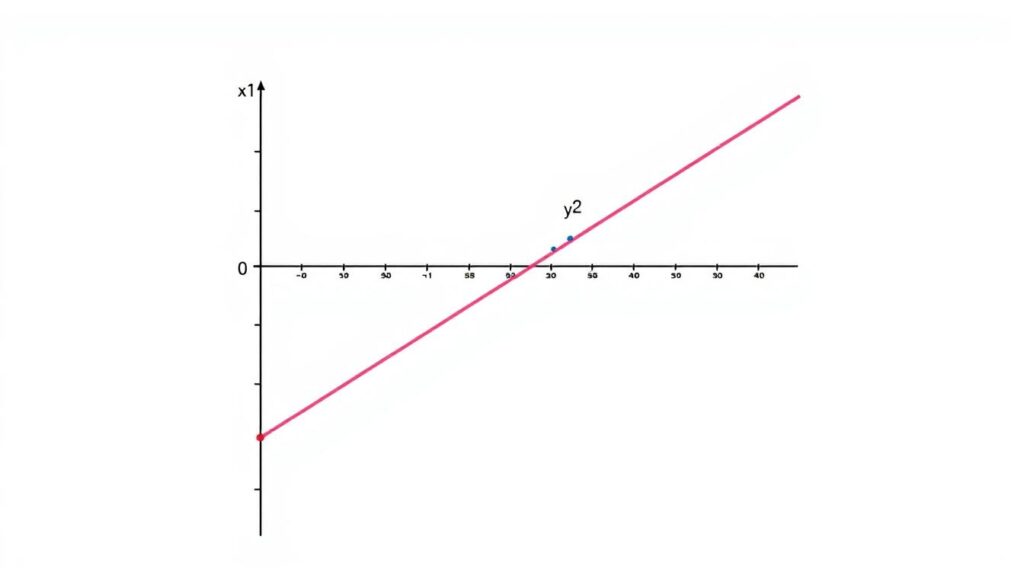
The slope of a line is essential in math and everyday life. It measures how steep a line is and which way it goes. Knowing how to figure out the slope helps you tackle math problems with ease.
Mathematicians use slope to show how fast a line goes up or down. It shows the link between changes across and up on a graph. Learning the slope formula can boost your math skills beyond the classroom.
Why Slope Matters
Slope reveals key facts about how a line acts. A positive slope means the line goes up from left to right. A negative slope shows the line goes down instead.
Some lines are special. Flat lines have zero slope. Straight up-and-down lines have no defined slope1.
Key Takeaways
- Slope measures the steepness of a linear equation
- The slope formula helps calculate line gradients
- Positive and negative slopes indicate different line directions
- Slope is essential in algebra, geometry, and real-world applications
- Understanding slope enhances mathematical problem-solving skills
Understanding the Concept of Slope
Slope is a key element in graphing lines and understanding rates of change. It shows how steep a line is and which way it goes. Slope helps us see how points connect on a coordinate plane2.
What is Slope?
Slope is the ratio of vertical change (rise) to horizontal change (run) between two points. It’s like measuring how fast a line goes up or down2.
You can think of slope as the tilt of a line. It tells you how quickly the line rises or falls3.
- Positive slope indicates an upward line direction
- Negative slope shows a downward line direction
- Zero slope represents a horizontal line
- Undefined slope applies to vertical lines
Importance of Slope in Real Life
Slope isn’t just for math class. It’s a useful tool in many jobs. Civil engineers use it to build roads. Geographers study land slopes.
Scientists also use slope to look at how things change over time4.
| Field | Slope Application |
|---|---|
| Architecture | Roof pitch calculations |
| Engineering | Road and railway gradient design |
| Calculus | Understanding derivative rates |
Slope tells a story of change, revealing how lines move and interact in mathematical and real-world contexts.
Learning about slope helps you understand line equations better. It’s a key part of graphing lines and seeing how math works in real life3.
How to Calculate Slope
Calculating slope is vital in math and real-world situations. It shows a line’s steepness and direction. Slope is often called “rise over run”5.
Using the Slope Formula
The slope formula is simple: m = (y2 – y1) / (x2 – x1). It compares two points to find a line’s gradient6.
- Identify two points on the line
- Calculate the vertical change (rise)
- Calculate the horizontal change (run)
- Divide the rise by the run
Step-by-Step Slope Calculation
Let’s explore how to find a line segment slope:
- Pick two coordinates on the line
- Subtract the y-coordinates to find vertical change
- Subtract the x-coordinates to find horizontal change
- Divide vertical change by horizontal change
The slope tells you how steep a line is and its direction of movement.
In linear equations, find the slope by using y = mx + b. Here, ‘m’ is the slope5.
Different slope values mean different things:
- Positive slope: Line rises from left to right
- Negative slope: Line falls from left to right
- Zero slope: Horizontal line
- Undefined slope: Vertical line
Understanding slope helps you grasp math relationships. It also lets you predict linear patterns6.
Different Types of Slope
Grasping line gradients is key in graphing and algebra. Slopes show how lines move across coordinate planes. They reveal a line’s steepness and direction7.
Exploring Slope Variations
Slopes fall into four main types based on their behavior:
- Positive Slope: Lines ascending from left to right7
- Negative Slope: Lines descending from left to right7
- Zero Slope: Horizontal lines7
- Undefined Slope: Vertical lines7
Characteristics of Slope Types
Slope shows the line equation’s angle with the x-axis. A positive slope occurs when x and y coordinates increase or decrease together. This creates an acute angle7.
A negative slope happens when coordinates change in opposite directions. This forms an obtuse angle7.
Calculating Slope Characteristics
| Slope Type | Angle with X-Axis | Calculation Method |
|---|---|---|
| Positive Slope | Acute (0-90 degrees) | m = Δy/Δx (positive result)8 |
| Negative Slope | Obtuse (90-180 degrees) | m = Δy/Δx (negative result)8 |
| Zero Slope | 0 degrees | m = 08 |
| Undefined Slope | 90 degrees | m = undefined8 |
“The slope tells a story about how a line moves through space.” – Mathematics Insight
The slope’s absolute value shows its steepness. Parallel lines have the same slopes. Perpendicular lines have slopes that are negative reciprocals of each other8.
Practical Applications of Slope
Slope is a powerful math concept with real-world uses. It helps analyze trends and make predictions in various fields. Economists use it to forecast property values in places like Hawaii9.
Road engineers use slope for safe infrastructure design. Slope measurements determine the safety of transportation routes10. Road slopes are shown in percentages, like a 5% downgrade for vertical drops10.
This helps design highways, mountain roads, and city streets safely. Slope is crucial for optimal safety standards in road construction.
Using Slope in Algebra
Slope is a powerful tool for understanding relationships in algebra. Financial analysts use it to track changes in salaries and tuition rates9.
Businesses calculate depreciation rates with slope. A slope of -10,000 shows a $10,000 yearly decrease in asset value10.
Understanding these relationships helps make smart decisions in economics and data science. It’s a valuable skill in many fields.
Slope in Geometry and Beyond
Slope has many uses in geometry, physics, and environmental science. Hydrologists use river gradients to understand water flow10.
Slope helps analyze population changes, rocket costs, and bike speeds9. It provides a way to measure change accurately.
Mastering slope allows you to interpret complex data precisely. It’s a valuable skill in many fields.
FAQ
What exactly is the slope of a line?
Slope measures a line’s steepness. It’s the ratio of vertical to horizontal change between two points. This tells you how steep and which direction a line moves.
The formula is m = (y2 – y1) / (x2 – x1). Here, (x1, y1) and (x2, y2) are two points on the line.
How do I calculate the slope of a line?
To find slope, follow these steps: Pick two points on the line. Calculate the change in y-coordinates (Δy). Find the change in x-coordinates (Δx).
Finally, divide Δy by Δx. For example, with points (2, 5) and (9, 19), Δy = 14 and Δx = 7. The slope is 14/7 = 2.
What do positive and negative slopes mean?
A positive slope (m > 0) shows a line rising from left to right. This indicates an increasing relationship. A negative slope (m
Where is slope used in real life?
Slope has many practical uses. It’s important in road construction for determining grades. Civil engineers use it to design infrastructure.
Geographers measure terrain gradients with slope. In economics, it helps analyze trends. Scientists and mathematicians use slope to understand rates of change.
What’s the difference between parallel and perpendicular lines in terms of slope?
Parallel lines have the same slope and never intersect. Perpendicular lines have slopes that are negative reciprocals of each other.
For example, if one line has a slope of 2, its perpendicular line would have a slope of -1/2.
Can a line have an undefined slope?
Yes, a vertical line has an undefined slope. This happens when the x-coordinate stays the same. There’s no change in the x-direction, making slope impossible to calculate.
How is slope related to algebra and graphing?
In algebra, slope is key for writing line equations. It’s used in point-slope (y – y1 = m(x – x1)) and slope-intercept (y = mx + b) forms.
When graphing, slope shows the line’s steepness and direction. This helps you understand how x and y variables relate.
Source Links
- Finding the Slope of a Line From Its Graph – https://courses.lumenlearning.com/mathforliberalartscorequisite/chapter/finding-the-slope-of-a-line-from-its-graph/
- 4.4: Understanding the Slope of a Line – https://math.libretexts.org/Bookshelves/Algebra/Elementary_Algebra_1e_(OpenStax)/04:_Graphs/4.04:_Understanding_the_Slope_of_a_Line
- Slope of a Line – Definition, Formulas and Examples – https://byjus.com/maths/slope-of-line/
- Slope – https://en.wikipedia.org/wiki/Slope
- Slope Calculator – https://www.calculatorsoup.com/calculators/geometry-plane/slope-calculator.php
- Slope Calculator – https://www.calculator.net/slope-calculator.html
- 4 Different Types of Slopes – How to find it? – https://www.coolkidfacts.com/different-types-of-slopes/
- Slope of a Line: Definition, Types, Formulas, Examples, and FAQs – GeeksforGeeks – https://www.geeksforgeeks.org/slope-of-line/
- 3.5: Applications of Slope | Elementary Algebra – https://courses.lumenlearning.com/slcc-elementaryalgebra/chapter/3-5-interpreting-slope/
- The Slope and Its Applications For Real-Life – https://www.linkedin.com/pulse/slope-its-applications-real-life-sherif-sakr-ish1f

