
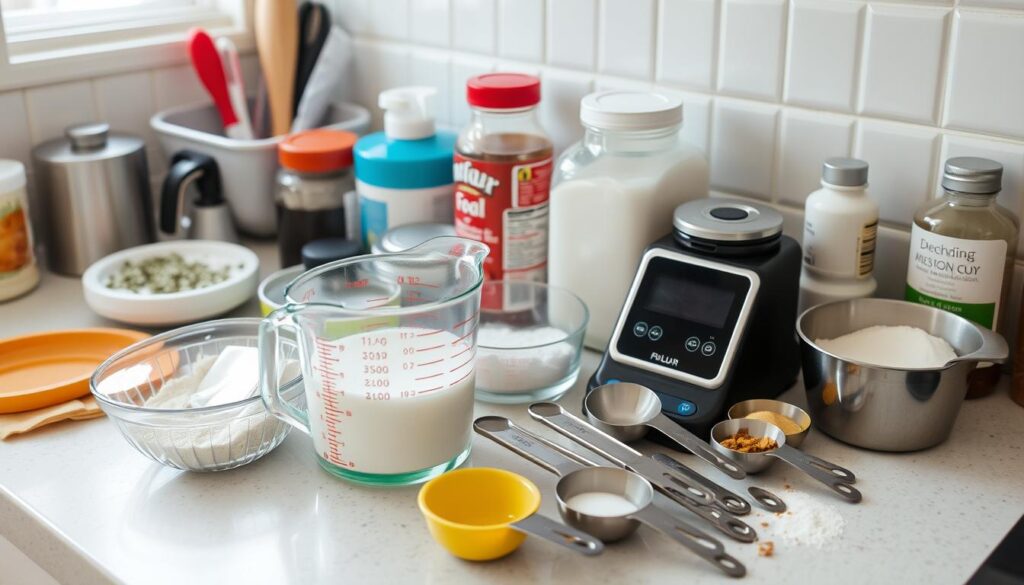
Measuring ounces accurately is vital for cooking and baking success. Knowing how to measure liquid and dry volumes can transform your culinary creations1.
Precision is key when measuring ounces. Water is a great reference: one cup weighs 8 ounces2. Other ingredients vary in weight. For example, honey is denser, weighing about 12 ounces per cup2.
Chefs use specific tools for weight conversion and ounce calculation. A standard cup equals 8 ounces or 16 tablespoons1. It’s also equivalent to 48 teaspoons.
Knowing these conversions will boost your cooking skills. Practice precision to see your culinary results improve.
Key Takeaways
- Accurate measurements are essential in cooking and baking
- Different ingredients have different weights per cup
- Use appropriate measuring tools for liquids and dry ingredients
- Understand basic conversion rates between ounces, cups, and tablespoons
- Practice precision to improve your culinary results
Understanding Ounces and Their Importance
Accurate measuring is key in cooking and baking. Ounces help you be precise in your kitchen adventures. They improve portion control and recipe consistency for both home cooks and chefs.
What Are Ounces?
Ounces are a versatile unit of measurement. In the US system, an ounce is a small but important weight measure. 1 pound equals 16 ounces3.
There are two main types of ounces in cooking:
The Role of Ounces in Cooking and Baking
Ounces are crucial in culinary measurements. They help you:
- Ensure accurate portion control
- Maintain consistent recipe results
- Track nutrition information precisely
“Precision in measurement is the key to culinary success.”
Different ingredients have varying weights. 1 ounce is approximately 28.35 grams3. A fluid ounce of one ingredient might not weigh the same as another5.
Mastering ounce measurements will improve your baking and cooking skills. You’ll create more consistent and tasty dishes every time.
Essential Tools for Measuring Ounces
Having the right kitchen equipment ensures accurate ingredient quantities. Measuring tools are vital for perfect recipes. They help both home cooks and professional chefs achieve precise measurements.
Different types of measuring devices exist. Understanding them will help you measure ingredients accurately every time.
Liquid Measuring Cups
Liquid measuring cups are see-through containers for fluid ingredients. They allow you to read measurements at eye level for accuracy6.
The OXO mini angled measuring cup is a specialized tool. It provides clear markings for various volume measurements6. Both bartenders and home cooks often use it.
- Clear, graduated markings
- Transparent design for easy reading
- Various sizes available
Dry Measuring Cups
Dry measuring cups are crucial for solid ingredients. They come in standard sets with different volume measurements:
| Measurement | Tablespoon Equivalent |
|---|---|
| 1/4 cup | 4 Tablespoons |
| 1/2 cup | 8 Tablespoons |
| 1 cup | 16 Tablespoons |
Kitchen Scales
A digital kitchen scale offers the most accurate measurements. It provides precise weights for both dry and liquid ingredients7.
Some professional models offer multiple unit conversions. They also provide exceptional precision for your cooking needs.
“Precision is the key to consistent cooking and baking.” – Professional Chef
When choosing measuring tools, look for readability, durability, and versatility. Quality kitchen equipment will greatly improve your cooking and baking results.
Techniques for Accurate Measurement
Precise measurements are key to cooking and baking success. Accurate ingredient measurement can make or break a dish. Let’s explore effective techniques to boost your kitchen skills.
Measuring Liquids with Precision
Follow these steps for accurate liquid measurements:
- Place the measuring cup on a flat surface8
- Bend down to read the measurement at eye level8
- Check the meniscus – the curved surface of the liquid – for exact measurement9
“Precision in measurement is the secret ingredient to culinary success.”
Dry Ingredient Measurement Techniques
Dry ingredients need a different approach for baking precision:
- The standard weight of flour is 4.25 ounces per cup9
- Spoon ingredients lightly into measuring cups8
- Level off the top with a straight edge for accurate portioning8
Pro Tips for Measurement Techniques
Boost your cooking accuracy with these expert strategies:
- Use a kitchen scale for most precise measurements8
- Utilize the tare function when weighing ingredients8
- Ensure ingredients are at the correct temperature8
Keep in mind that practice makes perfect. Focus on precise measurements to improve your cooking skills.
Your culinary creations will become more consistent and tasty over time. Enjoy the process of mastering accurate measurements in your kitchen.
Converting Ounces to Other Measurements
Mastering measurement conversion is key for cooking success. It boosts your recipe adaptation skills and culinary precision. Learning these cooking equivalents will take your kitchen game to new heights10.
One ounce equals 1/8 cup or 6 teaspoons. To convert fluid ounces to cups, divide by 810.
Pro chefs know that 16 ounces make 2 cups or 96 teaspoons. This knowledge simplifies baking conversions10.
For metric fans, 1 ounce is 28 grams. A pound weighs about 454 grams11.
These conversion tricks help you tackle international recipes easily. They work for both dry and liquid ingredients12.
FAQ
What’s the difference between ounces (oz) and fluid ounces (fl oz)?
Ounces measure weight, while fluid ounces measure volume. Eight fluid ounces of water weighs 8 ounces. However, 8 fluid ounces of honey weighs more because of its higher density.
How do I accurately measure liquids in ounces?
Use a clear liquid measuring cup on a flat surface. Bend down to read at eye level for precision. Make sure the liquid settles and the meniscus bottom aligns with the measurement line.
What’s the best way to measure dry ingredients in ounces?
Use dry measuring cups and lightly spoon ingredients in. Don’t pack unless the recipe says so. Level off the top with a straight-edged utensil like a knife.
For the most precise measurements, consider using a kitchen scale.
How many fluid ounces are in a cup?
One standard measuring cup holds 8 fluid ounces. This key conversion helps when following recipes or adjusting ingredient amounts.
Why is measuring ingredients precisely important?
Precise measurements ensure consistent results in cooking and baking. Different ingredients have varying weights and densities. Accurate measuring affects texture, taste, and overall recipe success.
Can I use the same measuring cup for liquids and dry ingredients?
No, use separate measuring cups for liquids and dry ingredients. Liquid cups are clear with a spout and volume lines. Dry cups are meant to be filled and leveled off.
How do I convert ounces to pounds?
Sixteen ounces equal 1 pound. If a recipe needs a pound, you’ll use 16 ounces. A kitchen scale helps make quick, accurate conversions.
What’s the most accurate way to measure ingredients?
A digital kitchen scale provides the most precise measurements. Scales measure ingredients by weight, which is more consistent than volume. This method works especially well for baking recipes.
Source Links
- How Many Ounces Are in a Cup—and Other Measurement Morsels – Biomedical Beat Blog – National Institute of General Medical Sciences – https://biobeat.nigms.nih.gov/2024/10/how-many-ounces-are-in-a-cup-and-other-measurement-morsels/
- Fundamentals of Measuring: Weight and Volume – https://www.cacfp.org/2023/11/14/fundamentals-of-measuring-weight-and-volume/
- What Is an Ounce in Math? Definition, Conversion, Examples, Facts – https://www.splashlearn.com/math-vocabulary/measurements/ounce
- Ounce – https://en.wikipedia.org/wiki/Ounce
- Understanding the Difference Between Fluid Ounces and Net Weight Ounces – https://www.fromnaturewithlove.com/library/fluidouncesandnetweightounces.asp?srsltid=AfmBOop9DW24oPFOLnHq3X1z-xQQWnDEjgmzH6TGSiWBK6QYCV3ibrrL
- Cocktail 101: Measuring Utensils – https://www.seriouseats.com/cocktail-101-measuring-utensils-jiggers-cups
- We Tried 10 Jiggers for Making Cocktails—Here Are Our Favorites – https://www.seriouseats.com/best-jiggers-6744795
- Mastering Cooking Measurements: Conversions and Measurements Guide – https://smokints.com/mastering-cooking-measurements-conversions-and-measurements-guide/
- Measuring Solids and Liquids – https://www.cafemeetingplace.com/fifty-minute-classroom/item/2034-measuring-solids-and-liquids
- How many cups is 1 Ounce? · Cooking Measurements & Conversion Chart – https://coda.io/@laila-robinson/cooking-measurements-conversion-chart/how-many-cups-is-1-ounce-18
- Measurement Equivalents | Exploratorium – https://www.exploratorium.edu/food/measurements
- Ounces to Teaspoons Converter – (oz to tsp) – https://www.inchcalculator.com/convert/ounce-to-teaspoon/

