
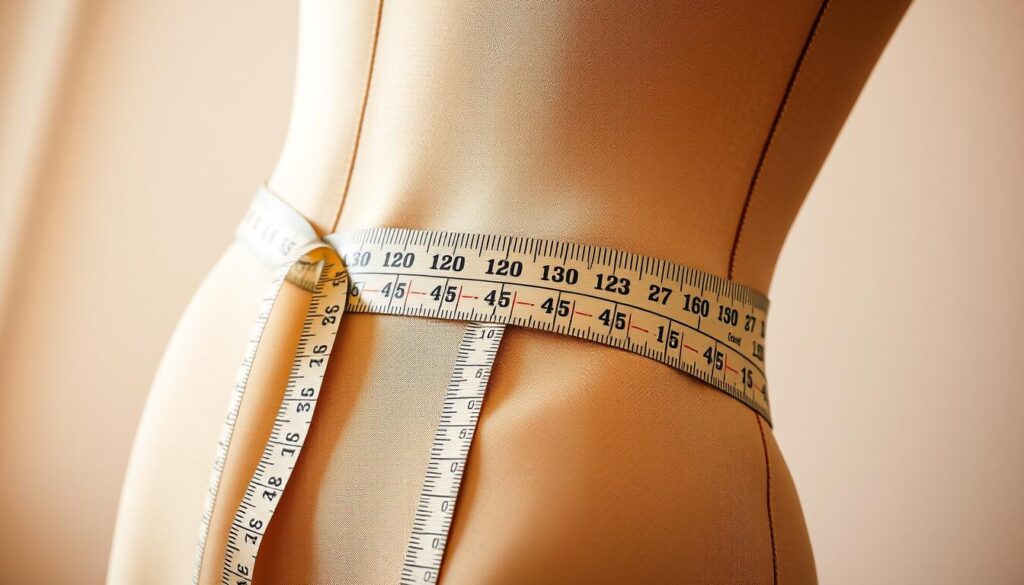
Accurate hip measurements are vital for finding well-fitting clothes and understanding your body shape1. Knowing your exact hip size can make online shopping easier and less frustrating1.
Measuring hips isn’t just wrapping a tape around your body. It’s about finding the widest point of your rear, which may not be at your hip bones1.
Precise measurements matter for getting the right clothing size and tracking fitness progress. With accurate numbers, you’ll have better luck finding clothes that fit perfectly online.
Different brands have their own sizing guidelines. Always check the specific brand’s size chart1. Reading online reviews can help you understand how an item might fit your body shape1.
Key Takeaways
- Measure at the widest point of your body’s rear
- Use a flexible measuring tape for accuracy
- Always check brand-specific size charts
- Consider online reviews for fit information
- Be prepared for some trial and error when shopping online
Understanding the Importance of Hip Measurements
Hip circumference reveals vital information about your health. It’s a key indicator of body composition and potential health risks. This measurement offers valuable insights for your well-being.
Hip measurements impact various aspects of life. They affect fashion choices and fitness goals. Understanding their importance helps in making smart health decisions.
Why Accurate Measurements Matter
Accurate hip measurements are crucial for several reasons:
- Clothing Fit: Helps you find the perfect size when shopping online or in-store2
- Health Assessment: Reveals potential health risks associated with body composition3
- Fitness Tracking: Monitors changes in your body shape during fitness journeys
Common Uses for Hip Measurements
Hip size calculations offer critical health insights. Body shape significantly impacts overall health3. “Apple-shaped” bodies carry more health risks than “pear-shaped” ones3.
Understanding your body composition is the first step toward better health and wellness.
Key health considerations for hip and waist measurements include:
- Waist-to-hip ratio helps assess potential health risks2
- Men should aim for a ratio below 0.90, women below 0.852
- A ratio higher than 1.0 indicates increased health complications2
Tracking hip circumference helps you monitor health risks. It aids in making informed lifestyle choices. You can also track fitness progress effectively.
Pro tip: Regular measurements can help you stay proactive about your health and fitness goals.
Tools and Materials Needed for Measuring Your Hips
Accurate hip measurements require the right tools. Your results will only be as precise as the tools you use. Choose wisely for accurate body measurements.
The Essential Measuring Tape
A flexible cloth measuring tape is vital for hip measurements4. Tailors recommend tapes that stretch and conform to body curves. Look for a tape that extends to 5 feet.
The tape should be made of soft, flexible material. Clear, readable markings are also important for accuracy.
- Extends up to 5 feet
- Is made of soft, flexible material
- Has clear, readable markings
Creative Alternatives for Hip Measurements
No standard tape? Try these creative options5:
- Use a piece of string
- Print a measurement tape from online resources
- Utilize a flexible ribbon
Pro tip: Avoid rigid metal tapes for body measurements. Wear thin, form-fitting clothes or measure directly on skin for accuracy4.
Accurate measurements help find perfectly fitting clothes that boost confidence.
Proper hip measuring techniques ensure comfortable, great-looking clothing choices5. Aim for precise measurements to enhance your wardrobe selection.
Step-by-Step Guide to Measuring Your Hips
Accurate hip measurements are key for finding well-fitting clothes. Hip sizes vary across brands, so precision is important. Regular measurements every 4-6 months help track body changes.
Most pattern companies focus on the widest part of your torso. Stand before a mirror wearing light, fitted clothing. Wrap a flexible tape around the fullest part of your hips.
Keep the tape snug but not tight. Ensure it stays parallel to the floor for accuracy. This method yields the most reliable results6.
Always note your measurement, rounding up to the nearest quarter-inch. Measure twice to confirm accuracy. Avoid bulky clothing as it can affect results6.
For more guidance, check Boody’s comprehensive measuring guide. It offers additional tips for precise hip measurements.
FAQ
What is the most accurate way to measure my hips?
Stand in front of a full-length mirror with your feet together. Find the widest part of your hips. Wrap a flexible cloth measuring tape around this area.
Keep the tape parallel to the floor and snug but not tight. Ensure the tape isn’t twisted and is at the same height all around. Take the measurement twice for accuracy.
What tools do I need to measure my hips?
A flexible cloth measuring tape is the best tool. You can find it in sewing kits or craft stores. If unavailable, use a string and measure it with a ruler.
Avoid metal measuring tapes as they aren’t flexible enough. For precise results, measure directly on skin or while wearing thin, form-fitting clothing.
Why are hip measurements important?
Hip measurements help determine clothing sizes, making online shopping easier. They’re used to calculate your hip-to-waist ratio, an important health indicator.
For women, a waist circumference less than 35 inches is recommended. Men should aim for less than 40 inches. This helps reduce health risks.
How do I add measurements for clothing fit?
Add 2 to 4 inches to your exact hip measurement for clothing. The extra inches depend on desired fit and fabric stretch.
For a relaxed fit, add closer to 4 inches. For a tailored look, stick closer to 2 inches. Always check the brand’s specific sizing guidelines.
Can I measure my hips by myself?
Yes, you can measure your hips alone. Use a full-length mirror to ensure the tape is straight and parallel.
Stand with feet together and wrap the tape around your hips’ widest part. For best results, ask someone to help you measure.
How often should I measure my hips?
Measure your hips every 4-6 weeks if tracking fitness progress or body changes. For clothing, measure when your weight or body composition noticeably changes.
Keep a record of your measurements to track progress. This ensures consistent and accurate sizing over time.
Source Links
- Measuring Yourself is the Secret to Buying Clothes Online That Actually Fit – https://www.goodhousekeeping.com/beauty/fashion/a39506045/how-to-measure-yourself/
- What Is Waist to Hip Ratio? – https://www.webmd.com/fitness-exercise/what-is-waist-to-hip-ratio
- Hip VS. Waist Measurement: How & Where to Measure Correctly – https://www.braceability.com/blogs/articles/hip-vs-waist-measurement
- How To Measure Hip: Step-by-Step – https://obviouslyapparel.com/blogs/mens-underwear-blog/how-to-measure-hip
- How to Measure Your Hips? – kiwisizing.com – https://kiwisizing.com/blog/how-to-measure-your-hips/
- How to Measure Hips Accurately: A Step-by-Step Guide – https://www.oliviapaisley.com/blogs/news/how-to-measure-hips-accurately-a-step-by-step-guide?srsltid=AfmBOopK_sV2eJr4kusshh-wlDbdVj96ILNfkP19x5o66pWJ-1ICDzwx

