
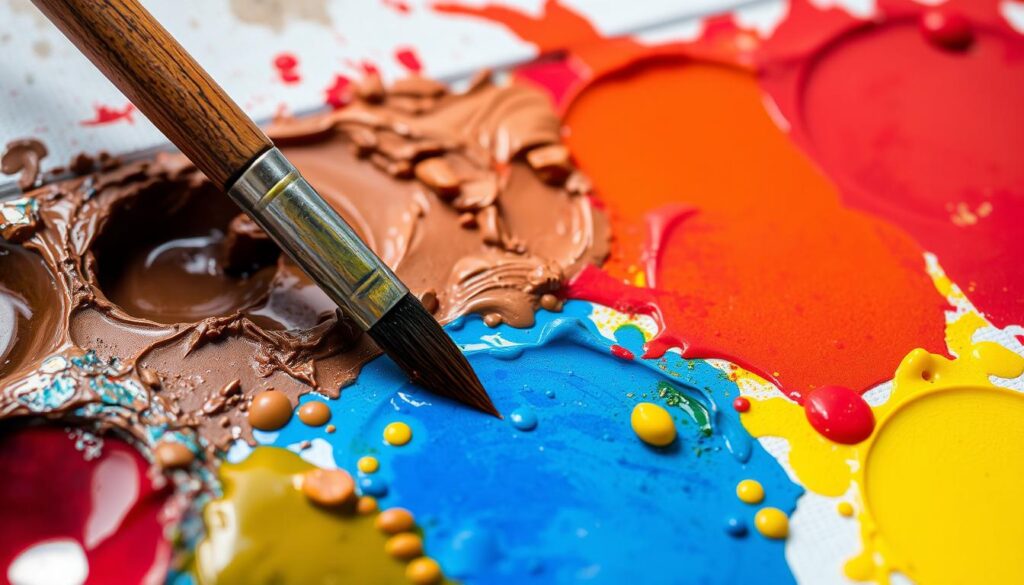
Creating brown paint can elevate your artistic projects. It’s a skill that benefits both pros and DIY fans. Learning to blend colors will help you achieve the perfect brown12.
Making brown is simpler than you might expect. By mixing primary colors, you can create precise brown shades. The secret lies in understanding color relationships and trying different ratios12.
Your painting adventure starts with three primary colors: red, yellow, and blue. These basic hues form the base for various brown shades. Mixing these colors lets you create a range of brown tones123.
Key Takeaways
- Brown can be created by mixing primary colors
- Complementary colors produce unique brown tones
- Adjust color proportions to customize your shade
- White lightens brown, black darkens it
- Experiment with different color combinations
Understanding Color Theory for Mixing Brown
Color theory is key for artists creating beautiful brown tones. It’s vital for both acrylic and oil paint mixing. Grasping these principles will elevate your artistic skills4.
The Basics of the Color Wheel
The color wheel shows how colors interact and blend. For brown, three primary colors are crucial: red, yellow, and blue5. These colors form the base for creating many other shades.
Primary, Secondary, and Tertiary Colors
Let’s break down the color hierarchy:
- Primary Colors: Red, Blue, Yellow5
- Secondary Colors (created by mixing two primaries):
- Orange (Yellow + Red)
- Purple (Blue + Red)
- Green (Blue + Yellow)4
Complementary Colors and Their Role
Complementary colors create rich brown tones. They’re opposite each other on the color wheel. When mixed, these pairs reduce color intensity4.
Key complementary pairs for brown include:
- Red + Green
- Blue + Orange
- Yellow + Purple5
These color relationships open up new possibilities. You’ll be able to mix nuanced brown shades in your artwork4.
“Color is my daylong obsession, joy, and torment.” – Claude Monet
Techniques to Create Brown Paint
Creating rich brown shades requires understanding color relationships. Explore various methods to mix watercolor paints for brown. Your artistic journey begins with experimenting and discovering nuanced hues.
Primary Color Blending
Brown emerges from mixing red, blue, and yellow. Balancing these colors is key to achieving natural pigments for brown2. Adjust ratios to produce a wide range of brown tones.
You can create light sandy beige, rich mahogany, and warm caramel shades. Each combination offers unique possibilities for your artwork.
- Light sandy beige
- Rich mahogany
- Warm caramel
Complementary Color Magic
Explore exciting brown variations through complementary colors for brown6. Specific color pairs produce distinctive results. Try these combinations for unique brown shades.
- Blue and orange create a green-based brown
- Purple and yellow generate a warmer yellow-tinted brown
Adding Depth with Paint Additives
Enhance your brown palette by experimenting with additives. White lightens the mixture, while black creates deeper, dramatic shades7. Different paint types react uniquely when mixed.
Watercolor, acrylic, and oil paints each have distinct characteristics. Test these variations to find your perfect brown shade.
Pro tip: Always test your color mixtures on a sample surface before applying them to your final artwork!
Tips for Achieving the Perfect Shade of Brown
Mastering paint blending takes patience and practice. Creating brown hues requires understanding color mixing. Experiment with different combinations to develop unique shades for your art.
Your mixing journey involves strategic color manipulation. Add red or yellow for warm browns. For cool browns, use blue or green.
Pros suggest mixing small portions to control saturation. This also helps reduce paint waste8.
Test mixed colors on sample surfaces. Layer different shades for depth. Use white or black sparingly to adjust lightness9.
Different art mediums can affect the final color. Watercolors, acrylics, and oils each have unique properties8.
Keep practicing to improve your color-mixing skills. Try tertiary color combos. Develop your own method for creating brown hues8.
FAQ
What are the primary ways to mix brown paint?
Mix brown paint by combining equal parts red, yellow, and blue. You can also blend complementary colors like blue and orange. Experiment with different ratios to achieve your desired brown shade.
How can I create different tones of brown?
Adjust the proportions of your base colors to create different brown tones. Add more red or yellow for warm browns. For cool browns, use more blue or green.
White will lighten the brown, while black creates darker shades. Test various combinations to find your perfect brown.
What’s the best way to test my brown paint mixture?
Always test your brown paint mixture on a sample surface before applying it. Use a white palette or scrap paper to check the color. This allows you to make adjustments for the perfect brown shade.
Can I mix brown in different types of paint?
Yes! Color mixing principles are the same for acrylic, oil, and watercolor paints. The main difference is in paint consistency and drying time. Each medium may need slight adjustments in technique.
How do I create a natural-looking brown?
Use complementary colors and pay attention to undertones for natural-looking brown. Mix colors gradually and consider using natural pigments. Experiment with small amounts of additional colors for depth and richness.
What colors work well with brown in design?
Brown pairs beautifully with green, blue, red, and pink. It’s a versatile neutral for warm, earthy schemes or elegant combinations. Consider the specific shade of brown when selecting complementary colors.
How can I adjust the saturation of my brown paint?
Add gray or mix in primary or secondary colors to adjust brown paint saturation. Reduce intensity by adding a small amount of the complementary shade. This helps control the vibrancy of your brown mixture.
Source Links
- How to Mix Paint Colors to Make Brown: 3 Easy Ways – https://www.wikihow.com/Mix-Paint-Colors-to-Make-Brown
- What Colors Make Brown? How to Create Custom Brown Paint – https://www.bhg.com/decorating/color/paint/which-colors-make-brown/
- Color Mixing 101: How to Mix Brown Paint in Acrylic – https://www.craftsy.com/post/how-to-mix-brown-paint
- What Colors Make Brown? How to Mix Brown – https://thevirtualinstructor.com/blog/what-colors-make-brown-how-to-mix-browns
- What Colours Make Brown? How To Mix Your Paint | Pinot & Picasso UK | UK’s New Art Experience – https://www.pinotandpicasso.uk/what-colours-make-brown-how-to-mix-your-paint/
- How to Make Brown Paint in Different Shades and Mediums – https://www.classpop.com/magazine/how-to-make-brown-paint
- How to make brown paint? Ever wondered which colours to mix to make Brown? – The Organic & Natural Paint Co – https://organicnaturalpaint.co.uk/blogs/how-to-make-brown-paint-ever-wondered-which-colours-to-mix-to-make-brown/
- Exploring What Colors Make Brown – https://www.tourboxtech.com/en/news/what-colors-make-brown.html?srsltid=AfmBOoo-xvMtVjUKTuOpkwOvwsBXJete0eIteVjf9-_RsR8Mm9OvR1lD
- What Colours Make Brown? How To Mix Your Paint – https://prime-pass.co.uk/brown-colour/

