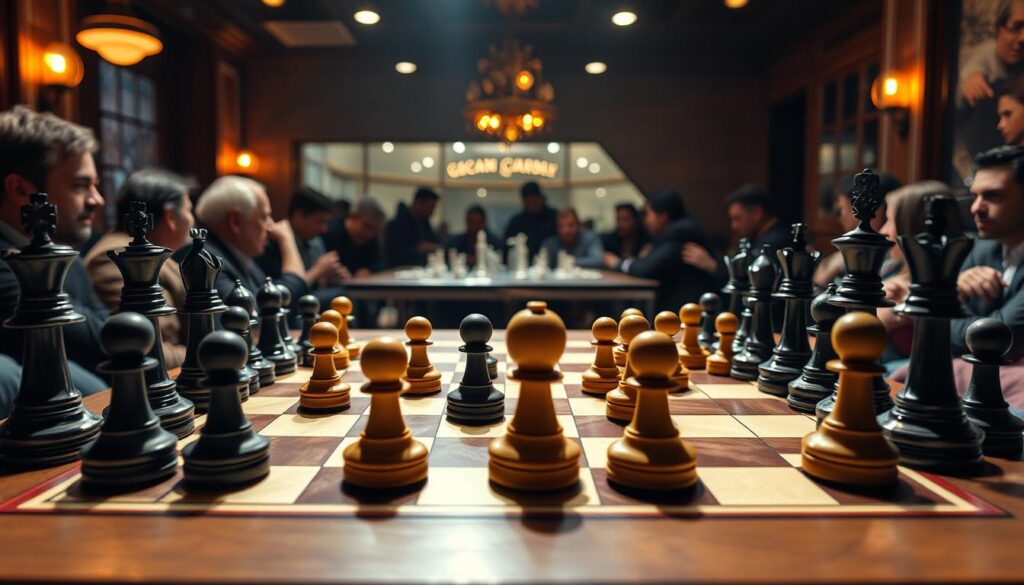
Magnus Carlsen, the world chess champion, has transformed the game with his unique strategic approach1. This guide reveals chess secrets to help you play like a grandmaster1.
Chess is booming in popularity, drawing players from diverse backgrounds2. Online tournaments and media have sparked interest in this intricate game2. Now’s the time to boost your chess skills.
Carlsen’s chess style is truly artistic. His piece coordination and psychological pressure tactics are unmatched1.
By studying his methods, you’ll grasp chess’s deeper strategic elements. You’ll see chess as more than a game – it’s a mental battlefield.
Key Takeaways
- Learn from Magnus Carlsen’s strategic chess approach
- Understand the fundamental principles of chess
- Develop a mindset of strategic piece coordination
- Embrace chess as a game of mental creativity
- Practice consistently to improve your skills
Understanding Chess Fundamentals
Chess is a game of strategy and precision. Mastering the basics will boost your confidence as a player. You’ll learn the core elements that make chess fascinating.
Essential Chess Pieces and Their Movements
Each chess piece moves in its own way. This creates a dynamic battlefield on the board. Let’s look at how they move:
- Pawns: Move forward, capturing diagonally
- Knights: Jump in L-shaped patterns
- Bishops: Glide diagonally across the board
- Rooks: Travel vertically and horizontally
- Queens: Combine rook and bishop movements
- Kings: Move one square in any direction
Strategic Board Control
Controlling the center of the board is key. It helps with piece development and overall strategy. Try to occupy and influence the central squares3.
“Chess is not about making complex moves, but understanding fundamental strategies.” – Magnus Carlsen
Effective Piece Development
Developing your pieces efficiently gives you an advantage. Castle early for king safety, usually by move 7. Create a solid pawn structure to support your plans4.
Practice these fundamentals often to improve your game. Remember, even grandmasters started with the basics. Keep learning and playing to enhance your skills.
Magnus Carlsen’s Approach to Chess Strategy
Magnus Carlsen’s chess strategy is unique and complex. He creates intricate positions and puts constant pressure on opponents. Carlsen’s positional play is a prime example of strategic chess mastery.
Key aspects of Carlsen’s tactical awareness include:
- Skipping traditional opening preparations5
- Recognizing intricate game patterns5
- Calculating moves up to 20 steps ahead5
Carlsen’s endgame skills are truly exceptional. He can win from seemingly equal positions. This shows his ability to create chances where others see none.
He challenges opponents by playing smart rather than trying to crush them quickly. Carlsen aims to outmaneuver and mentally pressure his rivals.
The goal is not just to win, but to outmaneuver and psychologically pressure your opponent.
Carlsen’s strategic approach involves:
- Avoiding predictable game patterns
- Embracing complex, unconventional positions6
- Maintaining psychological composure
Working with Garry Kasparov shaped Carlsen’s strategic thinking. This partnership stressed ongoing learning and flexibility. Carlsen stays creative and focused, even in simple positions.
He consistently finds unique ways to gain an advantage. His approach proves effective across various chess scenarios.
Building Your Chess Foundation
Developing a strong chess foundation requires dedicated effort and a strategic approach. Your chess improvement journey begins with selecting the right resources and practice routines. These tools will help you build a solid base for your skills.
Recommended Chess Resources and Apps
Digital tools can greatly enhance your chess learning experience. The Chess House collection offers exceptional resources for players at all levels. Here are some top chess resources to explore:
- Magnus Trainer app for personalized learning
- Chess.com interactive tutorials
- Lichess free training platform
- Chessable for opening principles study
Practice Routines for Improvement
Consistent practice is key to mastering chess. Develop a structured routine that challenges your skills and expands your strategic thinking. Aim to play at least 100 games, analyzing each match carefully.
“Practice isn’t the thing you do once you’re good. It’s the thing that makes you good.” – Malcolm Gladwell
Common Opening Principles
Understanding opening principles can transform your chess game. Focus on controlling the center and developing pieces efficiently. Protecting your king and creating flexible pawn structures are also crucial.
- Control the center of the board
- Develop pieces efficiently
- Protect your king
- Create flexible pawn structures
Study classic openings like the Sicilian Defense and Ruy Lopez. These will help build a solid foundation in chess strategy. Consistently applying these principles will enhance your chess skills and develop a sophisticated approach7.
Conclusion
Your chess journey demands dedication and strategic thinking. Magnus Carlsen’s career shows that chess mastery requires persistent practice and commitment to learning89. Every grandmaster started as a beginner, just like you.
Analyze each game to develop your skills. See mistakes as chances to grow. Study strategies and use resources to improve your technique.
Professional chess requires discipline and a structured approach. Chess mastery is a gradual process, not instant perfection. Your journey will have challenges and breakthroughs.
Stay patient and curious. Keep challenging yourself with new strategies. With practice, you’ll become a more confident chess player.
Enjoy the intellectual challenge of chess. Keep learning and stay motivated. Trust in your ability to improve with each move you make.
FAQ
How old was Magnus Carlsen when he became a grandmaster?
Magnus Carlsen earned his grandmaster title at 13. His strategic understanding and tactical brilliance set him apart from other young players. He’s considered one of the youngest chess prodigies in history.
What are the basic movements of chess pieces?
Chess pieces have unique movements. Pawns move forward, knights in L-shapes, and bishops diagonally. Rooks move vertically and horizontally, queens in all directions, and kings one square any way.
What resources can help me improve my chess skills?
Great resources include the Magnus Trainer app, Chess.com, and Lichess. Chess books like “The Immortal Game” offer valuable insights. YouTube tutorials and Twitch streams by experts provide additional learning opportunities.
Practice at least 100 games and analyze your play. This approach is crucial for improving your chess skills.
What is the importance of controlling the center in chess?
Controlling the board’s center is key in chess strategy. It boosts piece mobility and creates more attacking chances. This control also gives you greater strategic flexibility during the game.
How can I develop my chess pieces efficiently?
Develop your pieces quickly and castle by move 7 for safety. Focus on piece coordination and avoid moving the same piece repeatedly. Get your knights and bishops out early and connect your rooks.
What makes Magnus Carlsen’s chess style unique?
Carlsen is known for patient maneuvering and exploiting small advantages. His deep calculation skills help him find unconventional moves. He excels at creating complex positions and applying constant pressure on opponents.
What are some basic chess openings for beginners?
The Sicilian Defense and Ruy Lopez are good beginner openings. Use the Openings Trainer to explore over 3,000 opening lines. Join thematic tournaments to gain practical experience with different openings.
How important is understanding pawn structure in chess?
Pawn structure is crucial in chess. It shapes long-term strategy and affects piece mobility. Understanding pawn formations helps identify weaknesses and strengths in your position.
What should I focus on as a chess beginner?
Learn fundamental principles and piece movements. Practice controlling the center and developing pieces efficiently. Analyze your games and learn from mistakes. Gradually build your strategic understanding through consistent practice.
How can I practice chess like a professional?
Practice regularly on online platforms and study grandmaster games, especially Carlsen’s. Solve tactical puzzles and analyze your own games. Keep learning from chess books, apps, and instructional videos to improve your skills.
Source Links
- Positional Methods From Carlsen’s Play, Part 1 – https://www.chess.com/article/view/positional-methods-from-carlsens-play-part-1
- How to play chess for beginners: rules, moves and setup – https://www.dicebreaker.com/games/chess/how-to/how-to-play-chess
- PDF – https://www.newinchess.com/media/wysiwyg/product_pdf/9129.pdf
- Master Class Vol.8 – Magnus Carlsen 2nd Edition – https://shop.chessbase.com/en/products/master_class_vol8-2_magnus_carlsen
- Magnus Carlsen’s Biggest Secret – https://www.chess.com/article/view/magnus-carlsen-s-biggest-secret
- The Magnus Carlsen Approach: Analysing His Playstyle – https://chesscoaching.co.za/the-magnus-carlsen-approach-analyzing-his-playstyle/
- Facing the World’s Best: How I Drew Against Magnus Carlsen – https://lichess.org/@/peradetlic83/blog/facing-the-worlds-best-how-i-drew-against-magnus-carlsen/QH1mvDXB
- Magnus Carlsen: The Best Chess Player In the World Revealed – https://royalchessmall.com/en-bg/blogs/blog/best-chess-player?srsltid=AfmBOoqD6rYWPzruKNlOFAnE4QbuwTdf3EQF1dJ-4DaoU1Gyxt9FeAUg
- Chess: Exploring the Remarkable Journey of Magnus Carlsen – https://summitschoolofchess.com/understanding-magnus-carlsens-decision-a-chess-champions-journey/