
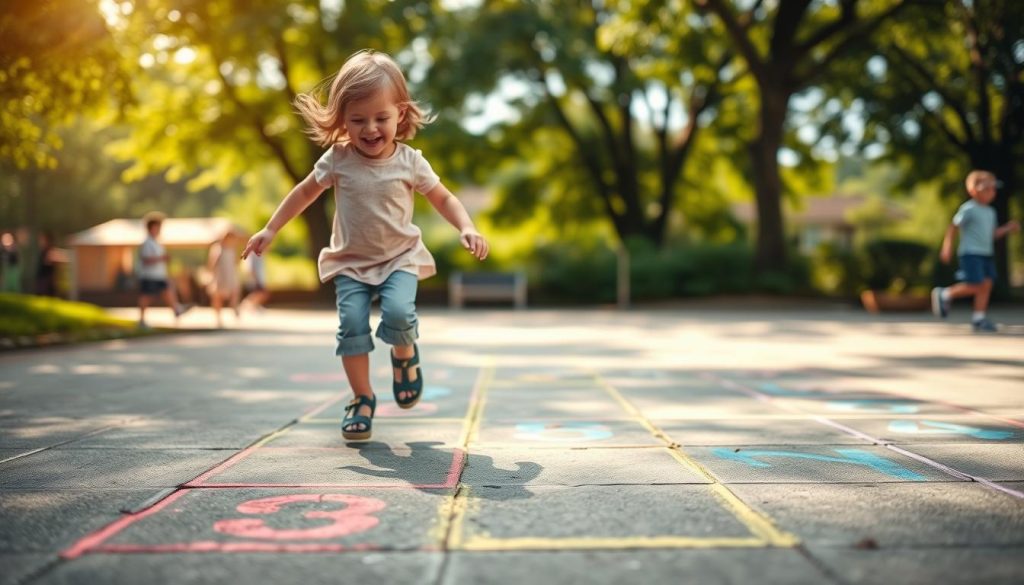
Hopscotch turns sidewalks into exciting play spaces for all ages. This classic game blends physical skill with playful strategy1. It’s perfect for solo or group play, offering flexibility in player numbers1.
The game’s roots go back to Roman Britain. Soldiers created footwork courses to boost their endurance2. Hopscotch helps kids develop motor skills, balance, and coordination12.
Children as young as 2 can start enjoying this fun activity1. All you need is chalk and an open surface like asphalt or concrete.
Players can adapt the game for indoor play using masking tape1. A typical game lasts 5 to 15 minutes, providing quick and engaging fun1.
Key Takeaways
- Suitable for players of all ages, starting from 2 years old
- Improves balance and motor skill development
- Can be played indoors or outdoors with minimal equipment
- Offers multiple gameplay variations
- Quick and entertaining physical activity
Setting Up Your Hopscotch Court
Hopscotch is a fun game for all ages. It needs little gear but offers lots of enjoyment. Let’s learn how to make a hopscotch pattern that’s sure to bring smiles.
This classic game sparks joy and gets people moving. It’s a great way to spend time outdoors with friends and family.
Gathering Your Materials
To set up a hopscotch court, you’ll need just a few simple items:
- Chalk (for drawing on concrete or asphalt)
- A small marker (like a stone or bean bag)
- A flat outdoor surface
Drawing the Perfect Hopscotch Grid
Designing your hopscotch court lets you be creative. You can adjust it for different skill levels. A typical pattern has 8-10 numbered squares3.
Hopscotch helps kids build balance and spatial awareness4. It’s a great way for children to learn while having fun.
- Find a smooth surface like a sidewalk or playground
- Use chalk to draw a vertical column of squares
- Create alternating single and double boxes
- Number each square sequentially from 1 to 105
- End with a home base or half-circle
| Court Feature | Description |
|---|---|
| Box Size | Approximately 1 square foot5 |
| Number of Players | 2-6 players5 |
| Recommended Age | 3 years and older5 |
Hopscotch courts can be changed to fit any player. You can make them simple for young kids or tricky for older ones.
This timeless game helps both body and mind grow. It’s a fantastic way to have fun and learn at the same time.
Play Hopscotch: Basic Rules and Instructions
Hopscotch is a fun and simple game. Players toss a marker into numbered squares. They get two tries to land it in the first square6.
Players hop on one foot in single squares. They use both feet in side-by-side squares. This tests balance and coordination6.
The aim is to hop through the course without mistakes. Stepping on lines or losing balance ends your turn7.
There are many exciting ways to play hopscotch. Some use letters instead of numbers for learning. Others have unique grid shapes7.
The “Potsy” version mixes hopscotch with category games. It’s great for building physical and mental skills6.
FAQ
What is the origin of hopscotch?
Hopscotch has ancient roots. Roman soldiers used it as a training exercise. They drew long courts and practiced hopping in full armor.
The game spread across Europe over time. It became a popular children’s playground activity worldwide.
How many players are needed to play hopscotch?
Hopscotch is flexible. It can be played solo or with multiple players taking turns. This makes it great for various settings.
What equipment do I need to play hopscotch?
You need chalk to draw the court. A small throwing object like a stone or bean bag is essential. You’ll also need a flat surface such as a sidewalk or playground area.
Some players use tape for indoor versions of the game.
What age is best for learning hopscotch?
Kids usually start playing hopscotch around 4-5 years old. By then, they’ve developed enough balance and coordination. However, players of all ages can enjoy the game.
Court design and rules can be adjusted to fit different skill levels.
Are there different hopscotch court designs?
Yes! The classic design is a numbered sequence of squares. But many regional and cultural variations exist. Some courts have unique patterns or special challenge zones.
These variations make the game more complex and interesting.
Can hopscotch be played indoors?
Absolutely! You can create indoor hopscotch using masking tape on a floor. Foam floor mats or special hopscotch mats also work well.
Just make sure you have enough space. A safe, non-slippery surface is important too.
What skills does hopscotch help develop?
Hopscotch boosts gross motor skills and balance. It improves hand-eye coordination and spatial awareness. The game also teaches basic math through counting and sequencing.
Kids learn turn-taking and rule-following while playing hopscotch.
How do I make hopscotch more challenging?
Try adding complex court designs or time limits. Use smaller throwing objects for a tougher game. Create special rules like hopping on one foot or spinning before throwing.
These changes can make hopscotch more engaging for older players.
Source Links
- The Genius of Play | Play Idea: Hopscotch – https://thegeniusofplay.org/genius/play-ideas-tips/play-ideas/hopscotch.aspx
- Hopscotch Game Rules and Creative Ideas for Play – https://findmykids.org/blog/en/how-to-play-hopscotch
- How to play hopscotch with children and have fun – EuroSchool – https://www.euroschoolindia.com/blogs/how-to-play-hopscotch-with-children/
- 11 Variations To Play Hopscotch, Basic Rules & Instructions – https://www.momjunction.com/articles/how-to-play-hopscotch-rules-draw-board-for-kids_00660856/
- How to Play Hopscotch | Guide to Hopscotch Rules & Instructions – https://gameonfamily.com/how-to-play-hopscotch/
- Learn classic hopscotch rules, plus new ways to play – https://www.care.com/c/classic-hopscotch-rules-plus-new-ways-to-pla/
- How to play hopscotch: The traditional rules, plus 6 fun variations to keep the game fresh, at PrintColorFun.com – https://printcolorfun.com/7146/how-to-play-hopscotch-grid-game-rules/

