
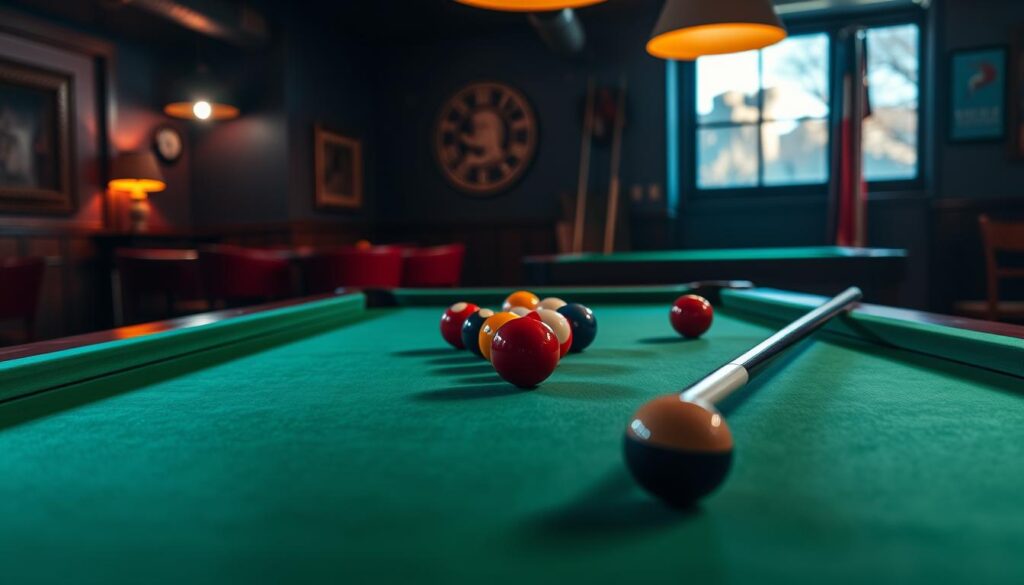
Pool is a thrilling game that blends skill, strategy, and precision. It’s perfect for solo play or with friends. You can enjoy this classic pastime in pool halls or at home1.
The game uses a pool table with six pockets. Players use cues to pocket colored balls strategically. Standard tables come in 7, 8, or 9-foot lengths1.
Most pool cues are about 58 inches long. They’re designed for making precise shots1.
Players use different types of pool balls. These include solids, stripes, the 8-ball, and the crucial cue ball1.
Popular game variations like 8-ball and 9-ball offer unique challenges. They’re exciting for players of all skill levels1.
Key Takeaways
- Learn the basic equipment: pool table, cues, and balls
- Understand different pool game variations
- Practice proper stance and grip techniques
- Develop strategic thinking and shot precision
- Enjoy the social and competitive aspects of pool
Understanding the Basics of Pool
Pool is an exciting cue sport that blends skill, strategy, and precision. It’s a game that captivates both beginners and seasoned players alike. Mastering the fundamentals is key to improving your billiards skills2.
What is Pool?
Pool, or billiards, is played on a felt-covered table with specialized accessories. Players use a cue stick to strike the white cue ball. The goal is to pocket balls strategically2.
Types of Pool Games
Pool offers various exciting game variations to keep players engaged. American-style eight-ball pool is the most popular type2. Here are the main variations:
- 8-Ball Pool: Uses sixteen balls (fifteen object balls and one cue ball)
- 9-Ball Pool: Played with nine numbered balls
- Straight Pool: Players aim to pocket any ball on the table
Essential Equipment
Specific equipment is needed for pool tournaments and casual games. Here’s what you’ll need to play effectively:
| Equipment | Specifications |
|---|---|
| Pool Table | Standard size: 9 feet by 4.5 feet2 |
| Cue Stick | Typically 58 inches long |
| Balls | 16 total: 15 object balls (7 solids, 7 stripes, 1 black 8-ball)3 |
“Pool is a game of precision, strategy, and continuous learning.”
Grasping these basics will boost your confidence as you begin your billiards journey. You’ll be well-prepared to tackle more advanced techniques in pool tournaments2.
Mastering the Rules of Pool
Pool games have essential rules you need to know. Understanding these rules is key for success in leagues and tournaments. Let’s explore the basics of pool gameplay.
General Rules for All Pool Games
Pool games share core principles every player must master. Players take turns shooting, continuing as long as they legally pocket their balls. Understanding key gameplay elements is crucial for success.
- Alternating turns between players
- Legal shot requirements
- Recognizing and avoiding fouls
Specific Rules for 8-Ball
In 8-ball, players are split into solids or stripes groups. Your aim is to pocket your assigned balls before the 8-ball. Here are some critical rules:
- Breaking must involve at least four balls hitting rails4
- Pocketing the 8-ball prematurely results in an automatic loss4
- Fouls grant the opponent “ball in hand” advantage4
Specific Rules for 9-Ball
9-ball requires pocketing balls in numerical order. This game challenges players to plan their shots carefully. Precise strategies are essential for success in 9-ball5.
“Understanding the rules is your first step to becoming a skilled pool player.” – Pool Mastery Guide
| Game Type | Key Rules | Winning Condition |
|---|---|---|
| 8-Ball | Pocket assigned ball group | Sink 8-ball after clearing group |
| 9-Ball | Pocket balls in numerical order | Legally pocket the 9-ball |
Improving your pool skills takes consistent practice. You need to understand the game’s mechanics deeply. This knowledge is crucial for success in tournaments and leagues6.
Essential Tips for Improving Your Game
Improving your pool game takes dedication and smart practice. Key techniques can boost your skills in pool halls or at home7.
Pro pool players excel by mastering basics and consistent techniques. Let’s explore ways to enhance your play.
Choosing the Right Cue
The right pool accessories are vital for performance. Find a cue that feels good and suits your style. New players should consider these factors:
- Cue length (typically 58 inches)
- Tip hardness
- Weight distribution
Perfecting Your Stance and Grip
Body position can make or break your shot. Stand with feet shoulder-width apart and weight evenly balanced7.
A relaxed grip is key. Holding the cue too tight can hurt your accuracy7.
“The key to great pool is consistency in technique and mental focus.”
Practicing Your Aim
Focused practice beats random ball hitting for effective pool play8. Try these practice strategies:
- Develop a consistent pre-shot routine
- Practice different shot angles
- Focus on cue ball positioning
Always chalk your cue before each shot. Move the chalk, not your cue8.
Check out advanced pool techniques to refine your skills further.
Performance Tracking
| Skill Area | Practice Focus | Improvement Goal |
|---|---|---|
| Stance | Body Alignment | Consistency |
| Grip | Relaxed Control | Accuracy |
| Aim | Angle Techniques | Precision |
Becoming skilled at pool takes time and patience. Stay committed to practice, and you’ll see great improvements.
Techniques for Advanced Play
Mastering advanced billiards skills goes beyond basic shooting. Spin and precise ball positioning can transform your game. Precision in pool requires strategic thinking and controlled execution9.
Advanced shot types need a deep grasp of angles and spin. The “ghost ball” technique improves contact points between balls9. A relaxed grip using your second finger can prevent missed shots10.
Pool tournaments and leagues offer chances to hone these skills. Competitive play demands mental strategy and physical precision. Mastering bridge techniques and vertical alignment is crucial10.
Regular practice and joining local leagues build muscle memory. These habits develop strategic thinking for high-pressure situations. With dedication, you’ll excel in competitive environments.
FAQ
What is the difference between pool and billiards?
Billiards is a broad term for cue sports, including pool. Pool uses a six-pocket table with 16 balls. The most common pool games are 8-ball and 9-ball.
What size pool table should I get for home use?
For home use, 7-foot or 8-foot tables are ideal. 7-foot tables suit smaller spaces and beginners. 8-foot tables offer a more professional experience.
Professional tournament tables are 9 feet long. However, these are often too large for most homes.
How do I improve my pool shooting technique?
Develop a consistent stance and stroke. Keep your feet shoulder-width apart and maintain a relaxed grip. Practice a smooth, pendulum-like motion with your cue.
Work on bridge hand techniques and visualize your shots. Develop a pre-shot routine to boost consistency and accuracy.
What are the basic rules of 8-ball pool?
Players are assigned stripes or solids after the break. Your goal is to pocket your balls before the 8-ball. Players take turns shooting, hitting their ball type first.
Scratching or pocketing the 8-ball too early results in a loss.
What equipment do I need to start playing pool?
You’ll need a pool table, a set of balls, and cue sticks. A standard cue is 58 inches long. Beginners should use a cue with a medium to medium-soft tip.
Helpful accessories include a chalk cube, cue rack, and bridge stick.
How do I apply English (spin) to the cue ball?
English is spin applied by striking the cue ball off-center. Right-hand English moves the ball right after contact. Left-hand English moves it left.
Mastering English helps control the cue ball’s path. This skill is crucial for advanced play.
What is a scratch in pool?
A scratch happens when the cue ball is pocketed or jumps off the table. Your turn ends, and your opponent gets ball-in-hand.
They can place the cue ball anywhere on the table. This penalty can significantly change the game’s momentum.
How can I practice pool at home?
Without a pool table, watch tutorials and practice your stance and grip. Play at local pool halls or bars. Consider joining a pool league for regular practice.
Many billiard supply stores offer practice areas. These can help you improve your skills.
Source Links
- How to Play Pool: 7 Steps (with Pictures) – wikiHow – https://www.wikihow.com/Play-Pool
- Pool 101: What You Need to Know About Rules, Supplies & More – https://everythingbilliards.net/everything-you-need-to-know-about-pool/
- How to Play Pool: A Comprehensive Beginner’s Guide – https://fcibilliards.com/blog/how-to-play-pool/?srsltid=AfmBOoqZ16XmOz01WPu0f0rUuP5_i161ouj0KGj3COb4BhgbWf5Ikqp5
- How to Play Pool: A Comprehensive Beginner’s Guide – https://fcibilliards.com/blog/how-to-play-pool/?srsltid=AfmBOor6lJhj1jFbisZHrjutQw3vdGDS0nFuJPthjzRxP0zoI24FiIvI
- Master the Basics: A Step-by-Step Guide to Playing Pool | Central Snooker Club – https://centralsnooker.co.uk/blog/master-the-basics-a-step-by-step-guide-to-playing-pool
- The Art of Pool: Mastering the Game and Improving Your Skills – Tredway Pools Plus – https://tredwaypools.com/the-art-of-pool-mastering-the-game/
- How to Dramatically Improve Your Pool and Billiards Skills – https://quedos.com.au/tips-drills-skills/
- 20 Tips for Improving your Game – https://www.pooldawg.com/article/pooldawg-library/tips-for-improving-your-game?srsltid=AfmBOooTUAleUrQa4eMQXoV4FhH0c5lV8Hil374lqnDCfkdfNb22w-a2
- How to Play Pool Better: Strategies and Tips to Improve Your Pool Game – https://blattbilliards.com/blogs/news/how-to-play-pool-better?srsltid=AfmBOooZTjtUr73dWP15eb2hbDbUOaK-WRNL1N33bByww2MKpNI7hrd0
- Advanced Fundamentals: How to Play Pool the Right Way – https://www.pooldawg.com/article/pooldawg-library/advanced-fundamentals?srsltid=AfmBOoqo6rPmiWQP5QejMAr3411Jzc060UQd7SMilSTi2LKVqnFZCDog

