
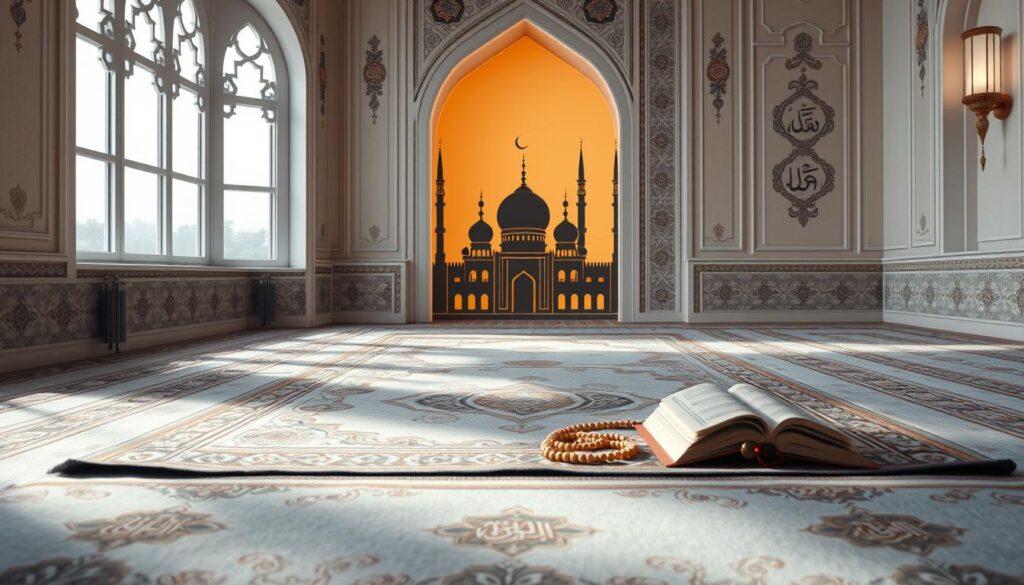
Islamic prayer, or Salah, is a spiritual journey of worship. It’s vital for new Muslims and those curious about Islam. Five daily prayers connect adult Muslims with Allah throughout the day1.
Salah in Islam goes beyond ritualistic movements. It’s a profound spiritual experience linking you to the divine. The five obligatory prayers follow the rhythm of daily life1.
Don’t worry if you feel overwhelmed as a beginner. Many new Muslims learn to pray within hours using guides1. Start with simple steps and build your confidence gradually.
Key Takeaways
- Prayer is a fundamental aspect of Islamic worship
- Five daily prayers connect Muslims with Allah
- Beginners can learn prayer techniques quickly
- Each prayer has specific timing and structure
- Consistent practice leads to spiritual growth
Understanding the Importance of Prayer in Islam
Prayer is a key part of Islamic worship. It connects Muslims directly with Allah. This spiritual practice shapes a believer’s entire life2.
The Role of Salah in a Muslim’s Life
Salah reminds Muslims of Allah’s presence daily. Prayer times become sacred moments for reflection. The five daily prayers create a rhythm of spiritual mindfulness32.
- Connects believers directly with Allah
- Provides spiritual discipline
- Offers moments of inner peace
Spiritual Benefits of Regular Prayer
Muslim prayer times offer deep spiritual benefits. Prayer brings inner peace and helps believers seek guidance. It purifies the heart and keeps people from negative actions34.
“The coolness of my eyes is in Salah” – Prophet Muhammad
Community and Unity Through Prayer
Islamic worship goes beyond personal practice. Praying together in mosques builds strong community bonds. It strengthens social ties and creates a sense of global brotherhood32.
Prayer transforms individual spiritual journeys into a collective experience of faith.
The Five Daily Prayers: An Overview
Islamic prayer is vital for Muslims worldwide. Five daily prayers form the spiritual core of Muslim practice5. These prayers, called salat, create a deep bond between believers and Allah6.
Muslim prayer times are set for specific periods. Each prayer has its own window for performance. Let’s explore these sacred moments of worship:
- Fajr (Dawn Prayer): The first prayer of the day7
- Dhuhr (Noon Prayer): Performed after the sun reaches its zenith
- Asr (Afternoon Prayer): Offered in the late afternoon
- Maghrib (Sunset Prayer): Immediately after the sun sets
- Isha (Night Prayer): Performed after twilight disappears
Fajr: The Dawn Prayer
Fajr prayer happens before sunrise, starting a Muslim’s spiritual day6. It has two rak’ahs and requires discipline. Most people are still asleep during this early morning prayer.
Dhuhr: The Noon Prayer
Dhuhr occurs when the sun is highest in the sky. This midday prayer helps Muslims reconnect with their spiritual purpose5. It offers a pause during daily activities.
Asr: The Afternoon Prayer
Asr prayer is offered when shadows are longest. It provides a moment to reflect during the busy workday6. This late afternoon prayer helps refocus on faith.
Maghrib: The Evening Prayer
Maghrib prayer happens right after sunset. It marks the end of fasting during Ramadan7. This prayer is a time for gratitude and reflection.
“Prayer is the spiritual nourishment of a believer’s soul.”
| Prayer Name | Time | Rak’ahs |
|---|---|---|
| Fajr | Before Sunrise | 2 |
| Dhuhr | Midday | 4 |
| Asr | Late Afternoon | 4 |
| Maghrib | Sunset | 3 |
| Isha | Night | 4 |
Smartphone apps and online calendars now make tracking Muslim prayer times easier6. These tools help believers stay connected to their faith throughout the day.
Preparing for Your Prayers: Steps to Follow
Islamic prayer preparation is crucial for a meaningful spiritual experience. Understanding Salah guidelines helps perform it correctly and reverently. Check out how to pray in Islam for detailed instructions.
Requirements for Prayer (Wudu)
Wudu is a ritual purification process essential before prayer. It involves washing specific body parts in a particular sequence8.
- Washing hands thoroughly
- Rinsing mouth and nose
- Cleaning face completely
- Washing arms up to the elbows
- Wiping head
- Washing feet
Choosing a Clean Space
Selecting an appropriate prayer area is key for Islamic dua. In North America, face east with a slight angle towards the north9. Prayer rugs are commonly used to ensure a clean worship surface.
Attire and Intent
Modest clothing is essential during Salah. Clothing requirements differ for males and females9. For men, cover from navel to knees. For women, cover the entire body except face and hands.
Make a sincere intention (Niyyah) in your heart before prayer. This mental commitment creates a spiritual connection with Allah. The Syafi’i school stresses that prayer involves physical movements, verbal utterances, and deep concentration10.
“Prayer is the spiritual communication between a believer and Allah, transcending physical boundaries.”
Performing the Prayer: A Step-by-Step Guide
Islamic prayer (Salah) involves precise movements and spiritual intentions. It connects you with Allah through mindful worship11. Each step moves you from worldly distractions to spiritual focus.
Prayer includes specific physical positions showing reverence and submission. You’ll start by standing and reciting Quran verses. Then, you’ll bow (Ruku) to praise Allah’s greatness11.
Next, you’ll prostrate (Sujud) in complete humility. The key is maintaining khushoo’ – deep heart-centered awareness during prayer11.
Avoid rushing through movements or performing them mechanically. Focus on communicating with Allah and understanding each recitation. Successful prayer needs intentional concentration and spiritual presence11.
Prayer offers profound spiritual rewards. Consistent, mindful Salah opens paths to inner peace and blessings. These include spiritual protection and hope for Paradise11.
Your prayer is more than a ritual. It’s a transformative practice connecting you directly with the divine.
FAQ
What is Salah (Islamic Prayer)?
Salah is a key Islamic worship act done five times daily. It connects Muslims directly to Allah. This practice involves specific movements, Quranic recitations, and spiritual devotion.
How many times do Muslims pray each day?
Muslims pray five times daily: Fajr, Dhuhr, Asr, Maghrib, and Isha. Each prayer has a specific time window. The number of units (rak’ahs) varies for each prayer.
What is Wudu, and why is it important?
Wudu is a ritual cleansing done before prayer. It involves washing specific body parts with clean water. Wudu prepares Muslims for prayer by ensuring physical and spiritual purity.
Do I need special equipment to pray?
A prayer rug is helpful but not required. You need a clean space facing the Qibla. Modest clothing and the intention to pray are essential.
Can women pray during menstruation?
Women are excused from praying during menstruation. They can resume after their cycle ends. A ritual purification (Ghusl) is needed before resuming prayers.
What if I miss a prayer?
Perform missed prayers as soon as you remember. This is called Qada prayer. It’s crucial to make up missed prayers promptly.
Do I need to know Arabic to pray?
Traditional prayer is in Arabic, but you can learn gradually. Many resources can help you understand and recite prayers correctly.
What are the spiritual benefits of regular prayer?
Regular prayer boosts faith and inner peace. It provides a sense of purpose and connects you with Allah. Prayer reminds us of divine presence and offers spiritual guidance.
Can I pray at home or only in a mosque?
You can pray anywhere clean that meets prayer requirements. Mosques are encouraged, especially for men on Fridays. However, you can pray at home, work, or any clean space.
How long does a typical prayer take?
A typical prayer lasts 5-10 minutes. The duration depends on the number of units (rak’ahs) and your pace. Fajr prayer has two rak’ahs, while Dhuhr and Asr have four.
Source Links
- Muslim Prayer salah namaz salat – https://www.muslimconverts.com/prayer/beginners_prayer.htm
- Importance of salah (prayer) according to the Quran and Hadith – https://www.quranexplorer.com/blog/merit-of-surah/Importance_of_salah_(prayer)_according_to_the_Quran_and_Hadith
- The Importance & Benefits of Salah in Islam | Muslim Rose Welfare – https://www.muslimrosewelfare.org.uk/blog/prayer-guide-blog-the-importance-and-benefits-of-salah-in-islam
- Importance of Prayer – https://www.alislam.org/book/salat/importance-of-prayer/
- 5 Muslim Daily Prayer Times and What They Mean – https://www.learnreligions.com/islamic-prayer-timings-2003811
- Salat: Daily Prayers – https://pluralism.org/salat-daily-prayers
- The Five Daily Prayer Times and Why We Observe Them – https://muslimhands.org.uk/latest/2019/03/the-five-daily-prayer-times-and-why-we-observe-them
- How to Perform Salah (Prayer) for Beginners – Muslim Pro – https://www.muslimpro.com/how-to-perform-salah-prayer-for-beginners/
- How to Perform Salah – Islamic Association of Raleigh – https://raleighmasjid.org/how-to-perform-salah/
- How to Pray in Islam: Step-By-Step Guide to Solat for Beginners – https://muslim.sg/articles/how-to-pray-in-islam-step-by-step-guide-to-solat-for-beginners
- How to Pray in Islam?: A Step-by-Step Guide | eilaf – https://eilaf101.com/how-to-pray-in-islam/

