
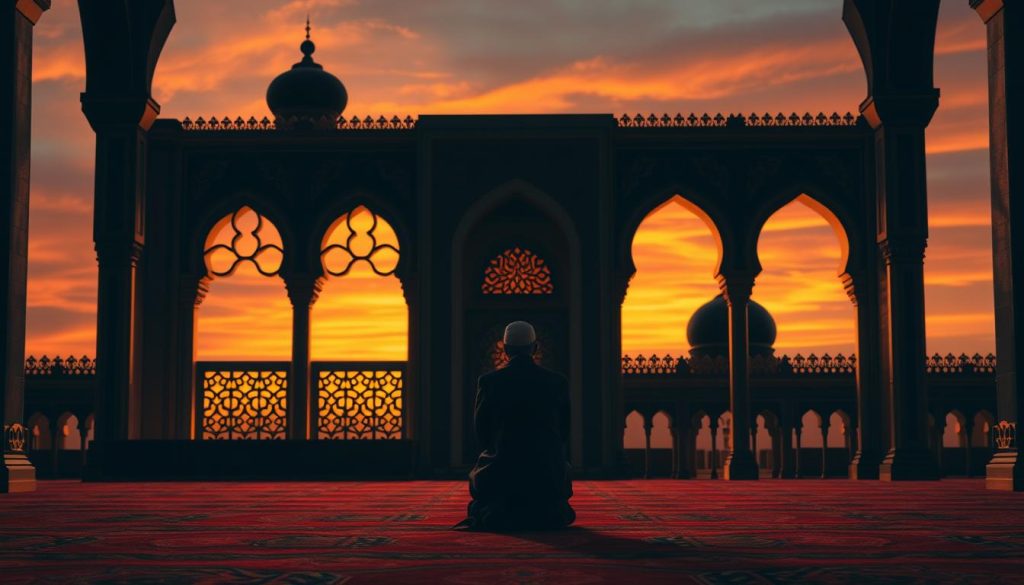
Salat al Maghrib is a sacred evening ritual in Islam. It connects Muslims with their spiritual practice. This prayer involves specific components and movements that create a meaningful worship experience1.
Muslims worldwide observe Salat al Maghrib just after sunset. It’s one of the five daily prayers in Islam. The prayer consists of three obligatory (fard) and two recommended (sunnah) rakats21.
Worshippers face the Qibla during this prayer. They perform precise sequences of standing, bowing, and prostrating. These actions demonstrate devotion and spiritual discipline3.
Key Takeaways
- Maghrib prayer consists of 5 total rakats
- Prayer must be performed facing Mecca
- Includes specific physical movements and recitations
- Takes approximately 3-5 minutes to complete
- Involves both mandatory and recommended components
Understanding Maghrib Prayer Essentials
Maghrib prayer is a sacred evening ritual in Muslim daily prayers. It occurs as the sun sets and darkness falls. This spiritually significant practice requires reverence and precision4.
Precise Timing Matters
Maghrib prayer happens right after sunset. It marks the shift from day to night4. Muslims must watch local sunset times for accurate prayer performance.
Preparation Prerequisites
- Perform ritual purification (Wudu)
- Select a clean prayer area
- Face the Qibla (Mecca’s direction)
- Wear modest, clean clothing
Essential Prayer Components
Maghrib prayer has specific elements crucial for valid Muslim prayer5. Key aspects include:
- Total Rak’at: 3 Rak’at (prayer units)
- Mandatory recitation of Surah Al-Fatihah
- Proper body positioning
- Intention (Niyyah) before starting
“Prayer is the spiritual communication between a believer and the Divine.”
Grasping these essentials turns Maghrib prayer into a deep spiritual experience. Regular practice and mindful prep enhance this evening prayer’s impact6.
Pray the Maghrib Prayer
The Maghrib prayer is a vital Islamic worship ritual. It involves specific movements and recitations that connect believers with Allah. This prayer takes place during sunset7.
Maghrib prayer has three obligatory (Fardh) rakats. Two additional Sunnah rakats are recommended for spiritual growth8. Muslims perform this prayer right after sunset.
The prayer time lasts until the sun fully disappears7.
- Begin with the Niyyah (spiritual intention)
- Perform wudu (ritual ablution)
- Face the Qibla direction
- Recite the opening takbir
During each rakat, you’ll perform specific actions:
- Standing and reciting Surah Al-Fatiha
- Bowing (ruku) with prescribed supplications
- Prostrating (sujood) while making specific prayers
The first two rakats are prayed out loud. The third rakat is recited silently7.
Finish the prayer with the final tashahhud and tasleem. Turn your head right and left while saying “Assalamu Alaikum wa Rahmatullah”7.
Remember, consistent and mindful performance of Salah is a fundamental aspect of Islamic spiritual practice.
Conclusion
Maghrib prayer offers more than a simple ritual. It provides a profound spiritual connection that transforms daily life. Regular practice can improve mental focus and personal well-being.
The prayer’s structure includes three Fard Rakats and additional Sunnah Rakats. This approach renews both spirit and body. It creates a natural pause for reflection and gratitude.
Understanding the spiritual significance of Maghrib prayer deepens one’s relationship with Allah. Its benefits include stress reduction and mental relaxation. It also resets one’s spiritual compass9.
Consistent practice unlocks the full power of Maghrib prayer. It strengthens faith and improves personal discipline. The prayer also fosters a meaningful connection with divine guidance10.
Maghrib prayer is more than a religious duty. It’s a path to inner peace and self-improvement. Its physical movements and spiritual focus boost mental and physical health9.
Embracing this daily practice can lead to personal transformation. It deepens understanding of one’s spiritual journey. Maghrib prayer is a powerful tool for growth and self-discovery.
FAQ
What is the exact timing for Maghrib prayer?
Maghrib prayer starts right after sunset. It lasts until Isha prayer begins, about an hour later. Check local prayer schedules for precise timings in your area.
How many rakats are in the Maghrib prayer?
Maghrib prayer has three obligatory (fard) rakats. It’s followed by two optional (sunnah) rakats. In total, the complete prayer consists of five rakats.
What do I need to prepare before performing Maghrib prayer?
Before praying, perform wudu and wear clean clothes. Face the qibla and ensure you have a clean prayer area. A prayer mat is helpful but not required.
Can I pray Maghrib if I missed its exact time?
If you miss Maghrib prayer, pray as soon as possible. This is called qada prayer. Try to pray on time, but make up missed prayers when needed.
What are the spiritual benefits of consistently performing Maghrib prayer?
Regular Maghrib prayer increases mindfulness and reduces stress. It offers a moment for daily reflection. This prayer strengthens your connection with Allah.
It serves as a peaceful transition from day to evening. Believers can pause and express gratitude during this time.
Do I need to know Arabic to perform the Maghrib prayer?
Traditional prayer is recited in Arabic, but beginners can learn gradually. Many resources offer transliterations and translations. These tools help new Muslims learn correct pronunciations and meanings.
What should I do if I’m traveling during Maghrib prayer time?
You can still perform Maghrib prayer while traveling. Many public spaces have designated prayer areas. If needed, pray in any clean, quiet spot facing the qibla.
Source Links
- How to Perform Salat al Maghrib – https://www.namazzamani.net/how-to-perform-salah/how-to-perform-salat-al-maghrib.htm
- How to Pray Salat al Maghrib: A Complete Guide – https://www.wikihow.com/Pray-the-Maghrib-Prayer
- How To Pray Maghrib Salah (prayer) – https://www.muslimconverts.com/prayer/how_to_pray_maghrib.htm
- A Step-by-Step Guide for Beginners – https://riwaya.co.uk/riwaya-blog/how-to-pray-salah/
- Constituent Parts of Prayer – https://www.alislam.org/book/salat/constituent-parts-of-prayer/
- My Salah Course | Complete Beginners Guide To Prayer | Adults & Reverts | Ramadan & Eid Gift – https://www.mysalahmat.com/products/my-salah-course?srsltid=AfmBOooDgMsbkv4hr___9Al3vakk0ij8sRkNo31JioPK26jnbAkcI2hF
- How To Pray Maghrib? Full Guide – Riwaq Al Quran – https://riwaqalquran.com/blog/how-to-pray-maghrib/
- How to Pray Maghrib Prayer: Step-by-Step Beginner’s Guide – https://www.quranfocus.com/blog/how-to-pray-maghrib-prayer-salat-a-beginners-guide/
- What is Maghrib Prayer, Significance and How to Perform – https://eilaf101.com/what-is-maghrib-prayer/
- Maghrib Namaz Rakat: A Guide to the Sunset Prayer – MATW Project – https://matwproject.org/islamic-charity/maghrib-rakat/

