
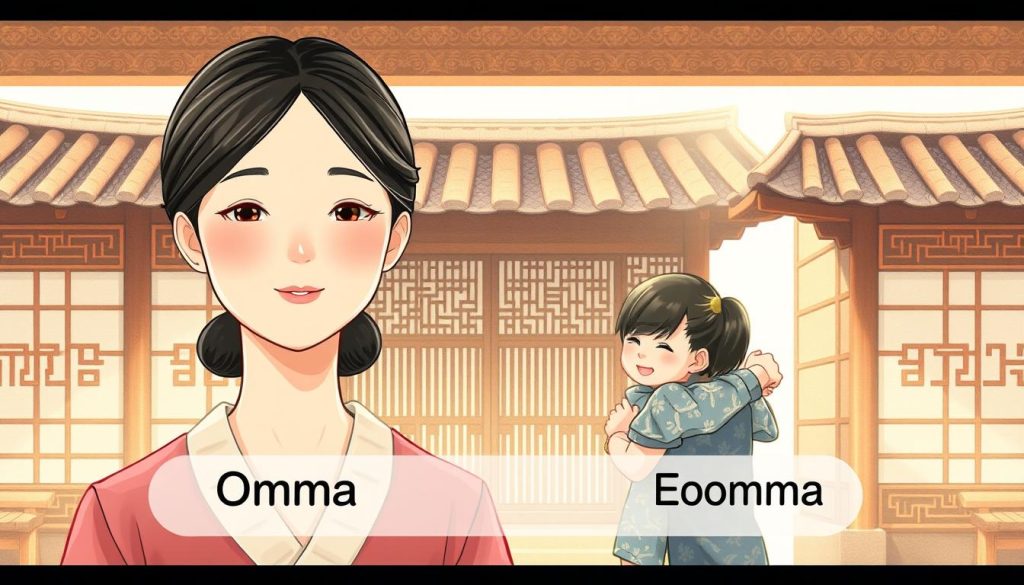
Korean offers a rich array of terms for “mother.” These words reflect deep cultural nuances and respect levels. The language provides three distinct ways to address a mother12.
Learning these variations is key for Korean language students. The three main terms are 엄마 (eomma), 어머니 (eomeoni), and 어머님 (eomeonim). Each serves a unique purpose in communication12.
Younger people often use the informal 엄마. Older generations prefer more formal expressions1. Word choice depends on context and the speaker’s age.
Key Takeaways
- Korean has multiple ways to say “mother” based on formality
- Context and generation influence word choice
- Respect is deeply embedded in language selection
- Informal term 엄마 is most common among younger people
- Formal terms show cultural respect and social hierarchy
Understanding Korean Words for Mother
Korean language shows a rich tapestry of family communication. It reflects deep social dynamics and respect. Korean words for family reveal layers of formality and emotional connection3.
In Korean, mothers can be addressed using three distinct terms. Each term carries unique social implications:
- 엄마 (eomma): Informal, intimate term similar to “mom”4
- 어머니 (eomeoni): Standard, polite term for “mother”5
- 어머님 (eomeonim): Highly formal, respectful term3
Cultural Context of Addressing Parents
Korean culture emphasizes collective identity through language. The use of 우리 (uri), meaning “our” instead of “my,” shows this approach3. Koreans prioritize shared experience over individual possession when referring to family.
Importance of Formality Levels
Formality in Korean is more than grammar—it’s a social compass. Different mother terms show relationship dynamics and respect levels. Term choice in social interactions reveals subtle relationship nuances5.
Using “Uri” (Our) Instead of “My”
우리 어머니 (uri eomeoni) means “our mother,” highlighting deep family bonds. This choice shows community and connection in Korean culture. It sets Korean apart from more individualistic languages4.
Say Mother in Korean: Essential Vocabulary Guide
Korean family vocabulary reveals deep respect and intricate social connections. It opens up a world of cultural understanding.
The Korean language has multiple ways to say “mother”. These terms depend on context and relationships.
- 어머니 (eomeoni): Formal term for “mother” used in respectful conversations6
- 엄마 (eomma): Informal, affectionate way to say “mom”6
- 어머님 (eomeonim): Highly respectful term when referring to someone else’s mother6
Choosing the right word depends on social context, age, and relationship. 엄마 (eomma) feels warm when speaking about your own mother.
어머니 (eomeoni) shows proper respect when discussing someone else’s mother. These terms go beyond simple translation.
Korean family terms reflect a deep appreciation for familial connections. Each word carries subtle nuances that enrich the language.
“Language is the road map of a culture. It tells you where its people come from and where they are going.” – Rita Mae Brown
Practicing these terms helps navigate Korean social interactions gracefully. The right word can show your cultural sensitivity.
Learning these Korean language nuances is an exciting journey. It reveals the depth of Korean culture.
Pronunciation Guide and Usage Rules
Mastering Korean pronunciation requires attention to subtle sound nuances. The guide helps English speakers learn these vocal techniques. Understanding the phonetic landscape is key for accurate communication7.
Focus on the ‘eo’ sound in “mother,” which is like the ‘u’ in “put”. Practice and attentive listening are crucial. Korean speakers value learners who grasp their language’s phonetic details7.
Basic Pronunciation Tips
Break down 어머니 (eomeoni) into syllables. The first ‘eo’ needs a soft, rounded vowel sound. Practice gentle transitions between sounds, giving each syllable equal emphasis7.
Listen to authentic Korean audio to refine your technique. This helps you capture the nuances of the language.
Common Pronunciation Mistakes to Avoid
Don’t apply familiar English sound patterns to Korean words. Avoid adding extra syllables or stressing wrong parts of the word. Aim for a smooth, rhythmic flow like native Korean speech7.
Careful listening and mimicking native speakers can help eliminate common errors. This practice improves your pronunciation significantly.
When to Use Each Form of “Mother”
The right form of “mother” in Korean depends on the context. Formal settings call for respectful terms, while casual ones allow relaxed language. Understanding these social cues shows linguistic and cultural awareness7.
FAQ
What are the different ways to say “mother” in Korean?
Korean has several terms for “mother” based on context and formality. 어머니 (eomeoni) is a standard formal term. 엄마 (eomma) is informal for one’s own mother. 어머님 (eomeonim) is highly respectful for someone else’s mother.
How do I choose the right term for “mother” in Korean?
Your choice depends on social context and relationships. 어머니 (eomeoni) is safe for most situations. 엄마 (eomma) is for your own mother. Use 어머님 (eomeonim) when referring to someone else’s mother with respect.
Why do Koreans use “uri” (our) instead of “my” when talking about family?
“Uri” reflects Korean culture’s collective nature, emphasizing family and community bonds. It shows that family members are seen as a unit. This highlights the importance of familial relationships in Korean society.
What are some common pronunciation challenges when saying “mother” in Korean?
English speakers often struggle with Korean vowel sounds and similar-sounding words. For 어머니 (eomeoni), focus on the soft ‘eo’ sound. Pay attention to the slightly nasalized ‘ni’ ending. Practice by listening to native speakers.
Is it considered rude to use an informal term for “mother” in Korean?
Context matters. Using 엄마 (eomma) for your own mother is fine. For someone else’s mother, it could be disrespectful. Always use the formal 어머님 (eomeonim) when talking about another person’s mother.
How do age and social status affect how I say “mother” in Korean?
Korean language is hierarchical. Your choice depends on age and social relationships. Younger people use formal terms for older family members. This shows respect through language use.
Can I use these terms for biological mothers and mothers-in-law?
어머니 (eomeoni) can be used for both. However, there are specific terms for mothers-in-law. 시어머니 (sieomeoni) is used for a mother-in-law. This shows Korean’s nuanced approach to family relationships.
Source Links
- 5 Different Ways To Address Mom In Korean – https://koreabridge.net/post/5-different-ways-address-mom-korean-fluenttongue
- How to say Mom in Korean – Akapinn – https://akapinn.com/how-to-say-mom-in-korean/
- How to say “mother” in Korean – Ways to express it – https://www.90daykorean.com/mother-in-korean/
- How to Say “Mother” in Korean (Formal & Informal) – https://www.wikihow.com/Say-Mother-in-Korean
- How To Say Mom In Korean (with Audio!) – Hangul House.com – https://hangulhouse.com/mom-in-korean/
- Korean Family Terms – How to address relatives & friends – https://www.90daykorean.com/korean-family-terms/
- Do You Speak American . What Speech Do We Like Best? . Beastly – https://www.pbs.org/speak/speech/beastly/

