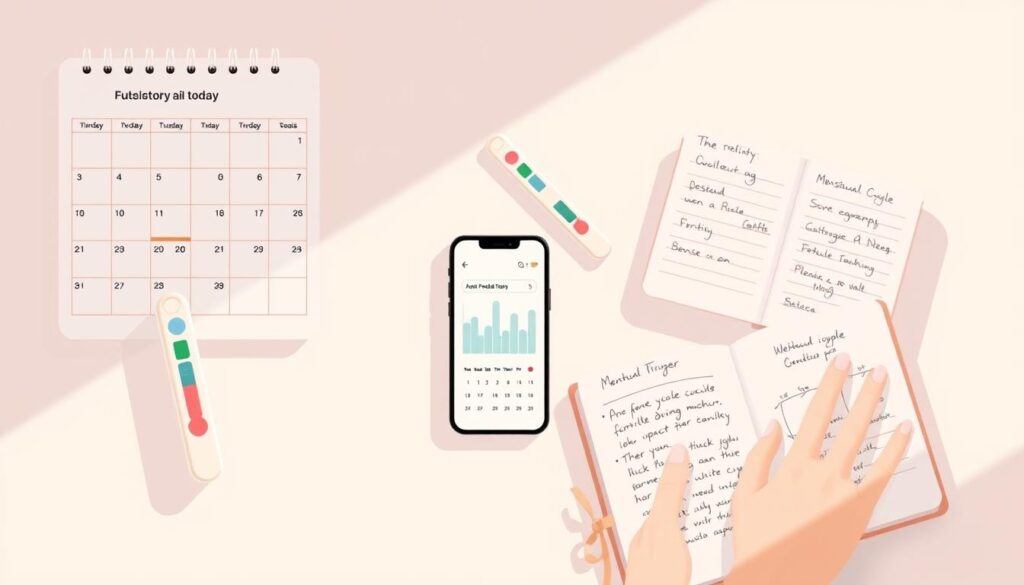
Fertility awareness methods (FAMs) offer a natural way to track ovulation and prevent pregnancy. These methods require careful observation of your body’s natural fertility signs. Understanding your menstrual cycle is key for family planning and reproductive health.
Tracking fertility involves monitoring several key indicators. One technique is tracking basal body temperature, which rises during ovulation. Some people use ovulation kits to detect hormones in urine and predict fertile windows.
Natural family planning can be highly effective when done right. These methods can be up to 99% effective with precise implementation. However, mistakes can reduce effectiveness to about 75%.
Combining multiple tracking approaches works best for fertility awareness. The most effective strategy uses temperature, cervical mucus, and calendar methods together. Your fertile days typically last around 7 days in each menstrual cycle1.
Key Takeaways
- Fertility tracking requires consistent daily monitoring
- Multiple tracking methods improve accuracy
- Fertility awareness methods can be up to 99% effective
- Understanding your body’s natural fertility signs is crucial
- Ovulation typically occurs mid-cycle
Types of Emergency Contraception
Knowing your emergency contraceptive options can protect against unplanned pregnancy. Post-coital contraception offers several ways to prevent conception after unprotected sex2.
The US offers four main emergency contraceptive pill (ECP) methods. These help prevent unplanned pregnancy2:
- Copper Intrauterine Device (Cu-IUD)
- Ulipristal Acetate (UPA)
- Levonorgestrel (LNG)
- Combined Estrogen and Progestin
Emergency Contraceptive Pills (ECPs)
ECPs provide protection within five days after unprotected sex2. Different options offer varying effectiveness levels.
- Ulipristal Acetate (UPA): A single 30 mg dose works best between 72-120 hours3
- Levonorgestrel (LNG): Single 1.5 mg dose or two 0.75 mg doses 12 hours apart2
Copper Intrauterine Devices (IUDs)
Copper IUDs are the most effective emergency contraceptive. They have a failure rate of less than 1%3.
Doctors can insert them within five days of unprotected sex. They also provide long-term contraceptive protection2.
Combined Oral Contraceptives
The Yuzpe method uses combined oral contraceptives. These contain ethinyl estradiol and levonorgestrel.
This method offers another post-coital contraception strategy2.
Remember, timing is crucial when using emergency contraception. The sooner you act, the more effective these methods become.
When to Use Emergency Contraception
Emergency contraception helps prevent unplanned pregnancies in unexpected situations. It’s crucial to know when to use it for your reproductive health45.
Unprotected Sexual Encounters
You may need emergency contraception after unprotected sex. This includes condom breakage, failed withdrawal, or fertility awareness miscalculations.
- Condom breakage or slippage
- Failed withdrawal method
- Miscalculation of fertility awareness methods
Emergency contraception can prevent up to 95% of pregnancies within 5 days after sex4. The quicker you use it, the more effective it is5.
Contraceptive Failure
Contraceptive failures need quick action. These include missed pills, late injections, dislodged diaphragms, or expelled IUDs.
- Missed birth control pills
- Late contraceptive injections
- Dislodged diaphragms
- Expelled intrauterine devices (IUDs)
Tip: Keep emergency contraceptive pills on hand for quick access when needed.
Sexual Assault
Emergency contraception is vital after sexual assault. Doctors recommend using it as soon as possible for best results4.
Emergency contraception is a fundamental right for all individuals at risk of unintended pregnancy.
Options include emergency pills and copper IUDs. Each has different effectiveness rates. A copper IUD inserted within 120 hours is over 99% effective4.
How to Use Emergency Contraception
Emergency contraception prevents unintended pregnancy. Different methods require specific approaches for maximum effectiveness6. Knowing how to use them can help you make informed decisions.
Taking Emergency Contraceptive Pills
Timing is crucial when using emergency contraceptive pills like Plan B. These pills delay ovulation or prevent fertilization6. Take them as soon as possible after unprotected sex.
Follow package instructions carefully. If you vomit within 2 hours, ask a doctor about repeating the dose. Levonorgestrel pills work best within 72 hours, with 94% effectiveness in 24 hours7.
Ulipristal acetate can be taken up to 120 hours after unprotected sex. It’s up to 98% effective in the first 24 hours7.
Inserting a Copper IUD
A copper IUD is another emergency contraception option. A healthcare professional must insert it within 5 days of unprotected sex6. It provides immediate, long-term birth control.
Follow-up Care and Regular Contraception
After using emergency contraception, resume or start regular birth control. UPA users should wait 5 days before starting hormonal contraceptives. Take a pregnancy test if your period doesn’t come within three weeks.
Side effects may include nausea, fatigue, and irregular bleeding. These symptoms are usually mild and go away on their own6.
Remember, emergency contraception is not a substitute for regular birth control and should be used only in exceptional circumstances.
Important Considerations and Limitations
Understanding emergency contraception’s effectiveness is vital. Its success depends on factors like body weight and timing. Women over 165 lbs may need specific methods like ulipristal or copper IUD for better protection8.
Your choice affects the method’s success rate. Ulipristal acetate shows lower pregnancy rates than traditional levonorgestrel pills. Failure rates range from 0.9% to 2.1%8.
The American College of Obstetricians and Gynecologists advises considering personal health factors when picking a method. Medical eligibility is crucial for choosing the right option.
Some methods have specific contraindications. For example, copper IUDs aren’t suitable for those with pelvic inflammatory disease9. Emergency contraceptive pills are generally safe but not for repeated use.
Frequent use may increase side effects. It’s best to consult healthcare professionals about long-term contraception strategies. They can provide personalized guidance for your specific needs.
FAQ
What is emergency contraception?
Emergency contraception (EC) prevents pregnancy after unprotected sex or contraceptive failure. It works within 5 days but is most effective when taken quickly. Options include emergency pills and copper IUDs.
How do emergency contraceptive pills work?
Emergency contraceptive pills (ECPs) prevent or delay ovulation. There are two main types: ulipristal acetate (UPA) and levonorgestrel (LNG).
UPA is a single 30 mg dose. LNG is taken as one 1.5 mg dose or two 0.75 mg doses 12 hours apart.
When should I use emergency contraception?
Use emergency contraception for condom breaks, missed pills, or after unprotected sex. It’s most effective within 120 hours of intercourse.
Consider it for late contraceptive injections, failed withdrawal, or after sexual assault without protection.
Are there any side effects of emergency contraceptive pills?
Side effects are usually mild. They may include nausea, vomiting, fatigue, and slight irregular bleeding.
If you vomit within 2 hours, take another dose. Most side effects go away on their own.
Is emergency contraception 100% effective?
No method is 100% effective. Emergency pills have pregnancy rates of 1.2% to 2.1%. Copper IUDs are most effective, with less than 1% failure rate.
Effectiveness may decrease in women with a BMI over 30 kg/m2.
Can I use emergency contraception as my regular birth control?
Emergency contraception isn’t for regular use. It’s less effective than consistent methods and may cause more side effects.
If you use it often, talk to a doctor about better birth control options.
Does emergency contraception protect against sexually transmitted infections?
No, emergency contraception doesn’t protect against STIs. If you’re worried about STI exposure, see a doctor for testing and treatment.
How soon after using emergency contraception can I start regular birth control?
With ulipristal acetate (UPA), wait 5 days before starting hormonal contraceptives. For copper IUDs, you can start other methods right away.
Ask your doctor for personalized advice on when to start regular birth control.
Can emergency contraception terminate an existing pregnancy?
No, emergency contraception can’t stop an existing pregnancy. It only prevents pregnancy before implantation occurs. It won’t harm a developing embryo.
Is emergency contraception available without a prescription?
Many emergency contraceptive pills are sold over-the-counter without a prescription. They’re available to people of all ages. Check your local pharmacy for availability.
Source Links
- Fertility Awareness Methods | Natural Birth Control – https://www.plannedparenthood.org/learn/birth-control/fertility-awareness
- Emergency Contraception – https://www.cdc.gov/contraception/hcp/usspr/emergency-contraception.html
- What Kind of Emergency Contraception Is Best For Me? – https://www.plannedparenthood.org/learn/morning-after-pill-emergency-contraception/which-kind-emergency-contraception-should-i-use
- Emergency contraception – https://www.who.int/news-room/fact-sheets/detail/emergency-contraception
- Emergency contraception – https://www.nhsinform.scot/healthy-living/contraception/emergency-contraception/
- Emergency contraception: MedlinePlus Medical Encyclopedia – https://medlineplus.gov/ency/article/007014.htm
- Morning After Pill: What To Know – https://my.clevelandclinic.org/health/treatments/23386-morning-after-pill
- Emergency contraception review: evidence-based recommendations for clinicians – https://pmc.ncbi.nlm.nih.gov/articles/PMC4216625/
- Emergency Contraception – Types – Contraindications – TeachMeObGyn – https://teachmeobgyn.com/sexual-health/contraception/emergency-contraception/