
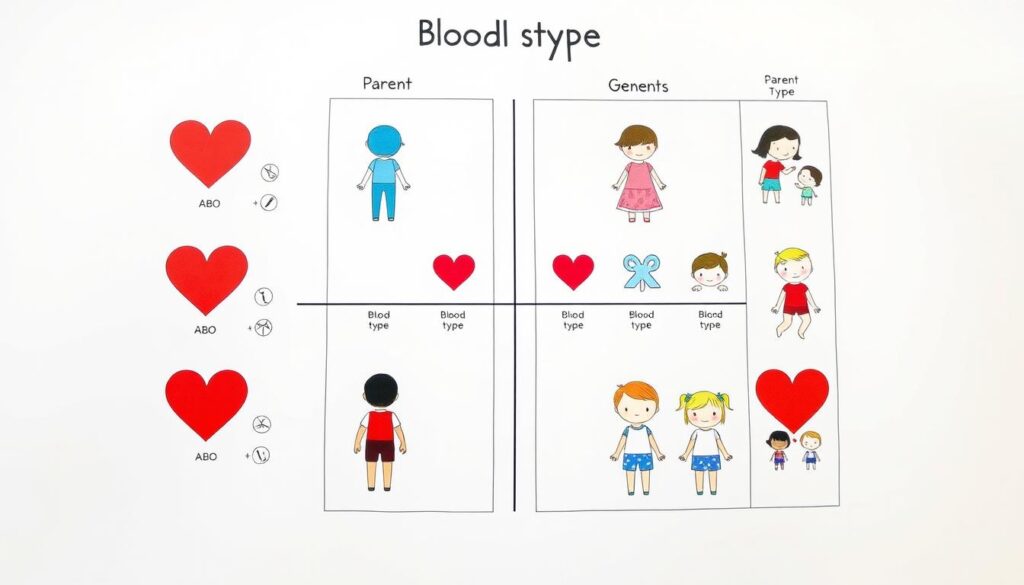
Curious about your baby’s blood type? A Baby Blood Type Punnett Square can help. It shows how genes from parents mix to determine blood types1.
Genetic inheritance is like a puzzle. Parents’ blood types are key pieces. The Punnett Square helps predict possible outcomes2.
Your baby’s blood type isn’t random. Each parent gives special genetic markers. These markers shape your future child’s blood type1.
Key Takeaways
- Punnett Squares help predict potential blood type probabilities
- Genetic inheritance involves complex chromosomal interactions
- Parents’ blood types significantly influence their child’s potential blood group
- Fetal blood typing provides probabilistic genetic insights
- Understanding genetic inheritance can be both scientific and exciting
Understanding Blood Types and Inheritance
Blood types are fascinating genetic traits in human biology. They’re determined by specific genetic inheritance patterns. These patterns shape how your body’s immune system works3.
What Are Blood Types?
Blood types are genetic markers on red blood cells. The ABO system groups blood into four types: A, B, AB, and O4.
These types depend on specific antigens. Antigens are key for understanding parental genotypes and predicting phenotypes3.
The ABO and Rh Blood Group Systems
Your blood type involves two key components:
- ABO System: Defines blood types based on A and B antigens
- Rh Factor: Indicates positive or negative blood type3
The US population shows interesting blood type patterns:
- Type O: 44%
- Type A: 42%
- Type B: 10%
- Type AB: 4%5
How Blood Types Are Inherited
Blood type inheritance follows specific genetic rules. You get one allele from each parent. This determines your unique blood type4.
The ABO gene is on chromosome 9. It has three alleles (A, B, O) that combine to create your blood type3.
“Understanding your genetic inheritance can provide fascinating insights into your biological makeup.”
Type O is a universal donor. AB is a universal recipient. These traits make certain blood types unique4.
The Basics of the Punnett Square
The Punnett square simplifies genetic inheritance. It predicts genetic outcomes using Mendelian genetics principles. Families can explore potential traits in their future children with this tool.
Exploring Genetic Prediction Tools
A Punnett square is a visual grid for genetic combinations. It tracks dominant and recessive alleles, showing how traits might be inherited.
Scientists use this method to understand complex genetic patterns. It’s especially helpful in blood type inheritance studies.
Creating Your Punnett Square
To create a Punnett square, follow these steps:
- List potential alleles from each parent along the grid’s sides
- Identify dominant and recessive genetic traits
- Fill in grid squares with potential genetic combinations
- Calculate probability percentages for each outcome
Genetic Inheritance Insights
Punnett squares reveal fascinating genetic probabilities. They help predict co-dominant blood groups and inheritance patterns6.
The probability of a baby inheriting a specific blood type can be calculated precisely7.
“Genetics is the blueprint of life, and the Punnett square is our map.” – Genetic Research Institute
Families can gain valuable insights into potential hereditary traits. This knowledge helps them prepare for unique genetic scenarios.
Creating a Baby Blood Type Punnett Square
Predicting your baby’s blood type can be thrilling. Genetic inheritance patterns shape blood types. The Punnett square helps us understand these multiple allele traits8.
Identifying Parents’ Blood Types
To use a Punnett square, you need both parents’ blood types. Each parent has two blood type alleles. These can be homozygous or heterozygous.
Here’s a quick guide:
- Type A can be AA or AO
- Type B can be BB or BO
- Type AB is always AB
- Type O is always OO9
Constructing Your Punnett Square
To build your Punnett square, follow these steps:
- Write one parent’s alleles across the top
- Write the other parent’s alleles down the side
- Fill in the grid with possible combinations
Understanding blood type inheritance helps families prepare for potential genetic scenarios.
Interpreting Your Results
The completed Punnett square shows possible blood types for your future child. The genetic inheritance of blood types follows specific patterns8.
| Parent 1 Type | Parent 2 Type | Possible Child Types | Probability |
|---|---|---|---|
| A | B | A, B, AB, O | 25% each |
| O | AB | A, B | 50% each |
Keep in mind that Punnett squares show probabilities, not guaranteed outcomes. Each pregnancy has its own unique genetic mix9.
Common Questions About Baby Blood Types
Blood type inheritance can be tricky for expecting parents. Punnett squares help predict outcomes, but they’re not guarantees. Genetic inheritance of blood types involves many factors that may surprise parents2.
Children can inherit unexpected blood types. The ABO system includes six possible combinations from A to O2. Genetic counseling helps explain these complex patterns and possible variations.
Prenatal testing reveals potential blood type issues. Rh factor incompatibility can cause problems during pregnancy10. Rh-negative moms carrying Rh-positive babies might develop antibodies affecting future pregnancies10.
Talk to a doctor if you have genetic concerns. Punnett squares offer predictions, but genetic testing gives more precise information10. Understanding these details helps you make informed health decisions for your family.
FAQ
How accurate is a Baby Blood Type Punnett Square in predicting my child’s blood type?
A Baby Blood Type Punnett Square offers probability estimates, not exact predictions. It shows possible blood types based on parents’ genetics. Your child’s actual blood type depends on the specific alleles inherited from both parents.
Can a child have a different blood type than both parents?
Yes! Blood types are inherited through recessive and dominant genes. A child can have a different blood type from both parents. This happens when parents carry hidden recessive alleles.
Punnett squares reveal the fascinating complexity of genetic inheritance. They show how unexpected blood types can occur in families.
What are the most important factors to consider when determining a baby’s potential blood type?
The ABO blood group system and Rh factor are crucial. Consider both parents’ blood types and their specific gene combinations. Remember that A and B alleles are dominant, while O is recessive.
The Rh-negative allele is also recessive. These factors combine to determine a baby’s potential blood type.
How do I know if there might be potential blood type compatibility issues during pregnancy?
Rh factor compatibility is key, especially if the mother is Rh-negative and father is Rh-positive. This could lead to Rh incompatibility, which may need medical attention.
Always consult a healthcare professional or genetic counselor. They can provide personalized guidance based on your specific genetic profile.
Are there any medical implications of blood type inheritance I should be aware of?
Yes, blood type can have important medical effects. Some types are more compatible for transfusions. Certain combinations can affect pregnancy outcomes.
Rh incompatibility can cause complications if not managed properly. Prenatal testing offers detailed information about potential genetic and blood type-related concerns.
Can a Punnett square help me understand other genetic traits besides blood types?
Absolutely! Punnett squares help understand various genetic inheritance patterns. They can predict the likelihood of inheriting different traits, from eye color to inherited conditions.
It’s a captivating way to explore how genetic information passes from parents to children. The tool reveals the complexity of our genetic makeup.
How complex is it to create a Punnett square for blood types?
Creating a Punnett square is simpler than you might think. Identify possible alleles for both parents and create a 2×2 grid. Then, fill in the potential combinations.
With practice, it becomes easier. Online calculators and genetic counseling can help you navigate the process confidently.
Source Links
- Blood Type Calculator – https://www.omnicalculator.com/health/blood-type
- What are all the possible blood types for any combination of parents? – The Tech Interactive – https://www.thetech.org/ask-a-geneticist/articles/2006/ask199/
- Genetics of blood type: inheritance and compatibility | Medicover Genetics – https://medicover-genetics.com/genetics-of-blood-type-inheritance-and-compatibility/
- Genes and Blood Type – https://learn.genetics.utah.edu/content/basics/blood/
- Blood Type Genetics – https://www2.nau.edu/lrm22/lessons/blood_type/blood_type.html
- Punnett Square – https://forums.studentdoctor.net/threads/punnett-square.812922/
- The making of the Fittest: Natural Selection and Adaptation – https://www.biointeractive.org/sites/default/files/SickleCell_Genetics_Teacher.pdf
- The Hh blood group – Blood Groups and Red Cell Antigens – https://www.ncbi.nlm.nih.gov/books/NBK2268/
- Step by Step Solution – https://www.vaia.com/en-us/textbooks/biology/essentials-of-genetics-10-edition/chapter-4/problem-11-in-humans-the-abo-blood-type-is-under-the-control/
- Blood Type Problems – https://www2.nau.edu/lrm22/lessons/blood_type/blood_type_probs.html

