
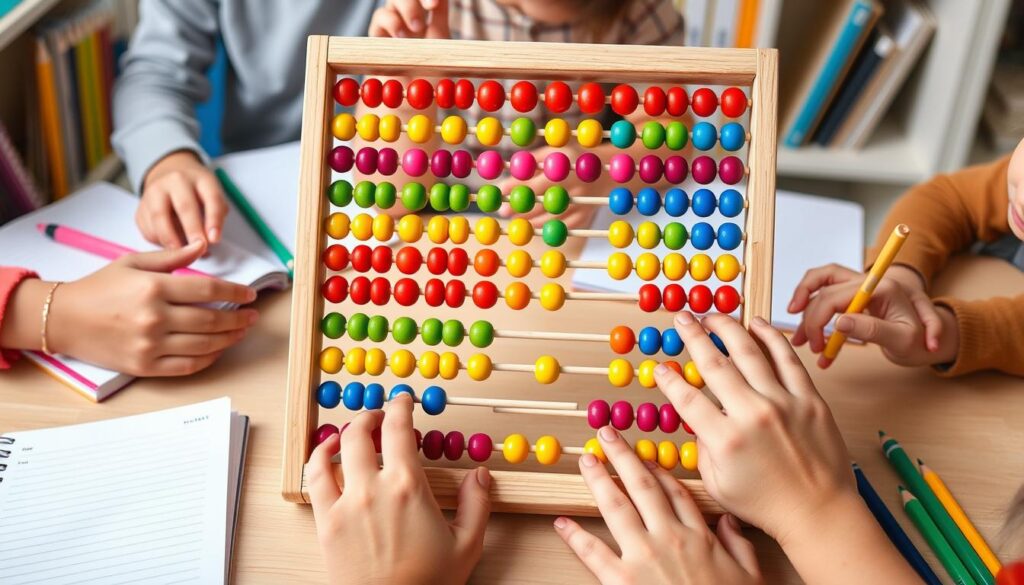
Dive into the captivating realm of abacus calculation. This ancient tool transforms math into an exciting adventure. It unlocks incredible mental math skills for both kids and grown-ups1.
This guide will show you essential abacus techniques. You’ll find that math can be fun and intuitive1. The abacus is more than a calculator; it’s a brain-training powerhouse.
Kids as young as 5 or 6 can start using an abacus. It boosts critical thinking and math skills1. Starting early gives kids a big brain boost.
Picture learning a new number language. Each bead tells a math story. Abacus skills go beyond simple math2. They build a strong base for advanced math thinking.
Students who master the abacus often excel in math2. It’s a unique way to sharpen mental math skills.
Key Takeaways
- Abacus learning is ideal for children aged 5-15
- Daily 10-minute practice yields significant improvements
- Enhances cognitive skills and mathematical thinking
- Provides a unique approach to mental calculation
- Supports brain development through engaging learning
Understanding the Basics of an Abacus
An abacus is an ancient calculating tool that makes math fun and interactive. It’s been used for centuries to help people learn arithmetic. This tool also boosts critical thinking skills3.
What is an Abacus?
An abacus is a counting frame for doing math. It has a rectangular frame with rods holding movable beads. These beads stand for different numbers4.
The abacus works great for kids learning math concepts. Each bead is placed to show specific place values3.
Different Types of Abacuses
Various cultures have developed unique abacus tools with distinct characteristics:
- Chinese suanpan: Traditional design with complex bead arrangements
- Japanese soroban: Simplified and more streamlined version
- Russian schoty: Unique horizontal design
Key Components of an Abacus
| Component | Description | Function |
|---|---|---|
| Frame | Rectangular structure | Holds rods and beads |
| Rods | Horizontal or vertical bars | Supports bead movement |
| Beads | Movable counting units | Represents numerical values |
Learning abacus techniques can boost thinking and problem-solving skills. Kids aged 3 to 6 can really gain from this fun learning method3.
“The abacus is not just a calculation tool, but a bridge to understanding mathematical thinking.” – Mathematics Education Expert
Regular practice with an abacus can improve your math skills. It also helps develop mental math abilities that last a lifetime4.
Setting Up Your Abacus for Use
Mastering abacus techniques starts with proper preparation. Understanding the tool’s structure is key. Your abacus journey begins with correct setup and positioning5.
Positioning Your Abacus Correctly
Correct positioning is vital for abacus learning. Place it on a flat surface with beads aligned vertically. The frame should feel comfortable, allowing smooth bead manipulation6.
- Ensure the upper deck beads are at the top
- Position lower deck beads at the bottom
- Keep the abacus at a comfortable angle
Understanding Abacus Bead Mechanics
Grasping bead movements is crucial for mastering abacus techniques. Each column represents a specific place value. These range from ones to tens and beyond5.
| Column Position | Place Value |
|---|---|
| Rightmost Column | Ones |
| Next Column | Tens |
| Left Columns | Hundreds, Thousands |
“Practice makes perfect when learning abacus calculations”
To reset to zero, push upper beads up and lower beads down. Practice representing numbers by moving beads smoothly6.
Regular practice develops intuitive abacus skills. This transforms math into a visual, engaging experience5.
Basic Operations: Addition and Subtraction
Abacus math boosts mental skills powerfully. It’s an engaging way to grasp math concepts and improve calculations. Mental math skills grow through abacus practice7.
Addition Strategies on an Abacus
Mastering abacus addition requires key techniques. Numbers are represented by beads, and specific methods are applied8.
Here are some effective strategies:
- The Ten Strategy: Break down numbers to make addition easier
- The Two 5s Method: Utilize bead configurations for quick calculations
- Carrying over digits when a column exceeds 9
Subtraction Techniques
Abacus subtraction is similar to addition. Start with the larger number, then remove beads for the smaller one.
If a column goes below zero, borrow from the next column7.
Practicing these Abacus for mental math techniques can significantly enhance your mathematical problem-solving skills8.
Schools value abacus for teaching math. Regular practice improves calculation speed and number understanding8.
Advancing Your Skills: Multiplication and Division
Abacus multiplication enhances mental math abilities. It builds on addition techniques you’ve mastered. The abacus offers a powerful method for complex calculations with precision9.
Multiplication involves strategic bead movements mimicking repeated addition. Students start with multiplication tables up to 9×9. This creates a solid foundation for advanced calculations10.
Practice problems like 8 × 37 and 9 × 54 develop computational skills. They reinforce your understanding of abacus techniques10.
Division on an abacus uses repeated subtraction methods. It solves complex problems efficiently. Regular practice enhances concentration, mental agility, and problem-solving skills11.
Abacus benefits extend beyond simple arithmetic. They develop critical cognitive abilities supporting lifelong learning. Mastering these skills requires dedicated practice.
Begin with basic problems and increase complexity gradually. Online resources and virtual simulations can enhance your learning experience11. Your abacus journey is an investment in mathematical proficiency.
FAQ
What exactly is an abacus?
An abacus is the world’s first non-digital calculator. It’s a wooden frame with beads arranged on rods or wires. This tool helps perform arithmetic by moving beads to represent numbers.
At what age should someone start learning to use an abacus?
The best time to start learning abacus is between 5 and 15 years old. Five is the ideal age to begin for optimal brain growth. Children can improve concentration, mental agility, and hand-eye-ear coordination most effectively at this age.
How does an abacus help with brain development?
Using an abacus boosts brain development by engaging multiple cognitive skills. It improves focus, concentration, and mental math abilities through hand-eye-ear coordination exercises. Manipulating beads helps kids develop spatial reasoning and number understanding.
What are the different types of abacuses?
The main types of abacuses are the Chinese suanpan and Japanese soroban. They differ slightly in bead setup and counting methods. Both use the same basic idea of doing math with a frame and movable beads.
Can adults learn to use an abacus?
Yes, adults can definitely learn to use an abacus! It’s like learning a new language and needs focus and practice. Many adults find it great for improving mental math and brain flexibility.
How fast can advanced abacus users perform calculations?
Advanced abacus users can do complex math very quickly. They often outpace standard calculators. With practice, skilled users can mentally picture and solve math problems at amazing speeds.
Is an abacus still relevant in the digital age?
Absolutely! An abacus offers unique brain benefits that digital calculators can’t match. It builds mental math skills and improves concentration. The abacus teaches number basics that digital tools often skip.
How difficult is it to learn abacus calculations?
Learning abacus math is challenging but doable with steady practice. It takes patience and dedication, like picking up a new language. Begin with simple addition and subtraction, then move to harder operations.
Source Links
- A Beginner’s Guide to the Abacus: What, Why, When, and How – https://www.mathcruise.com/abacus-what-why-when-and-how/
- Learning Math the Abacus Way: A Step by Step Guide – FasterCapital – https://fastercapital.com/content/Learning-Math-the-Abacus-Way–A-Step-by-Step-Guide.html
- How to Use an Abacus for Basic Math Operations – https://enthu.com/blog/abacus/how-to-use-an-abacus?srsltid=AfmBOooHtlC3-0HU3vo6Tom9JGEHxGWLmSEn1mKzRRuCmWnVVyRWmU7h
- The Abacus: A Brief Introduction – https://www.ecb.torontomu.ca/~elf/abacus/intro.html
- What is an Abacus & How to Use an Abacus in Math | Brighterly.com – https://brighterly.com/blog/how-to-use-an-abacus/
- All About the Abacus: Part One (Plus a DIY Abacus!) | SIS For Teachers – https://sis4teachers.org/2018/06/abacus-fun-part-one/
- How to Use an Abacus for Basic Math Operations – https://enthu.com/blog/abacus/how-to-use-an-abacus?srsltid=AfmBOopRG0v3no5w2rOLQk4A5rrNBaQK3hxwYjVIs1JLT7GzyM9W3tWT
- How to use an Abacus for Basic Math Operations | Turito – https://www.turito.com/blog/one-on-one-online-tutoring/how-to-use-an-abacus-for-basic-math-operations
- Mental Math Marvels: Enhancing Skills with Abacus Techniques – https://medium.com/@megha_karia/mental-math-marvels-enhancing-skills-with-abacus-techniques-8287242a85ef
- Engaging and Accessible – https://www.aph.org/app/uploads/2024/04/Abacus-Multiplication-to-Perfection-1.pdf
- Arithmetic: Advancing Arithmetic Skills with the Abacus – FasterCapital – https://fastercapital.com/content/Arithmetic–Advancing-Arithmetic-Skills-with-the-Abacus.html

