
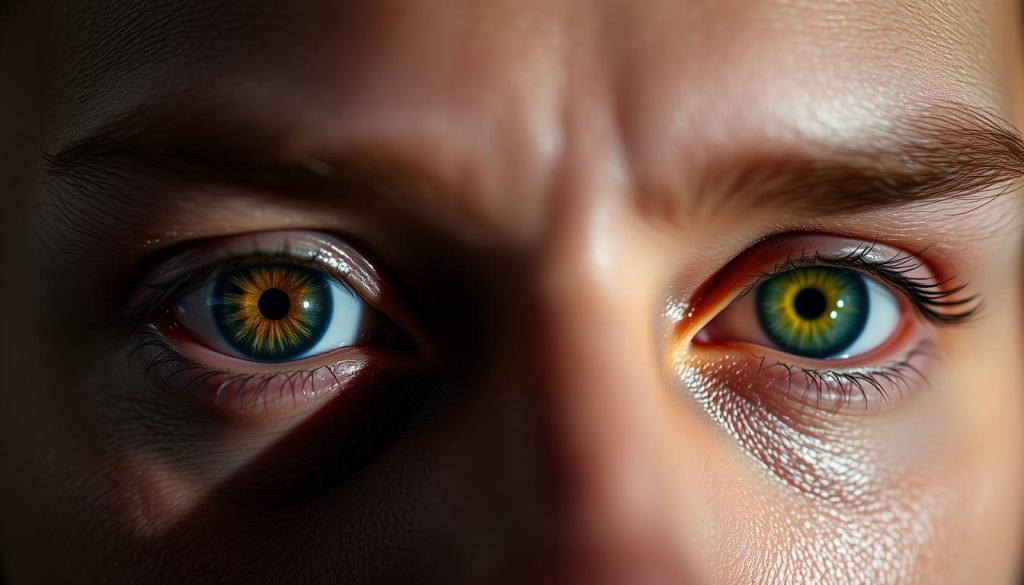
Eye color inheritance is a complex genetic dance. Your future children’s eye color depends on a mix of genetic factors. Hazel and green eye genetics make predicting eye color both challenging and exciting1.
Eye color isn’t a simple equation. It’s influenced by multiple genes from both parents1. Your hazel and green eyes create interesting genetic potential for your children’s eye color2.
Eye color pigmentation involves interactions between dominant and recessive genes. Green and hazel eyes are closer to the dominant end. This increases the chances of passing these colors down12.
Key Takeaways
- Eye color inheritance involves multiple genetic factors
- Hazel and green eyes have dominant genetic characteristics
- Genetic prediction of eye color is complex
- Both parents contribute genetic information for eye color
- Melanin plays a crucial role in determining final eye color
Understanding Eye Color Genetics and Inheritance Patterns
Eye color genetics is a fascinating blend of biological complexity. Our iris color is more than a simple genetic coin flip. Genetics plays a pivotal role in determining the unique hues that make each person’s eyes special.
Melanin and eye color are closely linked. Multiple genes influence the final appearance of our eye color. At least eight genes contribute to this genetic symphony3.
The OCA2 gene is a critical player. It controls nearly 75% of the blue-brown color spectrum3.
The Genetic Complexity of Eye Pigmentation
Over 150 genes influence eye pigmentation4. These genes work together to determine eye color details. They affect melanin production, storage, and pigment concentration in the iris.
- Melanin production and storage
- Pigment concentration in the iris
- Variations in genetic expression
Dominant and Recessive Gene Interactions
Eye color inheritance follows complex genetic interactions. Brown eyes are dominant, while blue eyes are recessive5. A study of 920 twin families revealed interesting facts.
- 74% of eye color variation comes from a dominant genetic factor
- 18% results from additive genetic factors
- 8% stems from unique environmental influences5
Genetic Variations and Eye Color Prediction
The OCA2 gene is crucial for melanin production. Genetic variations can reduce protein production, resulting in lighter eye colors4. This explains why parents with the same eye color can have children with different hues.
These genetic intricacies help unravel eye color inheritance mysteries. Our eyes are a remarkable testament to genetic complexity3.
Hazel and Green Eye Genetics: Probability and Predictions
Eye color inheritance is a complex genetic puzzle. Multiple genes interact to determine a child’s eye color. Up to 16 specific genes contribute to the final eye color outcome.
Parents with hazel and green eyes create intriguing genetic possibilities. Two green-eyed parents have a 75% chance of a green-eyed child. They also have a 25% chance of a blue-eyed child.
Ocular albinism can affect eye pigmentation. This rare condition impacts fewer than 1 in 60,000 individuals. Eye color inheritance depends on traits from both parents.
A baby’s true eye color isn’t always visible at birth. It can take 6 to 12 months to fully develop. Most pigment is produced during the first six months of life.
Eye color is typically established by one year old. Genetic predictions offer insight, but nature still holds surprises. Brown eyes remain the dominant trait in inheritance patterns.
Green and blue eyes follow more recessive patterns. Parents with hazel or green eyes may have children with various eye colors. This reflects the beautiful complexity of genetic inheritance67.
FAQ
What determines eye color in children?
Eye color is determined by a complex interaction of multiple genes. These genes primarily involve melanin production. When parents have hazel and green eyes, their children’s eye colors can vary widely.
The genetic mix can result in hazel, green, brown, or even blue eyes. The outcome depends on the specific genetic variations inherited.
Are hazel and green eyes rare?
Hazel and green eyes are indeed relatively rare. Green eyes occur in about 2% of the world’s population. Hazel eyes are slightly more common, affecting 5-8% of people.
Your genetic makeup is quite special due to this unique combination of eye colors.
How do different pigments affect eye color?
Eye color is mainly influenced by melanin. Two types play a crucial role: eumelanin (brown pigment) and pheomelanin (reddish pigment).
The amount, distribution, and interaction of these pigments determine the final eye color. This creates variations like hazel and green eyes.
Can eye color change as a child grows?
Yes, eye color can change significantly during early childhood. Many babies are born with blue or gray eyes. These may darken or change completely within the first few years of life.
The final eye color is typically established by around 3 years of age. This happens as melanin production stabilizes.
What are the chances of having a child with green or hazel eyes?
The probability is complex due to the polygenic nature of eye color inheritance. With one hazel-eyed parent and one green-eyed parent, the child is likely to have hazel or green eyes.
However, other colors are still possible. Genetic testing and family history can provide more insights into potential outcomes.
Do eye color genetics follow simple inheritance patterns?
Eye color doesn’t follow a simple dominant-recessive pattern. It’s a polygenic trait involving multiple genes that interact in complex ways.
This makes predicting exact eye color challenging. Children can inherit unexpected eye colors from their parents.
Can medical conditions affect eye color?
Certain genetic conditions like ocular albinism can significantly impact eye color and pigmentation. Some medical conditions can cause changes in eye color over time.
Rare genetic variations can result in unique eye color presentations. These may differ from typical inheritance patterns.
How do genetics influence the unique characteristics of hazel eyes?
Hazel eyes are characterized by a mix of colors, typically combining green, brown, and gold tones. This unique appearance results from varied melanin distribution and light interaction with the iris.
The specific genetic combinations producing hazel eyes involve multiple genes. These genes control pigment production and distribution in the eye.
Source Links
- Baby Eye Color Calculator – https://www.babymed.com/tools/baby-eye-color-calculator-predictor
- What color will your baby’s eyes be? – Orlando Health Arnold Palmer Hospital for Children – https://www.arnoldpalmerhospital.com/content-hub/what-color-will-your-babys-eyes-be/
- The Genetics of Eye Color – HudsonAlpha Institute for Biotechnology – https://www.hudsonalpha.org/the-genetics-of-eye-color/
- Genetics of Eye Color – https://www.news-medical.net/health/Genetics-of-Eye-Color.aspx
- What colour are your eyes? Teaching the genetics of eye colour & colour vision. Edridge Green Lecture RCOphth Annual Congress Glasgow May 2019 – Eye – https://www.nature.com/articles/s41433-021-01749-x
- Eye Color Genetics – All About Vision – https://www.allaboutvision.com/eye-care/eye-anatomy/eye-color/genetics/
- How Do Genetics Determine Eye Color? – https://www.verywellhealth.com/genetics-of-eye-color-3421603

