
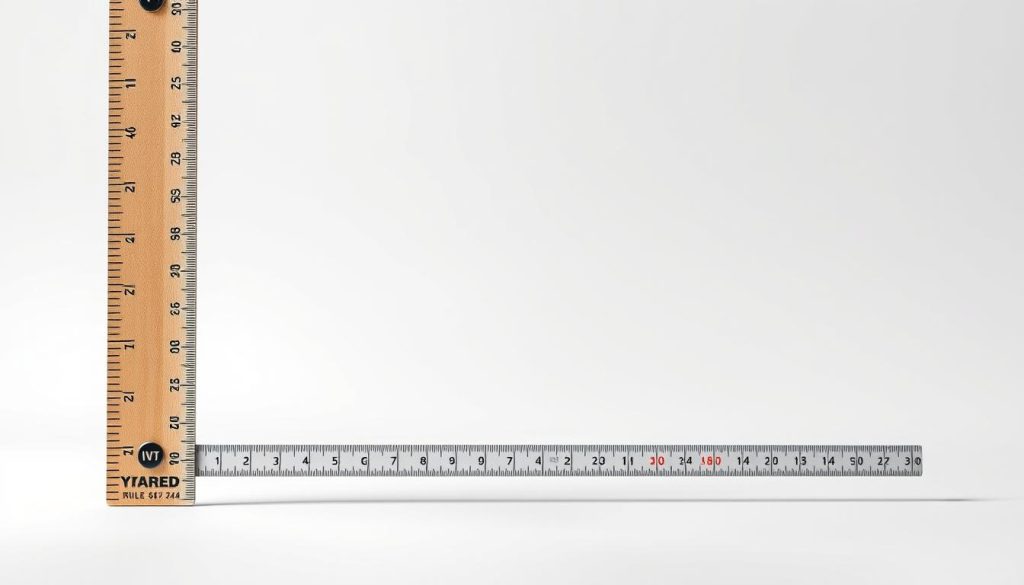
Yards and meters are important units for measuring length. The yard, used in the US, equals 3 feet or 36 inches. It’s a key unit in everyday measurements.
The meter is the base unit of length in the metric system. It’s used worldwide for scientific and standard measurements. A yard is slightly shorter than a meter.
One yard equals about 0.9144 meters. This small difference matters when converting between systems. Accurate conversions are vital for precise measurements.
The US uses the customary unit system with yards, feet, and inches. Most other countries use the metric system. This difference can cause confusion when working across regions.
Key Takeaways
- A yard is slightly shorter than a meter
- 1 yard equals 3 feet or 36 inches
- Metric system differs from US customary measurements
- Precise conversion is crucial for accurate measurements
- Understanding measurement units helps in practical applications
Understanding Basic Length Units and Their Origins
Measurement systems have shaped how we understand our world. They’re crucial in construction and tailoring. Different cultures created unique ways to measure length1.
The Historical Roots of Length Measurement
Ancient civilizations used body parts to measure length. The cubit, an early measure, varied between 450 mm and 500 mm across regions1.
Origins of the Yard Measurement
The yard became standard through gradual change. In 1959, it was defined as exactly 0.9144 meters2. One meter equals about 1.0936 yards2.
Development of the Metric System
The metric system had scientific roots. In 1791, the meter was proposed as 1/10,000,000 of the North Pole to Equator distance1.
The system evolved through precise definitions:
- 1960: Defined by wavelength of orange light from krypton-861
- 1983: Redefined based on light’s travel in vacuum1
Global Measurement Adoption
Most countries use the metric system. The U.S. mainly uses imperial. Australian building trades switched to metric in 19662.
“Measurement is the first step that leads to control and eventually to improvement.” – William Thomson
These systems show the complexity behind simple length units. They’re vital in construction and tailoring measurements.
Yard vs Meter: Direct Comparison and Conversion
Yards and meters are vital units for land surveying and sports field measurements. One yard equals about 0.9144 meters. Precise conversions ensure accurate results in these fields34.
Converting meters to yards is simple. Just multiply the number of meters by 1.093613. This method offers quick and reliable translations between these units.
Precise conversions are crucial for land surveying pros. Metric conversions help ensure accuracy across different measurement systems3.
Different regions use these measurements uniquely. The U.S. uses yards for sports fields and property lines. Many other countries prefer the metric system3.
Conclusion
Yards and meters play a vital role in our global society. Converting between these units is crucial for many professionals and hobbyists. Most countries use the metric system, while the US and UK still rely on yards5.
Accurate length conversion is essential for various projects. Crafters must consider fabric weight when calculating yardage. Lightweight materials may require up to 15% more fabric than medium-weight options6.
Many professionals now use digital tools for unit conversion. In fact, 62% of crafters use technology to support their work6. Mastering both yards and meters gives you an edge in diverse fields.
Understanding multiple measurement systems improves global communication. It allows for more precise interactions across cultures and professions. This knowledge opens doors to new opportunities worldwide.
FAQ
What exactly is the difference between a yard and a meter?
A yard is 0.9144 meters long. It’s an imperial unit, while a meter is metric. One yard is slightly shorter than one meter.
In precise measurements, this small difference can be significant. One meter equals about 1.0936 yards.
Why do some countries use yards while others use meters?
The difference comes from historical measurement systems. The U.S. and a few other countries still use the imperial system (yards).
Most of the world has switched to the metric system (meters). The metric system’s base-10 structure makes it more logical and standardized.
How do I convert yards to meters quickly?
To convert yards to meters, multiply by 0.9144. For a quick estimate, use 0.91 meters per yard.
To change meters to yards, multiply by 1.0936. These simple calculations make conversions easy.
Where are yards and meters most commonly used?
Yards are mainly used in the U.S. for land, sports fields, and construction. Meters are used worldwide for scientific research and engineering.
Most global scientific and commercial measurements use meters. Many sports, like track and field, also use metric units.
Are there any practical situations where the difference matters?
Yes, in precision work, small differences can be crucial. This includes engineering, land surveying, and scientific research.
In construction or manufacturing, exact measurements affect costs and quality. For global trade, using the right units ensures compatibility.
How did the meter become a standard unit of measurement?
The meter was first defined in 1793 during the French Revolution. It was one ten-millionth of the distance from the North Pole to the equator.
Today, the speed of light defines the meter. This provides an incredibly precise and universal measurement standard.
Is the United States planning to switch completely to the metric system?
The U.S. has adopted metric units in science and medicine. However, a complete switch is unlikely soon.
Most everyday measurements in the U.S. still use imperial units. Yards and feet remain common in daily life.
Source Links
- History of Length Units | Measurement System Basics | Measurement Fundamentals – https://www.keyence.com/ss/products/measure-sys/measurement-selection/basic/unit.jsp
- Unit of length – https://en.wikipedia.org/wiki/Unit_of_length
- Meters To Yards (m to yd) Conversion – 1 m is 1.0936 yd – https://www.squareyards.com/blog/meters-to-yards-conversion-cnvart
- International System of Units | Measurement, Conversion & History | Britannica – https://www.britannica.com/science/International-System-of-Units
- Yards to Meters conversion → Unitzzz.com – https://www.unitzzz.com/yard-to-meter-conversion/
- How Many Meters In A Yard Of Fabric: A Comprehensive Guide – North Shore Crafts – https://northshorecrafts.com/how-many-meters-in-a-yard-of-fabric/?srsltid=AfmBOopuYKo5L1aZ8rJSSaNyjBPG252Wvj9LLG-PtQVn5w3oW5Od_hrc

