
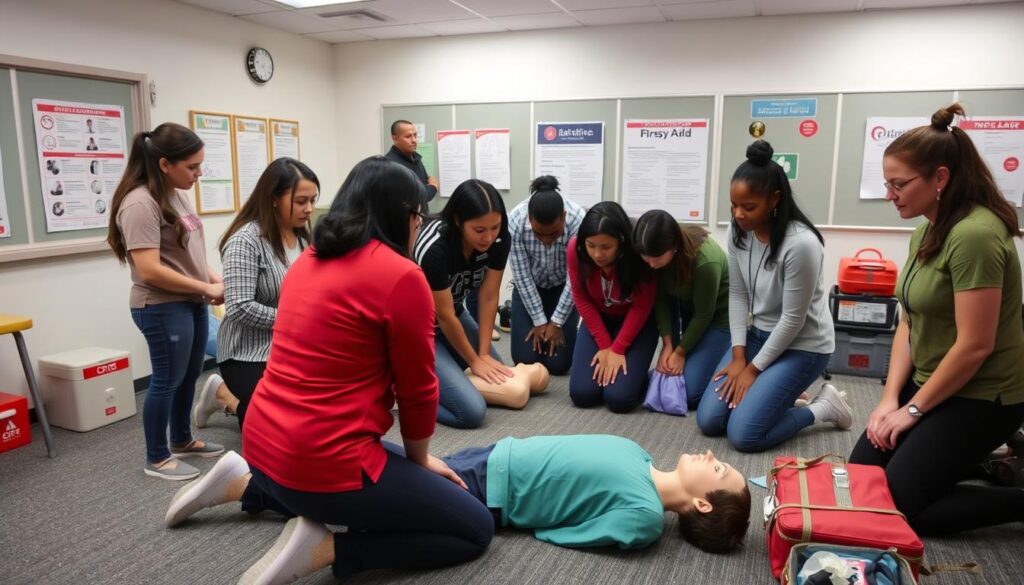
CPR First Aid is a vital emergency skill that can save lives. It empowers you to act decisively when sudden cardiac arrest occurs. Your quick actions could be the difference between life and death1.
Medical emergencies requiring cardiopulmonary resuscitation happen frequently. The American Red Cross offers thorough training programs to teach effective emergency response techniques2.
CPR training is open to everyone, regardless of their background. Over 4.6 million people learn lifesaving skills each year. This creates a network of potential rescuers ready for critical moments2.
Key Takeaways
- CPR can double or triple a cardiac arrest victim’s survival chance
- Training certification typically lasts two years
- Multiple course options available for different skill levels
- Emergency response skills are learnable by anyone
- Immediate action is critical during medical emergencies
The Fundamentals of CPR First Aid
CPR knowledge can save lives in emergencies. First aid certification teaches crucial skills for medical crises. Learning cardiopulmonary resuscitation (CPR) basics is vital for potential lifesavers.
Understanding Cardiac Arrest and Response Time
Cardiac arrest is a sudden, life-threatening condition requiring immediate action. Every second counts when someone’s heart stops working properly3.
Yearly, about 350,000 people die from cardiac arrest in the U.S3. Bystander help is crucial for survival. Men are slightly more likely to get CPR in public3.
Mastering Chest Compressions and Rescue Breaths
Effective CPR requires precise techniques for chest compressions and rescue breaths:
- Perform compressions at 100-120 times per minute4
- Use 30 chest compressions followed by two rescue breaths4
- Maintain a rhythm similar to the song “Stayin’ Alive”4
Using AED Devices Effectively
AEDs are vital for choking rescue and cardiac emergencies. Use an AED right away when it’s available5. Follow these key guidelines:
| AED Best Practices | Recommended Action |
|---|---|
| Minimize Compression Interruptions | Less than 10 seconds5 |
| Breath Duration | 1 second per breath5 |
“In an emergency, your knowledge can be the bridge between life and death.” – American Heart Association
Proper training through certified courses builds confidence in life-saving techniques. You’ll be ready to act when every moment counts4.
Building Essential Emergency Response Skills
Your quick response in critical moments can save lives. Emergency preparedness is about developing practical, life-saving skills. Organizations value comprehensive training that covers injury management and bleeding control.
First aid training equips you with crucial emergency techniques. Key skills include:
- Bleeding control techniques
- Wound management
- Responding to severe allergic reactions
- Choking rescue methods
Workplace emergency training varies based on industry risks. High-risk environments may need more frequent sessions. The aim is to create a safety-conscious space where people can handle unexpected situations.
Your training should include practical skills like developing an Emergency Action Plan. This plan outlines critical response procedures. It ensures you’re ready to act swiftly during emergencies6.
“In critical moments, knowledge transforms into lifesaving action.”
Emergency preparedness is an ongoing process. Regular refresher courses and drills help improve your skills7. By investing in thorough training, you become a vital link in community safety6.
Conclusion: Empowering Yourself to Save Lives
CPR first aid training turns everyday people into potential life-savers. It equips you with crucial skills for emergency situations8. By learning these techniques, you become a vital part of the survival chain.
Training programs teach comprehensive emergency response skills. You’ll learn chest compressions and critical care techniques8. These skills create a ripple effect of readiness in communities.
Some professions, like healthcare, require CPR certification. This highlights its importance in safety protocols8. Your commitment to CPR extends beyond personal knowledge.
You join a network of trained responders by learning CPR. Your quick action can save lives before medical help arrives8. In critical moments, your trained response can make all the difference.
CPR certification is a powerful tool of compassion and preparedness. Renew your certification every two years to stay updated8. This skill could be the most important one you’ll ever develop.
FAQ
What is CPR, and why is it important?
CPR is a vital life-saving method used in cardiac emergencies. It keeps blood flowing when someone’s heart stops beating. In the US, over 300,000 people face sudden cardiac arrest yearly.
Knowing CPR can double or triple a person’s survival chances. It’s a crucial skill that can make a real difference in emergencies.
Who can learn CPR First Aid?
Anyone can learn CPR First Aid, no matter their age or background. The American Red Cross offers easy-to-follow training courses for everyone.
These courses come in both in-person and online formats. They meet OSHA rules and job needs, making them great for pros and regular folks.
How quickly do I need to respond during a cardiac emergency?
In cardiac emergencies, every second counts. For each minute without CPR, survival odds drop by 7-10%. Quick action by bystanders is key.
Most cardiac arrests happen outside hospitals. Starting CPR fast helps keep blood moving until medical help arrives.
What skills are covered in First Aid training?
First Aid training teaches many life-saving skills. These include CPR, AED use, choking rescue, and dealing with bad bleeding.
You’ll also learn to spot and handle emergencies like strokes, allergic reactions, burns, and bites. The F.A.S.T. rule for strokes is covered too.
What is an AED, and how does it work?
An AED is a handy device that checks heart rhythm during sudden cardiac arrest. It can give an electric shock to help the heart beat normally again.
AEDs are easy to use. They give step-by-step instructions to guide you through the rescue process.
How often should I renew my CPR certification?
It’s best to renew your CPR certification every two years. Regular training keeps you up-to-date with new methods and rules.
The American Red Cross offers ongoing training to help you keep your life-saving skills sharp.
Can CPR First Aid training help in workplace settings?
Yes, it can! Many jobs require CPR and First Aid certification. These skills meet safety rules and make work safer.
They prepare staff to handle medical emergencies well. This creates a more secure environment for everyone.
What should I do if someone is choking?
First Aid training teaches you how to help someone who’s choking. You’ll learn back blows and abdominal thrusts (Heimlich Maneuver).
These methods can remove objects stuck in a person’s airway. They can prevent a dangerous situation from getting worse.
Source Links
- American Heart Association CPR and First Aid – https://cpr.heart.org/en/
- CPR Training | Red Cross – https://www.redcross.org/take-a-class/cpr/cpr-training?srsltid=AfmBOorhrdLrWchawMy9QvuuM8s8tyZUG4aa-QfA9-nn_1AW2Fc9fbqq
- What is CPR – https://cpr.heart.org/en/resources/what-is-cpr
- Cardiopulmonary resuscitation (CPR): First aid – https://www.mayoclinic.org/first-aid/first-aid-cpr/basics/art-20056600
- CPR Steps | How to Perform CPR | Red Cross – https://www.redcross.org/take-a-class/cpr/performing-cpr/cpr-steps?srsltid=AfmBOooSKiTA7rlAjidIAsAnMFj8SUzXPNUKxcGiCD7_GG1zkYj1Cwul
- Emergency Preparedness: The Importance of First Aid Training – https://cprcertificationnow.com/blogs/mycpr-now-blog/title-emergency-preparedness-the-importance-of-first-aid-training
- The Role of First Aid and CPR in Disaster Preparedness – https://cprcertificationnow.com/blogs/mycpr-now-blog/the-role-of-first-aid-and-cpr-in-disaster-preparedness
- CPR Certification: Empowering Individuals to Save Lives – https://cprcertificationnow.com/blogs/mycpr-now-blog/cpr-certification-empowering-individuals-to-save-lives

