Leonardo da Vinci was a famous Italian painter and artist from the Renaissance. He is considered one of the greatest painters in history1. His work is highly valued in art history1. He was known for his curiosity and skill, making him a symbol of human creativity.
Da Vinci worked in Florence for ten years. Sadly, few paintings from that time have survived2.
As an artist and painter, Leonardo da Vinci changed art forever. He found new ways to show human feelings, making art more intellectual1. His notebooks showed his deep interest in science, biology, and more, showing his innovative mind2.
Even 500 years after his death, his art is highly valued. This shows his lasting impact on art history1.
Leonardo da Vinci’s life teaches us to follow our curiosity and passions. Let’s explore his amazing life and work. We’ll learn about his creative problem-solving and innovative thinking.
Key Takeaways
- Leonardo da Vinci was a true renaissance artist and italian painter, known for his innovative and curious approach to art and science.
- His works remain among the most revered in art history, a testament to his enduring legacy1.
- Leonardo da Vinci’s notebooks contained research on various fields, including science, biology, anatomy, engineering, and art2.
- He devised new ways to portray human emotions, elevating painting to an intellectual pursuit1.
- Leonardo da Vinci’s life and work serve as a powerful reminder of the importance of embracing our curiosity and pursuing our passions.
The Life and Times of Leonardo da Vinci
Leonardo da Vinci’s life was filled with art and endless curiosity. He was a polymath who explored many fields. These included painting, sculpture, anatomy, and engineering.
Early Life and Education
Leonardo was born on April 15, 1452, in Anchiano, near Vinci, Republic of Florence (Italy)34. He was born to a notary, Piero da Vinci, and a peasant woman, Caterina. Despite his birth, he had a great upbringing.
He studied in the workshop of Verrocchio, a famous painter. This early education was key in shaping his interests.
Key Influences and Mentors
Verrocchio taught Leonardo a lot about art and science. His mentors and friends supported his curiosity. They helped him learn about anatomy, mechanics, and architecture.
Social and Political Context
Leonardo’s career flourished during the Early Renaissance and Renaissance movements3. It was a time of great cultural and intellectual growth in Italy. The lively social and political scene was perfect for his innovations.
He worked in cities like Florence, Milan, Rome, Bologna, and Venice. Each place offered its own opportunities and influenced his work.
Major Works and Contributions
Leonardo da Vinci was a true genius, blending art and science in a way that amazed everyone. His creativity and analytical mind made him stand out as an inventor and a visionary.
Iconic Paintings
The Mona Lisa, made between 1503 and 1519, is a global icon. It draws thousands to the Louvre Museum every day5. Another famous work, The Last Supper, from 1495 to 1498, tells a story from the Gospels with deep emotions5.
| Painting | Creation Period | Notable Features |
|---|---|---|
| Mona Lisa | 1503-1519 | Ambiguous smile, sfumato technique |
| The Last Supper | 1495-1498 | Sequential narrative, emotional expressions |
| Vitruvian Man | ~1490 | Ideal human proportions |
Contributions to Science and Engineering
Leonardo made big strides in anatomy, engineering, geology, optics, and hydrodynamics6. His detailed studies and observations show his deep understanding of nature. Though he didn’t publish, his notebooks show his curiosity and problem-solving skills.
Notable Inventions
As an inventor, Leonardo dreamed up many devices. These included flying machines, armored vehicles, solar power systems, and calculators6. His designs were way ahead of his time, showing his innovative spirit and drive for knowledge.
Legacy and Impact on Art and Science
Leonardo da Vinci’s work continues to inspire artists and scientists today. His skill as an artist and his forward-thinking ideas are unmatched. He set a high standard for creativity and innovation.
Influence on Future Artists
Leonardo’s use of sfumato and his focus on detail have inspired many artists7. His ability to show human feelings and body structure is a model for art education8.
Interdisciplinary Approach to Knowledge
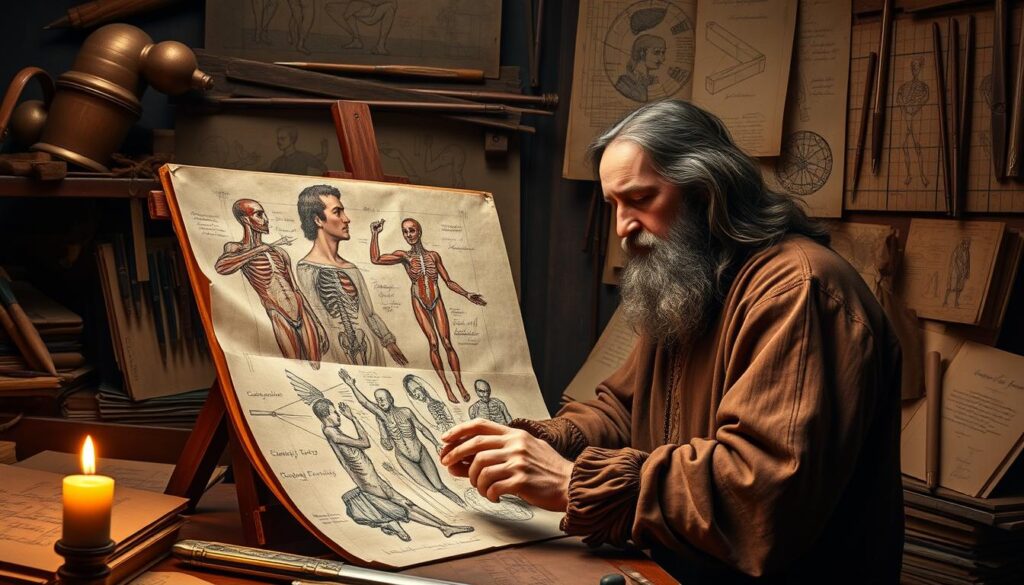
Leonardo’s blend of art and science opened doors for studying many subjects together. His detailed drawings of the body are used in medical books today9. This shows how his scientific work is as valuable as his art.
Recognition in Popular Culture
Leonardo da Vinci’s fame is seen in many forms, like documentaries, books, films, and online content. Bill Gates’ work on the Codex Leicester shows how Leonardo’s ideas are timeless9.
FAQ
Who was Leonardo da Vinci and why is he considered a Renaissance artist?
Leonardo da Vinci was an Italian genius from the Renaissance. He was known for his art, inventions, and science. As a Renaissance artist, he mixed art and science in his work. His famous pieces, like the Mona Lisa and The Last Supper, inspire many today.
What are some of Leonardo da Vinci’s most famous paintings?
Da Vinci’s famous works include the Mona Lisa and The Last Supper. The Mona Lisa is famous for its mysterious smile and sfumato technique. The Last Supper is known for its emotional depth and the moment Jesus reveals a disciple’s betrayal.
In what ways did Leonardo da Vinci contribute to science and engineering?
Da Vinci was a pioneer in science and engineering, aside from his art. He studied anatomy, geology, and optics. His inventions, like flying machines and armored vehicles, show his creativity and vision.
How did Leonardo da Vinci’s background and education influence his work?
Da Vinci’s unique upbringing and education in Verrocchio’s workshop gave him diverse skills. He was influenced by mentors and the intellectual climate of Renaissance Italy. This fueled his curiosity and ability to excel in many areas.
What is Leonardo da Vinci’s legacy in modern art and science?
Da Vinci’s impact on art and science is huge. His techniques and approach have inspired many. His work in science and inventions continues to motivate today’s researchers and innovators. He is a symbol of human creativity and ingenuity.
Why is Leonardo da Vinci often referred to as a polymath?
Da Vinci is called a polymath because of his wide range of skills. He excelled in painting, sculpture, engineering, and anatomy. His ability to combine knowledge from different fields shows the Renaissance ideal of a well-rounded intellectual.
How has Leonardo da Vinci been represented in popular culture?
Da Vinci has been featured in many forms of popular culture. His life and work continue to fascinate people around the world. His art, inventions, and legacy as a symbol of creativity are often highlighted.
Source Links
- https://www.pbs.org/video/leonardo-da-vinci-part-one-the-disciple-of-experience/ – Leonardo da Vinci | Part One: The Disciple of Experience | Episode 1
- https://www.nationalgallery.org.uk/artists/leonardo-da-vinci – Leonardo da Vinci (1452 – 1519)
- https://www.britannica.com/biography/Leonardo-da-Vinci – Leonardo da Vinci | Biography, Art, Paintings, Mona Lisa, Drawings, Inventions, Achievements, & Facts | Britannica
- https://www.mos.org/leonardo/biography.html – Biography
- https://www.britannica.com/list/10-famous-artworks-by-leonardo-da-vinci – 10 Famous Artworks by Leonardo da Vinci | Britannica
- https://en.wikipedia.org/wiki/Leonardo_da_Vinci – Leonardo da Vinci
- https://nlpwithpurpose.medium.com/da-vincis-legacy-bridging-the-worlds-of-art-and-science-4e28ed86d5bf – Da Vinci’s Legacy: Bridging the Worlds of Art and Science
- https://www.emp-art.com/emp-blog/leonardo-da-vinci-the-intersection-of-art-science-and-innovation – Leonardo da Vinci: The Intersection of Art, Science, and Innovation — EMP_Art
- https://medium.com/exploring-echoes/the-art-of-science-leonardo-da-vincis-hidden-legacy-f35274006678 – The Art of Science: Leonardo Da Vinci’s Hidden Legacy