
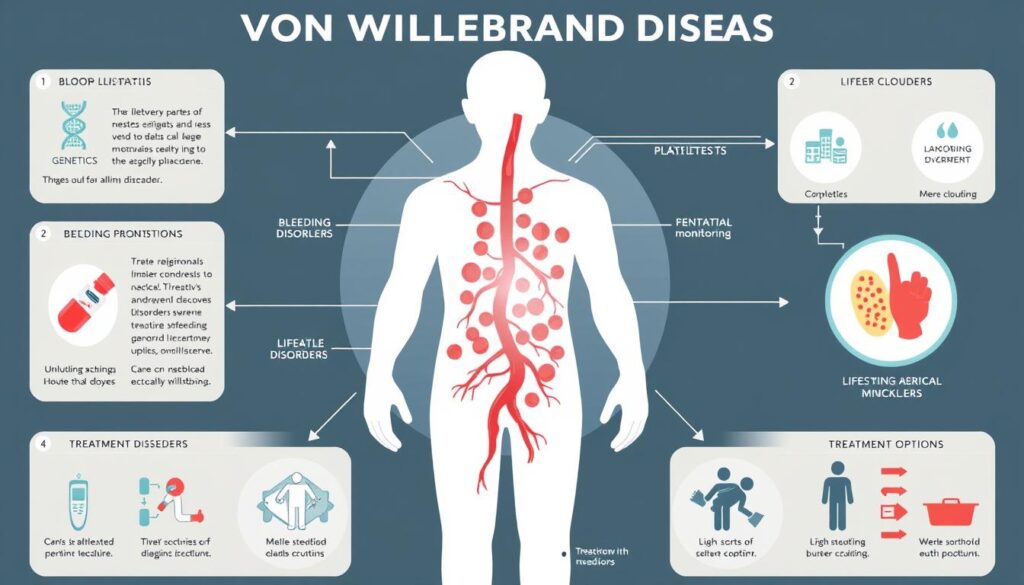
Von Willebrand Disease (VWD) is a complex bleeding disorder affecting many people worldwide. It’s the most common inherited clotting factor deficiency. VWD impacts how your blood clots and can create unique daily challenges1.
This condition occurs when your body lacks enough von Willebrand factor. Sometimes, the protein doesn’t work correctly. VWD can affect both men and women1.
It may cause complications during injuries, surgeries, and everyday activities. With proper knowledge and management, you can confidently navigate life with VWD.
People with VWD have longer blood clotting times. Even minor injuries can lead to extended bleeding. Women might face extra challenges during menstrual periods and childbirth1.
Your doctor can help you develop strategies to manage potential complications. Regular medical care is key to controlling symptoms and maintaining quality of life.
Key Takeaways
- VWD is the most common inherited bleeding disorder
- The condition affects blood clotting and can impact daily activities
- Both men and women can be diagnosed with VWD
- Proper medical management is crucial for quality of life
- Regular consultation with healthcare professionals can help control symptoms
Understanding Von Willebrand Disease
Von Willebrand Disease (VWD) is a genetic mutation affecting blood clotting. It’s the most common inherited bleeding disorder in the U.S. About 1% of Americans have VWD.
Knowing about this condition can help you manage your health better. VWD can cause prolonged bleeding and easy bruising.
What Causes VWD
VWD usually comes from a mutation in the von Willebrand factor gene. It’s often inherited through dominant or recessive patterns.
- Dominant inheritance (most common in Type 1 and some Type 2)
- Recessive inheritance (typical for Type 3 and some subtypes)
VWD affects males and females equally2. You can inherit the gene from a parent without symptoms3.
Different Types of VWD
| VWD Type | Prevalence | Characteristics |
|---|---|---|
| Type 1 | 85% of cases | Low levels of von Willebrand factor |
| Type 2 | 10-15% of cases | Defective von Willebrand factor |
| Type 3 | 3% of cases | Extremely low or no von Willebrand factor |
Common Symptoms and Signs
VWD can show up as prolonged bleeding and easy bruising. Here are some common signs:
- Frequent nosebleeds
- Easy bruising
- Prolonged bleeding from cuts
- Heavy menstrual periods
- Mucosal bleeding
“Understanding your specific type of VWD is crucial for effective management and treatment.”
If you notice ongoing bleeding or bruising, talk to a doctor. They can help diagnose and create a care plan for you2.
Managing Daily Life with VWD
Living with Von Willebrand Disease (VWD) requires careful management and lifestyle adjustments. Type 1 VWD is the most common form. It affects about three-quarters of people with inherited VWD4.
Your treatment options depend on your specific VWD type. Severe VWD often needs specialized care and bleeding prevention strategies5.
Medical professionals suggest key lifestyle changes. These include avoiding certain medications and informing healthcare providers about your condition.
- Avoid over-the-counter medications like aspirin that can affect blood clotting
- Inform all healthcare providers about your condition
- Wear a medical ID bracelet for emergency situations
- Choose low-impact physical activities
Medication management is vital for controlling bleeding episodes. DDAVP (desmopressin) can help release more von Willebrand factor into the bloodstream. Its effects last 6 to 24 hours4.
Other treatment options are available too. These include VWF concentrates and antifibrinolytic agents.
| Treatment Type | Purpose |
|---|---|
| VWF Concentrates | Control and prevent bleeding |
| Antifibrinolytic Agents | Prevent clot breakdown |
“Proper management and understanding of your condition are key to living a full, active life with VWD.”
Doctors suggest genetic testing for severe cases. This is especially important for families with a history of type 3 disease5.
Work closely with your medical team. Follow their recommended treatment options. This way, you can manage VWD effectively and enjoy a high-quality life.
Special Considerations for Women and Pregnancy
Pregnancy with von Willebrand Disease (VWD) needs careful planning and expert medical care. Knowing the unique challenges helps manage health and ensures a successful pregnancy.
Managing Menstrual Bleeding
Women with VWD often have heavy menstrual bleeding. This can greatly affect daily life6.
Key signs to watch for include:
- Bleeding lasting longer than 7 days
- Changing tampons or pads every 1-2 hours
- Passing blood clots larger than a quarter
Oral contraceptives may help control periods and reduce blood flow6. Your doctor can suggest ways to manage heavy menstrual bleeding.
Pregnancy Planning and Care
If you’re planning pregnancy, talk to a hematologist and high-risk pregnancy expert7. Some women with VWD may bleed less during pregnancy due to higher hormone levels6.
Postpartum Considerations
Women with VWD are more likely to have postpartum bleeding6. Uterine atony causes about 75% of postpartum hemorrhage cases7.
Breastfeeding can help control bleeding by keeping von Willebrand factor levels up6.
With proper medical guidance and proactive management, most women with VWD can have successful pregnancies.
Know your VWD type and work closely with doctors. This helps you manage prenatal care and reduce delivery complications.
Visit this high-risk pregnancy resource for more information.
Conclusion
Living with von Willebrand disease (VWD) requires understanding and proactive management. Modern medical approaches offer strategies to maintain your quality of life8. About 1 in 100 people have VWD, so you’re not alone8.
Your VWD journey involves building strong support and working with healthcare pros. A tailored treatment plan can help manage symptoms and reduce bleeding risks. Regular check-ups and staying informed about new treatments are vital9.
Lifestyle changes and medical advances can improve your daily life. Explore medical interventions for VWD and support networks for guidance. With proper care, people with VWD can lead active, fulfilling lives8.
Stay proactive, educated, and connected with your doctors. Your commitment to managing VWD will empower you. You can maintain excellent health and embrace life’s opportunities without limits.
FAQ
What is Von Willebrand Disease (VWD)?
Von Willebrand Disease is the most common inherited bleeding disorder. It’s caused by issues with the von Willebrand factor (VWF), a blood protein. VWD can lead to prolonged bleeding and difficulty forming blood clots.
How common is Von Willebrand Disease?
VWD affects up to 1 in 100 people. Many have mild symptoms and might not know they have it. The condition impacts males and females equally across all racial backgrounds.
What are the different types of VWD?
There are three main types of Von Willebrand Disease:
– Type 1: Most common (80% of cases), with lower VWF levels
– Type 2: VWF is present but doesn’t work correctly
– Type 3: Rarest and most severe, with little or no VWF
What are the typical symptoms of VWD?
Common symptoms include:
– Frequent or hard-to-stop nosebleeds – Easy bruising – Heavy or prolonged menstrual periods
– Prolonged bleeding from minor cuts
– Bleeding from gums
– Extended bleeding after injury, surgery, or dental work
How is VWD inherited?
VWD is usually inherited through dominant and recessive patterns. The altered gene can pass from parent to child, even without symptoms. It’s on an ordinary chromosome, affecting males and females equally.
Can women with VWD have children?
Yes, women with VWD can have successful pregnancies. It’s crucial to consult specialists before conceiving. Proper planning, medical monitoring, and preventive measures can help manage potential complications.
Is there a cure for Von Willebrand Disease?
There’s no permanent cure, but VWD can be effectively managed. Modern treatments like VONVENDI help control bleeding episodes and prevent excessive bleeding during surgery.
What precautions should people with VWD take?
Key precautions include:
– Avoiding blood-thinning medications without consulting your doctor
– Informing healthcare providers about your condition
– Wearing a medical ID bracelet
– Choosing safe physical activities
– Maintaining a healthy weight
– Regular check-ups with healthcare specialists
How is VWD diagnosed?
Diagnosis involves comprehensive blood tests to measure von Willebrand factor levels and function. Doctors review medical history, conduct physical exams, and may perform genetic testing. These steps help determine the specific type of VWD.
Source Links
- VONVENDI® [von Willebrand factor (Recombinant)] Living with VWD – https://www.vonvendi.com/living-with-vwd
- Von Willebrand disease-Von Willebrand disease – Symptoms & causes – Mayo Clinic – https://www.mayoclinic.org/diseases-conditions/von-willebrand-disease/symptoms-causes/syc-20354978
- Von Willebrand Disease: Current Status of Diagnosis and Management – https://pmc.ncbi.nlm.nih.gov/articles/PMC8919990/
- Patient education: von Willebrand disease (Beyond the Basics) – https://www.uptodate.com/contents/von-willebrand-disease-beyond-the-basics/print
- How I manage severe von Willebrand disease – https://pmc.ncbi.nlm.nih.gov/articles/PMC6899759/
- Von Willebrand Disease (VWD) in Women – https://www.bleedingdisorders.com/von-willebrand-disease/women
- PREGNANCY AND DELIVERY IN WOMEN WITH VON WILLEBRAND DISEASE – https://pmc.ncbi.nlm.nih.gov/articles/PMC7604852/
- von Willebrand disease: proposing definitions for future research – https://pmc.ncbi.nlm.nih.gov/articles/PMC7839375/
- Von Willebrand Disease in Women – https://www.acog.org/clinical/clinical-guidance/committee-opinion/articles/2013/12/von-willebrand-disease-in-women

