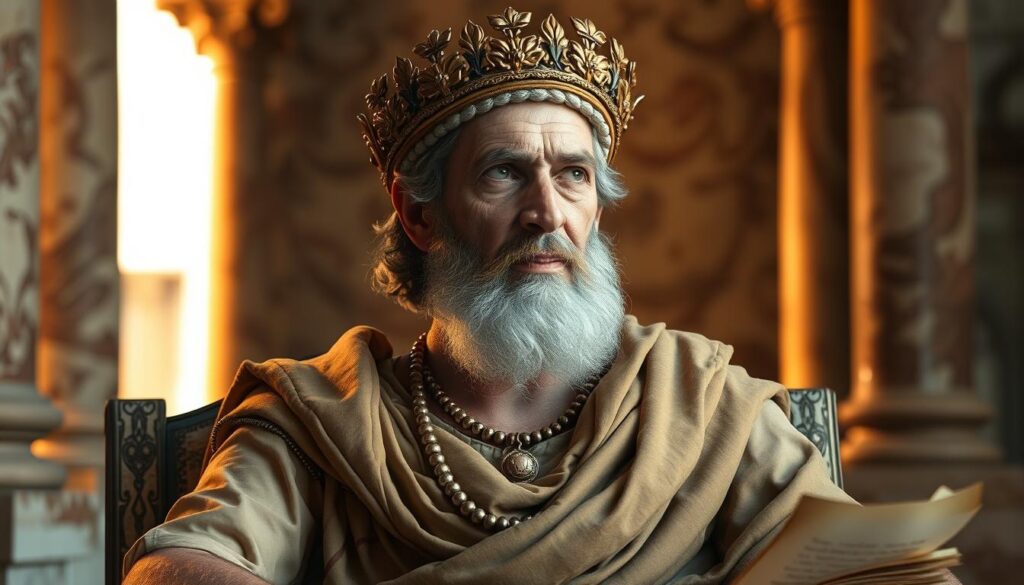
Marcus Aurelius was a Roman emperor known for his deep thoughts on Stoicism1. He was born on April 26, 121 CE in Rome, Italy2. He became a key figure in Roman history, ruling from 161 to 1801.
His time as emperor was tough, with wars and plagues. These challenges shaped his views on life and power2.
He studied rhetoric and philosophy, focusing on Stoicism. This education helped him see the world differently. It allowed him to think deeply about life and morality1.
Marcus Aurelius’s life is a great example of Stoicism, leadership, and personal growth1. His writings show us the value of living a simple, meaningful life2.
Key Takeaways
- Marcus Aurelius was a Roman emperor who ruled from 161 to 1801.
- He was born on April 26, 121 CE in Rome, Italy2.
- Marcus Aurelius’s education in rhetoric and philosophy, specially Stoicism, greatly influenced his life and reign1.
- His writings, including “Meditations,” continue to inspire and educate people on Stoic principles and personal growth2.
- Marcus Aurelius’s legacy extends beyond his reign, teaching us about leadership, ethics, and the human experience1.
The Meditations: A Guide to Personal Growth
“Meditations,” Marcus Aurelius’s most renowned work, is a personal diary. It reflects his journey living a Stoic life. This philosopher‘s efforts to apply Stoicism offer timeless insights into personal development and resilience3.
Overview of Marcus Aurelius’ Life
Marcus Aurelius was the Roman emperor from 161 to 180 A.D. During this time, he wrote twelve books of private journals between 170 and 180 A.D. These writings show his dedication to Stoic principles, even in the face of leadership challenges3.
Contributions to Stoicism
“Meditations” is a key piece of Stoic literature. It focuses on life’s impermanence, virtue, and the connection of all things. Marcus Aurelius’s thoughts promote self-improvement and moral integrity, core Stoic values34.
Key Works and Writings
“Meditations” was written in Greek and is divided into twelve books. Each book has about fifteen pages. Unlike many Stoic texts, Marcus Aurelius doesn’t cite Seneca but references Homer and Plato. This shows his wide-ranging intellectual interests4.
| Major Themes | Description |
|---|---|
| Change | Emphasizes the constant flux of life and the importance of adaptability. |
| Death | Encourages acceptance of mortality as a natural part of existence. |
| Rational Mind | Advocates for reason and logic as guides for action and thought. |
| Interconnectedness | Highlights the unity of all things and the importance of community. |
Leadership and Governance Styles
Marcus Aurelius was the perfect Roman emperor. He mixed Stoic philosophy with his leadership. His 19-year rule was filled with strength and dedication5.
The Role of Stoicism in His Leadership
Stoicism helped Marcus Aurelius focus on reason and the common good. His journal, “Meditations,” shows his leadership was about self-control and understanding emotions56.
Challenges Faced During His Reign
Marcus faced many challenges as Roman emperor. He battled wars, rebellions, and the deadly Antonine Plague. These tests showed his ability to keep ancient Rome stable while staying true to Stoic values5.
Legacy in Roman History
Marcus Aurelius is known as one of the “Five Good Emperors.” He made the Senate stronger and set a high standard for leaders76.
| Aspect | Description | Source |
|---|---|---|
| Reign Duration | 161-180 AD, 19 years | 5 |
| Philosophical Influence | Stoicism stressing resilience and duty | 56 |
| Challenges | Wars, rebellions, Antonine Plague | 5 |
| Senate Empowerment | More authority and duties for the Senate | 7 |
| Legacy | One of the Five Good Emperors, respected in Roman history | 76 |
Justice: Acting for the Sake of the Cosmopolis
Marcus Aurelius, a famous philosopher and emperor, saw justice as key to a peaceful society. He believed in a cosmopolis, where all humans are part of a global community. This community is united by respect and a shared moral duty.
Themes of Virtue and Self-Discipline
Marcus Aurelius taught the importance of virtue and self-control. He thought that being true to oneself and acting ethically was vital for the good of all8.
- Justice
- Piety
- Temperance
- Wisdom
Reflective Practices in Daily Life
Marcus Aurelius used daily reflection to keep Stoic values alive. In his Meditations, he wrote about the need to live justly and control oneself9.
Impact on Modern Philosophy
Marcus Aurelius’s ideas live on in today’s philosophy. His thoughts on justice and global citizenship spark debates on ethics and responsibility worldwide.
“The happiness of your life depends upon the quality of your thoughts.”
| Aspect | Impact |
|---|---|
| Global Ethics | Focus on universal citizenship and moral duty |
| Moral Responsibility | Urges actions for the benefit of all |
| Philosophical Thought | Stoic virtues are woven into modern ethics |
Marcus Aurelius’s commitment to Stoicism makes him a key figure in philosophy. His wisdom shows how ancient ideas can tackle today’s problems.
Relevance Today: Lessons from Marcus Aurelius
Marcus Aurelius’s teachings are very relevant today. They help us deal with stress and tough choices through Stoicism.
Applying Stoic Principles in Modern Life
Stoicism teaches us to be strong and in control, which is key in today’s fast world. Marcus Aurelius showed us to focus on what we can control. This helps us face challenges better10.
Inspirational Quotes and Their Meaning
Marcus Aurelius’s book, Meditations, is full of inspiring quotes. One quote says, “You have power over your mind — not outside events. Realize this, and you will find strength,”10. It shows the power of inner strength. These words motivate people to find peace and clarity within themselves.
Continual Influence in Philosophy and Psychology
Marcus Aurelius’s ideas are also seen in modern psychology and leadership studies. His views on being virtuous and disciplined are key in therapy and personal growth1110. His philosophy also encourages empathy and kindness, helping build better communities.
FAQ
Who was Marcus Aurelius?
Marcus Aurelius was a Roman emperor known for his leadership and philosophy. He was a strong believer in Stoicism. This made him see life, power, and ethics in a unique way.
What is the significance of “Meditations” by Marcus Aurelius?
“Meditations” is a personal journal by Marcus Aurelius. It shows how he applied Stoic principles to everyday life. It talks about life’s fleeting nature, the value of virtue, and how we’re all connected.
How did Stoicism influence Marcus Aurelius’s leadership?
Stoicism guided Marcus Aurelius in ruling the empire. It taught him to be rational, do his duty, and think of the greater good. He used these principles to make decisions that helped the empire and its people.
What challenges did Marcus Aurelius face during his reign?
Marcus Aurelius faced many challenges, like wars and the Antonine Plague. These experiences deepened his commitment to Stoic values. They showed him the importance of resilience in leadership.
How has Marcus Aurelius impacted modern philosophy?
Marcus Aurelius’s work, like “Meditations,” has greatly influenced modern philosophy. His thoughts on justice, virtue, and global citizenship are relevant today. They show the lasting impact of Stoic ideas.
How can Stoic principles of Marcus Aurelius be applied today?
Marcus Aurelius’s Stoic principles are useful today. They teach self-control, rational thinking, and focusing on what you can control. These ideas help with stress, making ethical choices, and personal growth in our busy world.
What is the concept of cosmopolis in Marcus Aurelius’s philosophy?
Marcus Aurelius believed in the cosmopolis, a universal city where all are citizens. This idea highlights his views on justice and our duty to act for the good of all. It shows how he saw humanity as connected.
How did Marcus Aurelius’s role as emperor shape his philosophical views?
Being a Roman emperor taught Marcus Aurelius about leadership and governance. These experiences shaped his philosophy. They made him more committed to Stoic virtues and applying philosophy to leadership.
What are some key themes in “Meditations” by Marcus Aurelius?
“Meditations” covers themes like life’s impermanence, the importance of virtue, and our connection to all things. Through his reflections, Marcus Aurelius shows how Stoicism can guide us towards self-improvement and moral integrity.
How is Marcus Aurelius viewed in Roman history?
Marcus Aurelius is remembered as one of the “Five Good Emperors” of Rome. His reign was marked by stability and effective governance. His philosophical leadership and commitment to Stoicism have made him a revered figure in Roman history.
Source Links
- https://en.wikipedia.org/wiki/Marcus_Aurelius – Marcus Aurelius
- https://www.britannica.com/biography/Marcus-Aurelius-Roman-emperor – Marcus Aurelius | Biography, Meditations, & Facts | Britannica
- https://dailystoic.com/meditations-marcus-aurelius/ – Meditations by Marcus Aurelius: Book Summary, Key Lessons and Best Quotes
- https://www.goodreads.com/book/show/30659.Meditations – Meditations
- https://www.ejshin.org/leadership-marcus-aurelius-the-stoic-leader-in-turbulent-times/ – Leadership | Marcus Aurelius – The Stoic Leader in Turbulent Times
- https://dailystoic.com/12-lessons-on-leadership-from-the-last-great-emperor/ – 12 Lessons On Leadership From The Last Great Emperor
- https://donaldrobertson.name/2017/08/03/marcus-aurelius-politics-and-freedom/ – Marcus Aurelius, Politics, and Freedom
- https://plato.stanford.edu/entries/marcus-aurelius/ – Marcus Aurelius
- https://plato.stanford.edu/archivES/FALL2017/entries/marcus-aurelius/ – Marcus Aurelius
- https://medium.com/@stoicminds.channel/from-marcus-aurelius-to-modern-life-how-stoicism-is-still-relevant-today-e83ddf8ddc4d – From Marcus Aurelius to Modern Life: How Stoicism is Still Relevant Today
- https://retrospectjournal.com/2024/03/03/the-relevance-and-modernity-of-debts-and-lessons-from-marcus-aurelius-meditations/ – The Modern Relevance of ‘Debts and Lessons’ from Marcus Aurelius’ Meditations