
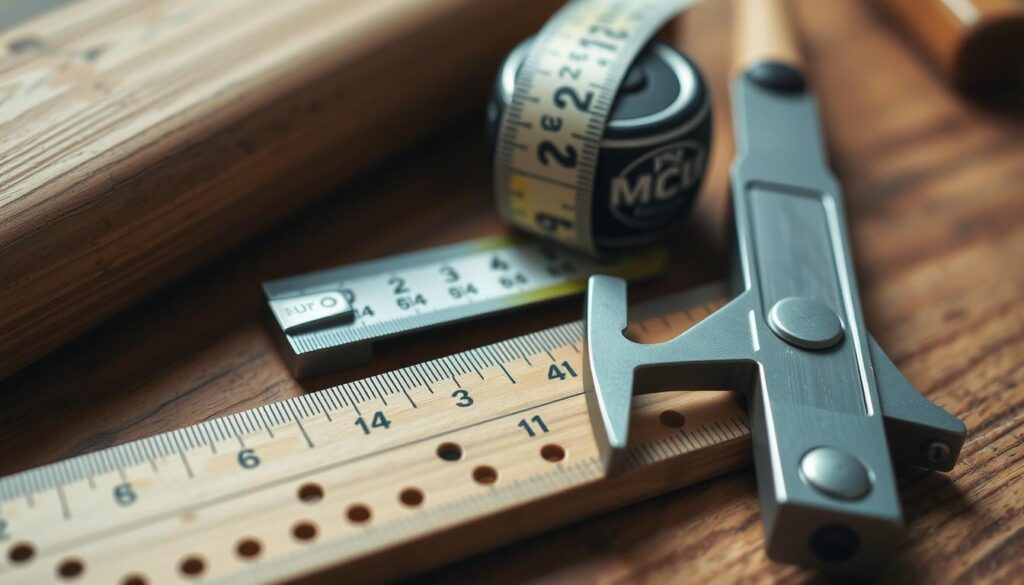
Measuring in inches is key for many projects. It helps you work with precision and confidence. This skill is useful for home improvements, crafting, and design work.
Linear inch measurements are vital in construction and carpentry. They’re also crucial for interior design. Accurate measurements ensure successful project outcomes for pros and DIY fans alike.
To master inch measurement, you’ll need some basic tools. A standard tape measure is your main tool for accurate linear measurements.
Most tape measures have 16 marks per inch. This allows you to measure up to 1/16 of an inch with great precision1.
Improving your measurement skills takes practice and focus. Experts stress the need for repeated measurements. They also recommend keeping detailed records to ensure accuracy2.
Key Takeaways
- Linear inches are fundamental for multiple industries
- Precision matters in measurement techniques
- Tape measures offer versatile measuring capabilities
- Understanding measurement tools is crucial
- Practice improves measurement accuracy
Understanding the Basics of Inches
Accurate measurements are vital in many areas of life. Inches play a key role in measurements. Knowing inches helps you use an Inches Calculator or perform Inches Conversion with ease.
What is an Inch?
An inch is a key length unit in the United States. An inch ruler has 12 equal spaces. Each inch is split into 16 precise lines3.
This allows for very detailed measurements. You can measure both large and tiny increments with accuracy.
Historical Context of the Inch
The inch has a long history. On July 1, 1959, a big change happened. The inch was redefined in relation to metric units4.
This set 1 inch equal to 2.54 centimeters. Before this, different places had their own inch definitions.
- The Roman inch measured 0.971 standard inches
- The French inch (pouce) measured 1.066 standard inches
- The U.S. inch became the global standard measurement
The Metric System vs. Inches
Many countries use the metric system. Yet, inches are still crucial in the United States. Industries like construction and engineering rely on inch measurements4.
Knowing how to convert inches to centimeters is key. It helps with global talks and precise work.
“Measurement is the first step that leads to control and eventually to improvement.” – H. James Harrington
Inches are used in many tools, from digital calculators to rulers. Knowing inch measurements helps you work more accurately and efficiently.
Tools You Need for Accurate Measurements
Precision in projects starts with the right measuring tools. Accurate tools are vital for home improvements and detailed designs. Choosing versatile and precise instruments is key.
The Right Measuring Tape
A high-quality tape measure is essential. The Festool tape measure offers an innovative inside measurement scale5. It provides exceptional convenience for various tasks.
When picking a tape measure, look for durable markings and smooth retraction. Consider length capacity and measurement capabilities. These features ensure reliable performance in different situations.
Digital vs. Manual Measuring Tools
Modern measurement techniques offer various options. Laser tools provide quick, precise results up to 30 meters6. For intricate work, calipers excel at thickness measurements5.
| Tool Type | Precision Level | Best Use |
|---|---|---|
| Tape Measure | Medium | General measurements |
| Laser Measure | High | Long-distance measurements |
| Calipers | Very High | Precise thickness |
Tips for Consistent Measurements
To convert inches to mm or use conversion charts effectively, follow these tips:
- Always check tool functionality before use6
- Keep measuring tools clean
- Ensure adequate lighting
- Measure twice for accuracy
Mastering measurement tools improves project outcomes6. Practice and attention to detail will boost your skills. You’ll excel at converting inches to mm and achieving precise measurements.
Practical Applications of Measuring in Inches
Precise measurements are key for home and workspace projects. Mastering inch measurements can elevate your DIY skills and creative projects. This knowledge helps you achieve professional results in home improvements and unique designs7.
Converting inches to feet is crucial for home projects. A standard ruler is 12 inches long, perfect for small measurements7. Tape measures, ranging from a few to over 100 feet, help with larger projects7.
Inch measurements are vital for sewing and crafting. They ensure perfect fits in fabric cutting and pattern design. A yardstick (3 feet long) is great for checking dimensions7.
Always double-check your measurements. This practice saves materials and prevents frustrating mistakes. Accuracy is key in crafting and DIY projects.
Furniture layout requires exact measurements. Converting inches to feet helps visualize space needs. It ensures furniture fits perfectly in your room. Remember, one foot equals 12 inches7.
This knowledge aids in quick calculations for interior design. It allows for seamless planning of your living spaces. Proper measurements lead to harmonious and functional room layouts.
FAQ
How do I read fractions on an inch ruler?
An inch ruler has 16 lines for fractions from 1/16 to 1. Start by learning the smallest mark (1/16 inch). Then, practice spotting larger fractions like 1/8, 1/4, and 1/2.
With time, you’ll get better at reading these small increments quickly. Regular practice will help you become more accurate.
What tools do I need for measuring in inches?
You’ll need a few key tools for measuring in inches. A retractable tape measure offers versatility. A ruler or yardstick works well for shorter measurements.
A straight edge or level ensures accuracy. Don’t forget a pencil and paper to record your measurements.
How can I ensure accurate measurements?
Always measure twice to confirm your reading. Place the tool’s starting point exactly at the length’s beginning. Extend it carefully to the endpoint.
Read the marking that aligns with the endpoint. Write down measurements right away to avoid confusion. Double-check your work for best results.
Why are inch measurements important in different projects?
Precise inch measurements are vital in home improvement, sewing, crafting, and furniture design. They ensure proper fit of materials, fixtures, and design elements.
Accurate measurements help you achieve professional results. This applies whether you’re making custom furniture or fitting a new window frame.
What is the relationship between inches and feet?
One inch equals 1/12 of a foot. This means 12 inches make up a single foot. Knowing this conversion helps you switch between these common units easily.
This skill is especially useful in construction, carpentry, and interior design projects. It allows for quick and accurate conversions.
How do inches compare to metric measurements?
One inch is equal to 2.54 centimeters. The U.S. mainly uses inches, while most other countries use the metric system.
This conversion is helpful when working with international specs. It’s also useful for converting measurements in various projects.
What are some tips for measuring with a tape measure?
Extend your tape measure fully and lock it in place. Hold it straight and taut, avoiding curves or bends.
Start from the zero mark, aligning it with your measurement’s starting point. For long measurements, ask someone to help keep the tape straight.
Source Links
- How to Read a Tape Measure – https://www.homedepot.com/c/ab/how-to-read-a-tape-measure/9ba683603be9fa5395fab90e6f14546
- How to Measure Linear Inches | Architectural Glass – https://architecturalglass.com/how-to-measure-linear-inches-a-comprehensive-guide/
- How to Read a Ruler in Inches and Centimeters · PrepScholar – https://blog.prepscholar.com/how-to-read-a-ruler-inches-cm
- Inch – Unit of Measurement Definition – https://www.inchcalculator.com/inch-background-and-definition/
- Tools for taking inside measurements – https://discuss.toolguyd.com/t/tools-for-taking-inside-measurements/188
- Measuring tools: A guide to accurate measurements and how to measure correctly – https://globalfinanceschool.com/measuring-tools-how-to-measure-correctly/
- Measurement of Length in Customary Units – https://www.98thpercentile.com/blog/measurement-of-length-customary-units/

