
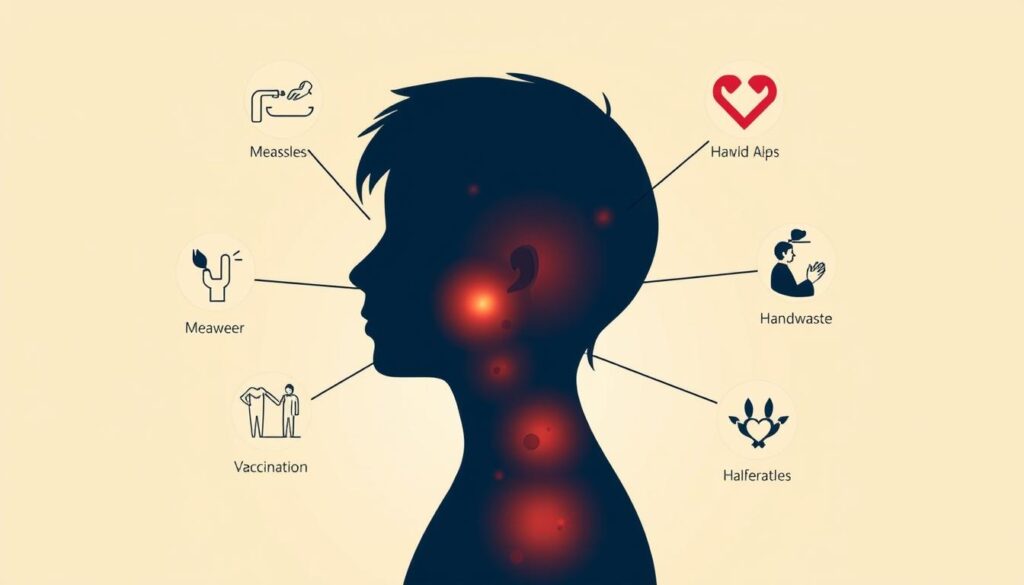
Measles is a severe viral infection that can greatly affect your health. This highly contagious disease spreads fast and poses big risks, especially for kids and vulnerable groups1.
It’s vital to know the symptoms, prevention methods, and treatments. This knowledge helps protect you and your loved ones from this dangerous illness2.
The measles virus attacks your breathing system. Symptoms usually show up 8 to 12 days after exposure1. Unvaccinated people are at highest risk.
In fact, 9 out of 10 unvaccinated people may get measles when exposed3. Spotting these signs early helps you act fast and get proper medical care.
Vaccination is the best way to prevent measles. The MMR vaccine is highly effective. It offers 97% protection when given in two doses2.
Stay informed and take action. You can greatly lower your chances of getting this serious viral infection3.
Key Takeaways
- Measles is a highly contagious viral infection
- Symptoms typically appear 8-12 days after exposure
- The MMR vaccine provides up to 97% protection
- Unvaccinated individuals are most at risk
- Early recognition and medical intervention are critical
Understanding Measles: Causes and Transmission
Measles is a serious viral infection that challenges global health systems. It’s an extremely contagious pathogen that spreads rapidly through populations. Low vaccination rates increase the risk of outbreaks.
The measles virus belongs to the morbillivirus family and attacks the respiratory system. Up to 90% of unimmunized people exposed to an infected individual can contract the disease4. This high transmission rate makes understanding its spread crucial.
What Causes the Measles Virus
Measles spreads through microscopic respiratory droplets that remain infectious in the air for about two hours5. An infected person can spread the virus by coughing, sneezing, or talking.
How Measles Spreads
- Airborne respiratory droplets
- Direct contact with infected bodily fluids
- Shared breathing spaces
- Touching contaminated surfaces
Risk Factors and Susceptibility
Some groups face higher risks of contracting measles and experiencing severe complications. These include unvaccinated children, people with weakened immune systems, and pregnant women.
| Risk Group | Potential Complications |
|---|---|
| Unvaccinated Children | High risk of hospitalization4 |
| Individuals with Weakened Immune Systems | Increased vulnerability to severe outcomes |
| Pregnant Women | Potential pregnancy-related complications |
Vaccination remains the most effective strategy for preventing measles transmission. The measles vaccine provides lasting protection against the virus. It’s 95% effective after one dose and 99% after two doses5.
Protecting yourself and others through vaccination is a critical public health responsibility.
Key Symptoms and Stages of Measles
Measles is a highly contagious viral infection with distinct stages. It develops over time, showing characteristic symptoms6. The disease typically appears 11-12 days after exposure, bringing a series of health challenges6.
The initial phase of measles starts with classic symptoms. You might feel quite unwell during this time. Common signs include:
- High fever (potentially reaching over 104°F)7
- Persistent dry cough
- Runny nose
- Red, watery eyes (conjunctivitis)7
A key early sign of measles is Koplik’s spots. These tiny white spots appear inside the mouth. They have bluish-white centers and warn of advancing infection.
The measles rash is the most visible symptom. It usually shows up 3-5 days after initial signs. The rash starts on your face and behind the ears.
It then spreads to your chest, back, and feet. Complications can be serious. About 1 in 5 unvaccinated people might need hospital care7.
Children face particular risks. 1 in 20 might get pneumonia7. 1 in 1,000 could develop encephalitis7.
“Early recognition of measles symptoms is crucial for proper medical intervention and preventing potential complications.”
High-risk groups should be extra careful. These include children under 5 and adults over 20. Pregnant women and those with weak immune systems are also at risk6.
Prevention Strategies and Vaccination Guidelines
Measles prevention relies on widespread vaccination. Before the vaccine, over 400,000 cases were reported yearly in the U.S. Now, efforts have cut measles cases by 99%8.
The true number of cases may have exceeded 4 million per year. Today, collaborative efforts have significantly reduced the disease’s impact.
The MMR vaccine is crucial for measles prevention. Experts recommend a specific schedule for the best protection:
- First dose at 12-15 months of age
- Second dose at 4-6 years old
- Additional doses for international travelers
Vaccine Effectiveness and Recommendations
The measles vaccine is highly effective. It offers at least 95% protection for children vaccinated at 15 months or older8.
A two-dose vaccination schedule is now standard. This approach helps create strong immunity against the virus8.
Special Vaccination Considerations
Different groups need specific vaccination approaches. Healthcare workers, students, and travelers have unique guidelines for full protection.
Adults born after 1957 without immunity proof should get at least one MMR vaccine dose9.
Your vaccination is not just about personal protection—it’s about safeguarding your entire community.
High-Risk Group Recommendations
Some populations need extra care in measles prevention. Immunocompromised individuals, infants, and those with limited healthcare access require special protocols.
These groups need tailored vaccination strategies to reduce infection risks. Their protection is crucial for community health.
Conclusion
Measles awareness remains crucial in protecting vulnerable populations worldwide. Vaccination is the most effective strategy against measles. From 2000 to 2023, immunization prevented over 60 million deaths10.
Sadly, in 2023, about 107,500 people died from measles globally. Most were unvaccinated children under 5 years old10. In 2023, only 83% of children got their first measles vaccine dose.
This is lower than the 86% in 201910. The United States reported 121 measles cases in 202211. Your choice to vaccinate can prevent disease spread and protect community health.
We need a team effort to eliminate measles. Stay informed and support high vaccination rates. You can help achieve the global goal of measles elimination. The Centers for Disease Control and Prevention stresses the importance of comprehensive immunization strategies1011.
Your commitment to measles awareness and vaccination can save lives. It protects the most vulnerable in our global community. Each immunized person brings us closer to a measles-free world.
FAQ
What is measles and how serious is it?
Measles is a highly contagious viral infection. It can cause serious complications like pneumonia and ear infections. The virus spreads through respiratory droplets and can be dangerous for infants and people with weak immune systems.
How does measles spread?
Measles spreads through airborne droplets when an infected person coughs or sneezes. These droplets can remain infectious in the air for up to two hours. You can catch measles by being in the same room as an infected person.
What are the typical symptoms of measles?
Measles symptoms usually appear 8-12 days after exposure. They include high fever, dry cough, runny nose, and sore throat.
Other symptoms are inflamed eyes and a distinctive red rash. The rash starts on the face and spreads downward. Tiny white spots called Koplik’s spots may appear inside the mouth.
How can I prevent measles?
The best prevention is vaccination. The MMR vaccine is 97% effective and given in two doses. The first dose is at 12-15 months and the second at 4-6 years.
Adults born after 1957 without immunity should get at least one dose. Special guidelines may apply for travelers.
Who is most at risk for severe measles complications?
High-risk groups include unvaccinated children and infants under 12 months. Pregnant women and people with weak immune systems are also at risk. Those with vitamin A deficiency and travelers to high-risk areas face greater danger.
How long is measles contagious?
Measles is contagious from about four days before the rash appears. It remains contagious until four days after the rash develops. You can spread the virus before you know you’re sick.
What complications can result from measles?
Measles can lead to pneumonia, ear infections, and diarrhea. More serious complications include encephalitis (brain inflammation) and seizures. In rare cases, it can cause permanent brain damage or death.
Is the measles vaccine safe?
Yes, the measles vaccine is safe and cost-effective. It’s been thoroughly tested and has prevented over 60 million deaths globally since 2000. Side effects are typically mild and far less dangerous than measles complications.
Source Links
- Measles: Not a Measly Virus – https://my.clevelandclinic.org/health/diseases/8584-measles
- A preventable disease that’s on the rise-Measles – Symptoms & causes – Mayo Clinic – https://www.mayoclinic.org/diseases-conditions/measles/symptoms-causes/syc-20374857
- Measles (Rubeola) (for Parents) – https://kidshealth.org/en/parents/measles.html
- Measles – NFID – https://www.nfid.org/infectious-disease/measles/
- Measles: What You Should Know – https://www.hopkinsmedicine.org/health/conditions-and-diseases/measles-what-you-should-know
- Measles Clinical Diagnosis Fact Sheet – https://www.cdc.gov/measles/hcp/communication-resources/clinical-diagnosis-fact-sheet.html
- Measles Symptoms and Complications – https://www.cdc.gov/measles/signs-symptoms/index.html
- Recommendations of the Immunization Practices Advisory Committee (ACIP) – https://www.cdc.gov/mmwr/preview/mmwrhtml/00041753.htm
- GUIDELINES FOR THE PREVENTION AND CONTROL OF MEASLES OUTBREAKS IN CANADA: An Advisory Committee Statement (ACS): Measles and Rubella Elimination Working Group (MREWG) – https://pmc.ncbi.nlm.nih.gov/articles/PMC6802448/
- Measles – https://www.who.int/news-room/fact-sheets/detail/measles
- Preventing and Managing Measles – https://www.uspharmacist.com/article/preventing-and-managing-measles

