
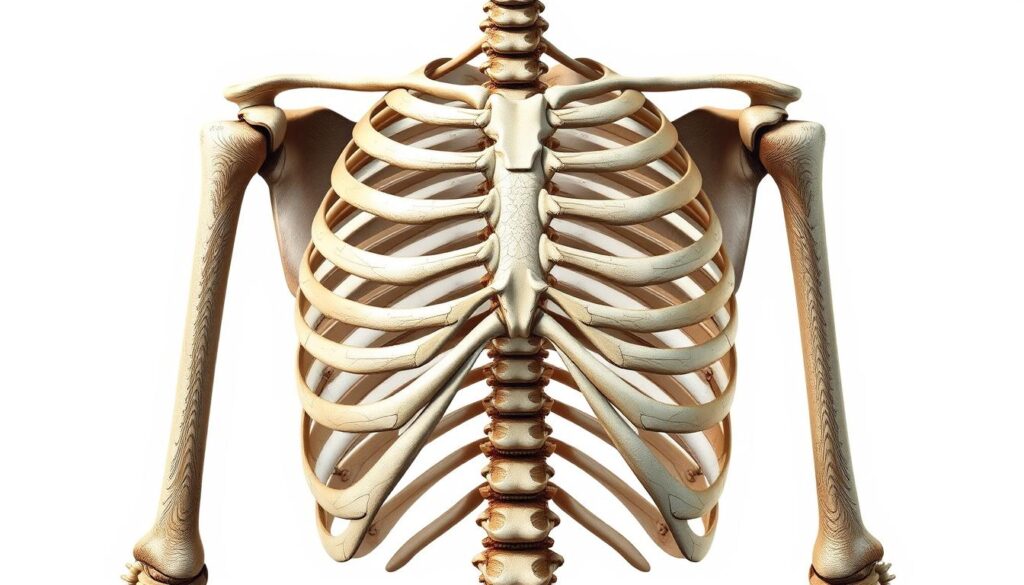
Your rib cage protects vital organs and supports your skeletal system. Male physiology offers intriguing details about rib count and unique characteristics1.
A comprehensive study analyzed ribs from live adult subjects. It provided unprecedented details about rib variations1. Demographic factors like age, height, weight, and sex influence rib shape and orientation1.
Your rib cage is more dynamic than you might think. Age explains up to 20% of population variability in rib characteristics1. Height and sex strongly correlate with rib size1.
For males, the average weight is 89.6 kg. Their average height is 177.9 cm1. These measurements showcase typical dimensions of the human male physique.
Key Takeaways
- Most humans have 24 ribs, 12 on each side
- Rib characteristics vary based on individual demographics
- Age significantly impacts rib shape and orientation
- Height and sex strongly influence rib size
- Individual variations in rib structure are normal
How Many Ribs Do Men Have?
Human bone structure holds fascinating secrets about our bodies. Ribs protect vital organs and support breathing. They’re a key part of our anatomy.
Most people are born with a standard rib setup. Both men and women typically have 12 pairs of ribs. That’s 24 ribs in total.
Understanding Rib Classifications
Ribs come in different types. They’re grouped based on how they connect to the sternum.
- True Ribs: The first seven pairs directly attach to the sternum
- False Ribs: Pairs 8-10 connect indirectly to the sternum
- Floating Ribs: The last two pairs (11-12) only connect to the spine
Rare Rib Variations
Some people have unique rib configurations due to genetic conditions. These variations can lead to interesting body trivia.
| Condition | Rib Variation |
|---|---|
| Cervical Ribs | Extra ribs between neck and collarbone2 |
| Down Syndrome | Potential extra or missing ribs2 |
| Spondylocostal Dysplasia | Abnormal rib and spine development2 |
While most people have a standard rib count, genetic variations can create unique anatomical differences.
Most rib variations don’t need treatment unless they cause health issues. In rare cases, doctors might use special surgeries for severe problems.
One example is using vertical expandable prosthetic titanium ribs. These help address serious complications in some patients.
The Essential Functions of the Human Rib Cage
Your rib cage is a marvel of human anatomy. It protects vital organs and supports breathing. Most people have 24 ribs, with 12 on each side.
This flexible skeletal system shields your most important internal structures3. It’s a crucial part of your body’s defense mechanism.
- Protecting critical organs like the heart and lungs
- Facilitating breathing mechanics
- Providing structural support for the upper body
The rib cage’s design allows for amazing flexibility. Cartilage enables expansion and contraction during breathing. This is key for proper lung function3.
Your skeletal system can adjust during various activities. It even adapts during pregnancy. This adaptability is truly remarkable.
| Rib Type | Attachment | Function |
|---|---|---|
| True Ribs (1-7) | Directly attached to sternum | Primary protection |
| False Ribs (8-10) | Indirectly connected via cartilage | Chest wall support |
| Floating Ribs (11-12) | No anterior attachment | Additional flexibility |
Your rib cage contains soft spaces between ribs. These spaces are filled with blood vessels, nerves, and muscles. They contribute to its complex functionality3.
The rib cage: Nature’s ingenious protective armor and breathing mechanism.
Rib cages are typically uniform. However, some people might have genetic variations. These can result in extra or fewer ribs4.
Understanding your rib cage’s structure is fascinating. It helps you appreciate its vital role in your body’s function and overall health.
Conclusion
Human anatomy reveals fascinating insights about rib count. Most people have 24 ribs in 12 pairs, regardless of gender. This fact debunks common myths about rib numbers5.
Rib characteristics can vary based on age, weight, and height. Male ribs typically have larger cross-sectional areas and higher bone density6. These differences highlight the need for personalized medical understanding.
Rare genetic conditions can cause rib count variations. However, most people have a consistent skeletal structure. The rib cage protects vital organs and supports breathing.
Exploring the skeletal system deepens our appreciation for human anatomy. Understanding your ribs offers valuable insights into your body’s structure. This knowledge can help you better care for your health.
FAQ
How many ribs do men have?
Most humans, including men, have 24 ribs. There are 12 ribs on each side of the body. Both males and females have the same number of ribs.
What are true ribs?
True ribs are the first seven sets of ribs. They connect directly to the breastbone by costal cartilage. These ribs provide crucial support to the chest cavity.
What are false and floating ribs?
False ribs (8-10) share a cartilage connection to the sternum through rib 7. Floating ribs (11 and 12) only connect to the thoracic vertebrae. They don’t attach to the sternum at all.
Can people have more or fewer than 24 ribs?
Yes, some people are born with extra ribs or fewer ribs. This occurs in about 0.5-1% of the population. Extra ribs are called supernumerary ribs, while fewer ribs are due to rib agenesis.
What are cervical ribs?
Cervical ribs are extra ribs on the 7th cervical vertebra. They’re more common in females. Sometimes, they can cause thoracic outlet syndrome by pressing on nerves and blood vessels.
What is the primary function of ribs?
Ribs protect vital organs in the chest. This includes the heart, lungs, and parts of the liver and spleen. They also maintain space for lung expansion during breathing.
Are some ribs more prone to fractures?
Yes, ribs 7-10 are more likely to fracture. This is due to their position. Rib fractures can happen from direct pressure, like car accidents or falls.
What is a serious rib-related medical condition?
Flail chest is a serious condition involving multiple rib fractures. It can cause breathing difficulties and potential lung damage. In severe cases, it may lead to pneumothorax with a 10-15% mortality rate.
Source Links
- The effect of age and demographics on rib shape – https://pmc.ncbi.nlm.nih.gov/articles/PMC5522896/
- Do Men and Women Have the Same Number of Ribs? – https://www.healthline.com/health/bone-health/how-many-ribs-do-men-have
- Why is the Rib Cage So Important? Simple Explanation for Kids – https://humanbodylearning.com/rib-cage-anatomy-function/
- Rib Cage: What To Know – https://www.webmd.com/a-to-z-guides/rib-cage-what-to-know
- How Many Ribs Do Humans Have – Are men missing a rib – https://payrchat.com/blogs/5945/how-many-ribs-do-humans-have-are-men-missing-a-rib
- Population trends in human rib cross‐sectional shapes – https://pmc.ncbi.nlm.nih.gov/articles/PMC11021607/

