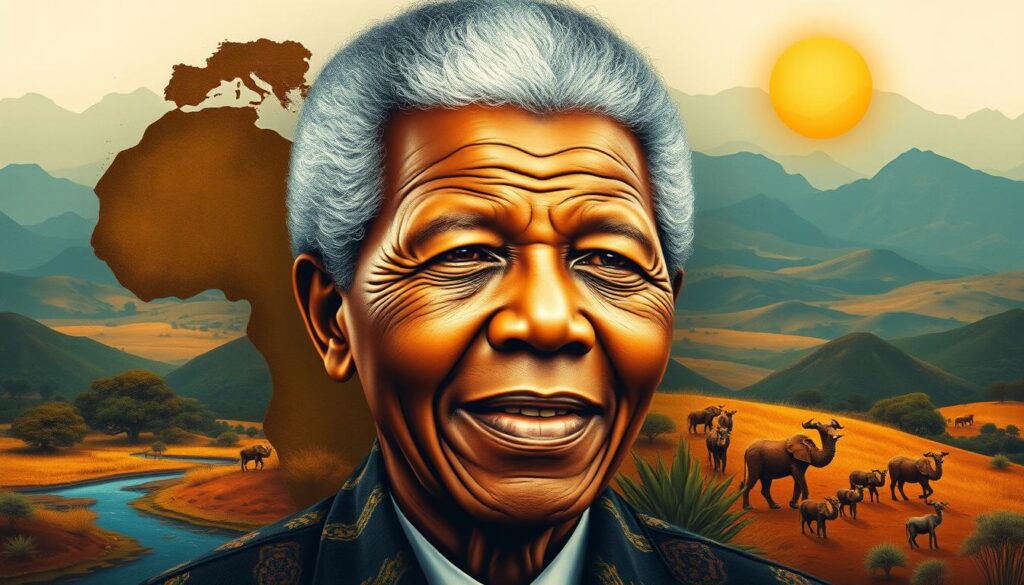
Nelson Mandela was a famous activist from South Africa, born on July 18, 1918, in Mvezo, South Africa1. He belonged to the Madiba clan of the Xhosa-speaking Tembu people. His early life in rural South Africa, family background, and cultural context shaped his worldview. This foundation helped him become a leader in South Africa.
Nelson Mandela’s life and legacy inspire and educate people worldwide. He is a key figure in South African history. His story teaches us about activism and leadership in South Africa.
Key Takeaways
- Nelson Mandela was a prominent activist and leader in South Africa.
- He was born on July 18, 1918, in Mvezo, South Africa1.
- Mandela served as the first Black President of South Africa from 1994 to 19992.
- He spent 27 years in prison, with 18 of those years on Robben Island3.
- Nelson Mandela was awarded the Nobel Peace Prize in 1993, jointly with South African President F. W. de Klerk23.
- He became South Africa’s first democratically elected president in 19943.
Political Activism and Imprisonment
Nelson Mandela became a key freedom fighter against apartheid in South Africa. He fought for human rights by joining the African National Congress (ANC) in 1943. He also co-founded the ANC Youth League in 1944.
The African National Congress and Resistance
Mandela led the ANC to fight harder against apartheid. They moved from peaceful protests to more direct actions. Mandela helped start Umkhonto we Sizwe, the ANC’s military wing, to fight for equality.
Life on Robben Island
In 1964, Mandela was sentenced to life in prison during the Rivonia Trial4. He spent 27 years, mostly on Robben Island, facing tough conditions. Yet, he inspired others with his courage and leadership.
Global Solidarity and Campaigns
Mandela’s imprisonment drew global support, starting worldwide campaigns for his freedom and an end to apartheid4. People around the world saw him as a symbol of justice and equality. This pressure pushed the South African government to talk about his release.
Presidency and Legacy
After his release in 19905, Nelson Mandela became a symbol of unity. He led South Africa towards democracy. In 1994, he was elected as the nation’s first black president. This was a major step towards hope and change.
Major Policies and Achievements
Mandela’s presidency brought big changes to end apartheid. He set up the Truth and Reconciliation Commission for healing and truth5. His team also worked to cut poverty and inequality, making the economy more fair.
Nation Building and Reconciliation
Mandela led with forgiveness and inclusivity5. He worked hard to bring a divided nation together. His efforts helped avoid violence and paved the way for democracy.
| Policy | Impact |
|---|---|
| Truth and Reconciliation Commission | Facilitated healing and accountability |
| Economic Reforms | Addressed poverty and inequality |
| Education Initiatives | Improved access for all citizens |
In 19935, Mandela and F.W. de Klerk were awarded the Nobel Peace Prize for ending apartheid peacefully5c>. This honor showed his dedication to peace and justice worldwide.
Influence on Global Human Rights
Nelson Mandela was deeply committed to human rights worldwide, not just in South Africa. As a leading activist, he worked with global groups to push for fairness and justice everywhere.
Nelson Mandela’s International Impact
Mandela’s message of forgiveness touched hearts and minds globally. Through The Elders, he pushed for peace and justice, tackling big issues like HIV/AIDS and children’s rights. His leadership showed us the strength of kindness in making a difference.
Awards and Recognitions
Mandela was honored many times for his dedication to peace and equality. He won the Nobel Peace Prize in 1993, along with Frederik Willem de Klerk, for ending apartheid peacefully6. He also received:
- The United Nations Human Rights Prize
- The Presidential Medal of Freedom
- Over 250 international awards and more than 50 honorary degrees7
Continued Relevance in Modern Activism
Mandela’s legacy is a key part of today’s fight for justice. Modern activists find inspiration in his fight for equality and freedom. His lessons guide us in striving for a fairer, more just world.
The Man Behind the Legend: Personal Life and Character
Nelson Mandela’s life was shaped by his personal relationships and strong values. He balanced public service with family moments. This balance influenced his leadership and activism.
Family and Relationships
Mandela was married three times and had six children. Each relationship added to his personal life. He was a devoted husband, father, and grandfather, showing his commitment to family.
Personal Philosophy and Wisdom
Mandela believed in forgiveness and resilience. He chose reconciliation over revenge, leading South Africa to peace. His wisdom came from years of struggle, teaching that true freedom comes from unity.
Enduring Cultural Impact
As a freedom fighter, Mandela’s legacy goes beyond politics. He inspired art, literature, and global justice movements8. His image as a peacemaker symbolizes hope and the fight for human rights worldwide.
FAQ
What were the early influences that shaped Nelson Mandela’s worldview?
Nelson Mandela grew up in rural South Africa. His family and culture shaped his activism. He learned about apartheid’s injustices, leading him to fight for equality.
How did Nelson Mandela become involved with the African National Congress (ANC)?
Mandela joined the ANC in 1944 to fight apartheid. His leadership skills quickly rose. He founded Umkhonto we Sizwe, the ANC’s military wing.
What was the significance of Nelson Mandela’s “I Am Prepared to Die” speech?
Mandela’s speech in 1964 showed his commitment to fighting apartheid. It showed his willingness to die for freedom. This speech made him a symbol of resistance worldwide.
How did Nelson Mandela maintain his leadership and dignity during his imprisonment?
Mandela stayed strong in prison, even on Robben Island. He united inmates and kept fighting for human rights. His principles made him a symbol of resistance.
What were the key achievements of Nelson Mandela’s presidency?
Mandela was South Africa’s first black president from 1994 to 1999. He focused on reconciliation and equality. He established the Truth and Reconciliation Commission and fought poverty.
How did Nelson Mandela contribute to global human rights and international diplomacy?
Mandela’s work on reconciliation and justice influenced the world. He worked with The Elders and fought against HIV/AIDS. His Nobel Peace Prize helped spread his message of equality.
In what ways does Nelson Mandela’s legacy continue to influence modern activism?
Mandela’s legacy guides today’s social justice movements. His peaceful negotiation and commitment to justice inspire activists. His ideas help tackle global challenges.
What personal philosophies guided Nelson Mandela’s actions and leadership style?
Mandela believed in forgiveness, inclusivity, and justice. He chose reconciliation over revenge. His compassionate leadership helped heal South Africa.
How did Nelson Mandela balance his personal life with his role as a freedom fighter and president?
Mandela kept his family close despite his demanding roles. His family life influenced his leadership. Balancing his personal and public lives kept him grounded.
What cultural impacts has Nelson Mandela had beyond politics?
Mandela’s life has inspired art and literature worldwide. His image as a symbol of peace continues to inspire. He has had a lasting cultural impact.
What role did global solidarity and international campaigns play in Nelson Mandela’s release from prison?
Global support was key to Mandela’s release. Leaders and activists worldwide applied pressure. Their efforts led to negotiations that freed him in 1990.
How did Nelson Mandela’s education influence his activism?
Mandela’s education gave him critical thinking skills. He studied law at the University of Fort Hare and Witwatersrand. This empowered him to challenge apartheid effectively.
Source Links
- https://en.wikipedia.org/wiki/Nelson_Mandela – Nelson Mandela
- https://www.britannica.com/biography/Nelson-Mandela – Nelson Mandela | Death, Facts, Biography, & Apartheid | Britannica
- https://humanrights.ca/story/story-nelson-mandela – The story of Nelson Mandela | CMHR
- https://www.britannica.com/biography/Nelson-Mandela/Incarceration – Nelson Mandela – Anti-Apartheid, Imprisonment, Activist | Britannica
- https://president.georgetown.edu/speeches/mandela/ – Reflections on the Life and Legacy of Nelson Mandela – Office of the President
- https://www.thediplomaticsociety.co.za/4087-the-impact-of-nelson-mandela-on-human-rights-as-global-legitimizer – The impact of Nelson Mandela on Human Rights as Global Legitimizer
- https://globalgovernanceforum.org/visionary/nelson-mandela/ – Nelson Mandela – Global Governance Forum
- https://www.npr.org/2013/12/06/191579391/the-man-the-myth-the-reading-list-3-books-on-nelson-mandela – The Man, The Myth, The Reading List: Nelson Mandela