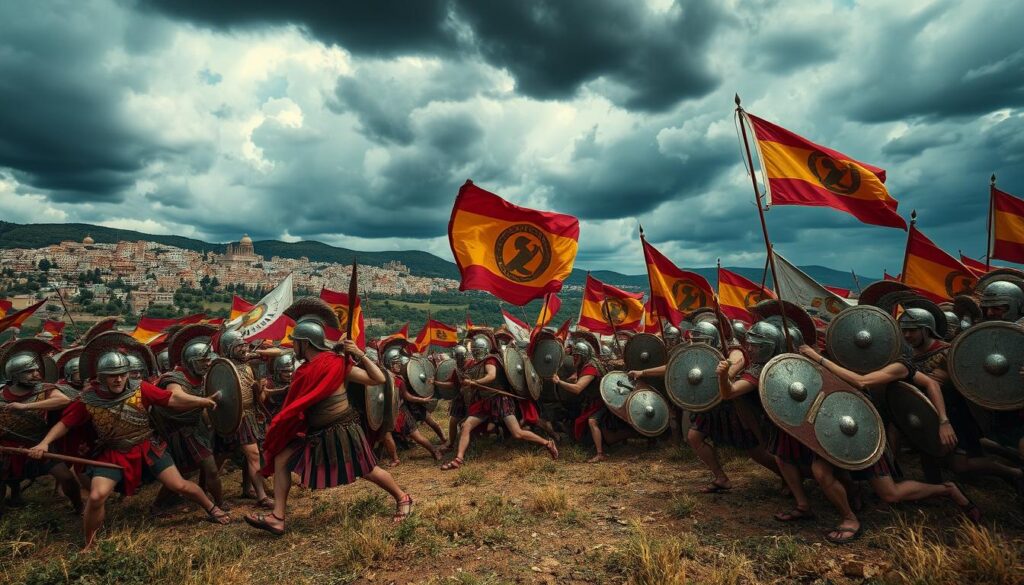
The Peloponnesian War was a key event in the History of Peloponnesian Peninsula. It was fought between Athens and Sparta and their allies from 431 to 404 BC. This war involved most of the Greek world1.
This conflict lasted nearly three decades. It was between Athens, with its strong navy, and Sparta, known for its powerful land army. Both were in the Ancient Peloponnese2.
The war ended with the Delian League’s collapse. This led to Spartan dominance over Athens and its allies. The Peloponnesian League, led by Sparta, won over the Delian League, led by Athens1.
It involved Athens and Sparta, the two most powerful city-states of ancient Greece. Athens led the Delian League, while Sparta led the Peloponnesian League. Nearly all Greek city-states were involved2.
Key Takeaways
- The Peloponnesian War was a significant conflict in ancient Greek history, fought between Athens and Sparta from 431 to 404 BC.
- The war resulted in the dissolution of the Delian League and established Spartan hegemony over Athens and its allies.
- The conflict saw the transformation of Greek warfare from a limited form of conflict to an all-out struggle between city-states, including mass atrocities1.
- The war involved the two most powerful city-states of ancient Greece, Athens and Sparta, with Athens leading the Delian League while Sparta led the Peloponnesian League2.
- The Peloponnesian War had a profound impact on the History of Peloponnesian Peninsula and the Ancient Peloponnese.
- The war led to the end of the Golden Age of Greece and paved the way for Macedon’s takeover of Greece and later Alexander the Great’s Empire2.
Introduction to the Peloponnesian War
The Peloponnesian War lasted from 431 BCE to 404 BCE. It was a major conflict in ancient Greece. The war was between the Athenian Empire and the Peloponnesian League, led by Sparta. It caused a lot of tension in the region3.
Historical Context
After Greece defeated the Persian Empire, a power vacuum formed. Athens and Sparta, the top powers, fought for control. They used the Peloponnese’s geography to plan their military moves4.
Key Players
Athens was led by important figures like Pericles, Nicias, and Alcibiades. They were key in shaping the empire’s policies and military actions3. Sparta, on the other hand, had leaders like Archidamus II, Brasidas, and Lysander. Their tactics were vital in Spartan strategies3.
Overview of Conflicts
The war had significant phases, including the Archidamian War and the Sicilian Expedition. Athens sent over 100 ships to Sicily in 415 BCE. But, they suffered huge losses by 413 BCE4. The war ended with Sparta’s victory at Aegospotami in 404 BCE. This led to Athens’ surrender34.
Major Phases of the War
The Peloponnesian War lasted for many years, with different stages that changed its course. These stages help us understand the History of Peloponnesian Peninsula conflicts.
Archidamian War (431-421 BC)
The first part of the war, named after King Archidamus II of Sparta, focused on land battles and sea strategies. Sparta had strong land forces, but Athens had a better navy and more wealth56. Athens had 10 ships for peace, but later increased them for more safety5. This time saw big events like the siege of Potidaea, costing Athens 2,000 talents5.
Sicilian Expedition (415-413 BC)
Athen’s big plan was the Sicilian Expedition, aiming to grow its power. Led by Pericles, it failed badly, weakening Athens6. This failure was a big blow to Athens’ strength2.
Ionian or Decelean War (413-404 BC)
The last stage was the Ionian or Decelean War, with Sparta getting help from Persia. They worked on Decelea near Athens56. Sparta’s weak navy was helped by Persian money and ships5. The Battle of Aegospotami in 405 BC destroyed Athens’ fleet, leading to Athens’ defeat and the war’s end in 404 BC62.
| Phase | Years | Key Events | Outcome |
|---|---|---|---|
| Archidamian War | 431-421 BC | Land invasions, Siege of Potidaea, Naval expansion | Prolonged conflict with high costs for Athens |
| Sicilian Expedition | 415-413 BC | Athenian campaign in Sicily, Defeat of Athenian forces | Significant weakening of Athens’ military power |
| Ionian or Decelean War | 413-404 BC | Spartan-Persian alliance, Battle of Aegospotami | Spartan victory and decline of Athenian dominance |
Consequences and Legacy of the Peloponnesian War
The Peloponnesian War ended, changing ancient Greece forever. It left a mark on its society and politics.
Impact on Ancient Greece
After the war, Athens lost, and Sparta took control. This changed the power balance in the Peloponnese region. It brought big changes to how people governed and lived7.
Lasting Historical Lessons
The Peloponnesian War is a key lesson in military tactics and alliances. It shows the dangers of being too powerful and the challenges of long wars87.
Influence on Modern Warfare
Today’s military strategies owe a debt to the Peloponnesian War. The importance of naval power and forming alliances comes from this ancient conflict8.
FAQ
What was the Peloponnesian War?
The Peloponnesian War was a major conflict in ancient Greece. It lasted nearly three decades, from 431 to 404 BC. Athens, with its strong navy, fought against Sparta, known for its powerful land forces.
This war changed the balance of power in Greece. It had a big impact on Greek culture, politics, and society.
Who were the main participants in the Peloponnesian War?
Athens and the Delian League fought against Sparta and the Peloponnesian League. These alliances were the two most powerful in Greece. Each side had strong military strengths and strategic resources.
What were the primary causes of the Peloponnesian War?
The war started because of growing tension between Athens and Sparta. This tension came after Greece defeated the Persian Empire. Both city-states wanted to be the top power, leading to conflict.
How did the geography of the Peloponnese region influence the Peloponnesian War?
The Peloponnese’s geography was key in the war. It helped Sparta’s land tactics and Athens’ sea power. The peninsula’s location also made it easier to move troops and resources.
What were the major phases of the Peloponnesian War?
The war had three main phases. The first was the Archidamian War, with Sparta invading Athens’ land. The second was the Sicilian Expedition, where Athens failed to conquer Sicily. The third was the Ionian or Decelean War, with Sparta getting stronger and creating the Peloponnesian Empire.
What were the consequences of the Peloponnesian War for ancient Greece?
The war’s end changed ancient Greece a lot. Athens lost its top spot, and the Peloponnesian League weakened. Sparta became more powerful. The war also caused social and economic problems, leading to the decline of city-states.
How did the Peloponnesian War influence modern warfare?
The Peloponnesian War teaches us about power, alliances, and war’s human cost. It shows the importance of logistics, geography, and shifting alliances. It also highlights the need for strategic planning and adaptability in war.
What is the historical significance of the Peloponnesian Peninsula in the war?
The Peloponnesian Peninsula was very important in the war. It was Sparta’s heartland and controlled key land routes and resources. Its geography helped Sparta’s military campaigns and was a key factor in the war’s outcome.
Source Links
- Peloponnesian War – https://en.wikipedia.org/wiki/Peloponnesian_War
- What Was the Peloponnesian War? – https://www.thecollector.com/what-was-the-peloponnesian-war/
- Peloponnesian War | Summary, Causes, & Facts | Britannica – https://www.britannica.com/event/Peloponnesian-War
- Introduction to the Peloponnesian War – https://courses.lumenlearning.com/atd-herkimer-westerncivilization/chapter/introduction-to-the-peloponnesian-war/
- Ancient Greek civilization – Peloponnesian War, Sparta, Athens | Britannica – https://www.britannica.com/place/ancient-Greece/The-Peloponnesian-War
- Peloponnesian War – Legio X Fretensis – https://x-legio.com/en/wiki/peloponnesian-war
- Effects of the Peloponnesian War – https://courses.lumenlearning.com/atd-herkimer-westerncivilization/chapter/effects-of-the-peloponnesian-war/
- Peloponnesian War ‑ Who Won, History & Definition | HISTORY – https://www.history.com/topics/ancient-greece/peloponnesian-war