
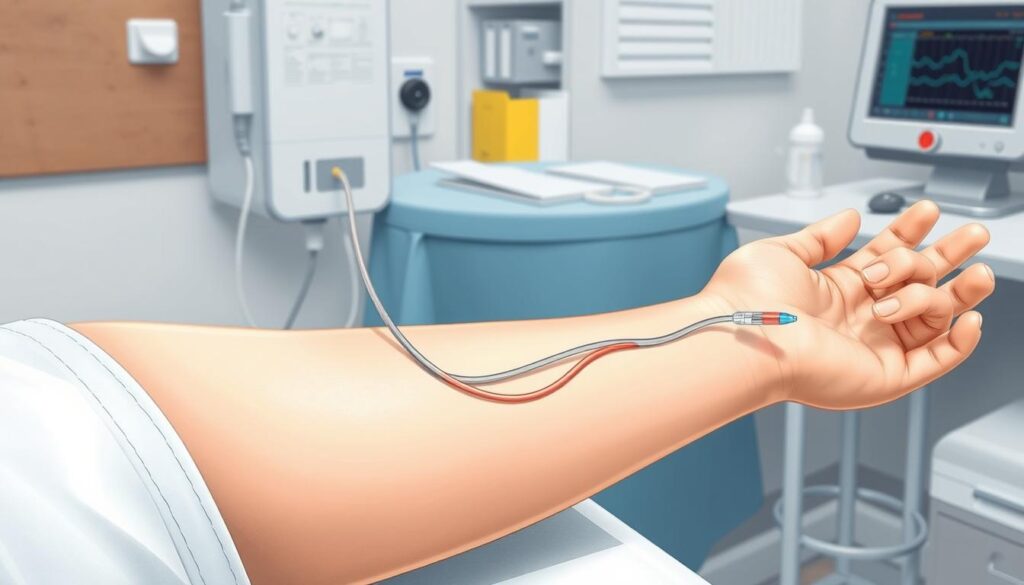
PICC lines are vital for complex medical treatments. This specialized device provides long-term vascular access1. A thin tube is inserted into your arm vein, extending close to your heart1.
Your PICC line serves many important functions. It delivers medications, IV nutrients, and blood products1. It’s also used for drawing blood samples1.
Patients needing frequent medical care often benefit from PICC lines2. This includes those undergoing chemotherapy or long-term antibiotic treatments2.
PICC lines can stay in place for weeks or months1. The insertion is minimally invasive and done in various medical settings1.
Key Takeaways
- PICC lines provide long-term, secure vascular access
- Versatile for multiple medical treatments and procedures
- Minimally invasive insertion process
- Reduces need for repeated needle sticks
- Can remain in place for extended treatment periods
Understanding Vascular Access and PICC Lines
Vascular access devices are vital for intravenous therapy. They help deliver medications and support patient care. These tools allow healthcare providers to manage complex treatments with minimal discomfort.
What is a PICC Line?
A peripherally inserted central catheter (PICC) is a long-term central venous catheter3. It’s a thin, flexible tube inserted into a large vein, usually near the elbow4.
PICCs deliver medication directly to the bloodstream. They can stay in place for weeks or months, reducing the need for multiple needle insertions3.
Types of Vascular Access Devices
| Device Type | Duration of Use | Primary Application |
|---|---|---|
| PICC Line | Weeks to Months | Short to Mid-Term IV Therapy |
| Implantable Port | Months to Years | Long-Term Chronic Treatment |
| Tunneled Catheter | Weeks to Months | Specialized Medical Treatments |
Benefits of PICC Line Treatment
- Reduced risk of vein damage5
- Minimal discomfort during insertion5
- Suitable for extended medication delivery4
- Supports various treatment protocols3
Choosing the right vascular access device depends on your specific medical needs and treatment plan.
Doctors pick vascular access devices based on each patient’s needs. This ensures the most effective and comfortable treatment approach4.
PICC Line Insertion Procedure and Placement
PICC line insertion can seem scary, but knowing what to expect helps. Your healthcare team will guide you through each step. This important medical procedure can make treatment easier6.
PICC placement usually happens in an outpatient setting. It takes about 30 to 45 minutes. Doctors use ultrasound to ensure the catheter goes in the right spot76.
Preparation Steps
- Blood tests to assess platelet levels6
- Imaging tests like X-rays and ultrasounds6
- Discussion of medical history with healthcare providers6
You’ll get local anesthesia to reduce pain. The doctor will make a small cut in your skin. Then, they’ll carefully move the catheter through your vein towards your heart6.
Potential Complications to Consider
PICC line insertion is usually safe, but some risks exist:
- Bleeding
- Vein damage
- Nerve injury
- Risk of infection6
“Proper placement and careful monitoring are key to successful PICC line treatment” – Medical Vascular Specialists
After insertion, your medical team will secure the catheter’s outer part. They’ll cover it with a clean dressing. You’ll learn how to protect the site and care for your PICC line7.
Recovery is usually quick. Mild discomfort may last 1-3 days. Follow your doctor’s instructions for the best care and maintenance7.
Living with Your PICC Line: Care and Maintenance
Proper PICC line care is crucial for your health. It prevents potential complications. Learning to manage your catheter will boost your confidence during treatment8.
Daily Care Requirements
Your daily PICC line care routine involves several key steps. These steps ensure your health and prevent infections.
- Check the insertion site regularly for any signs of redness or swelling
- Keep the area clean and dry at all times
- Perform weekly flushing using 10mls of 0.9% Sodium Chloride8
- Change dressings at least once weekly9
Infection Prevention Guidelines
Preventing infections requires strict hygiene and proper handling. Follow these steps when caring for your PICC line:
- Wash your hands thoroughly before touching the catheter9
- Use aseptic non-touch technique during maintenance8
- Avoid using sharp objects near the catheter
- Change needle-free connectors weekly8
Your diligence in PICC line care can significantly reduce the risk of potential complications.
Activity Restrictions and Lifestyle Adjustments
Managing your daily activities requires careful thought. Here are some specific guidelines to follow:
- Avoid lifting objects over 4.5 kg (10 lbs.) with the affected arm9
- Take showers instead of baths to protect your catheter9
- Avoid swimming while the PICC line is in place
Consult your healthcare provider about specific PICC line care. They can tailor recommendations to your needs8.
For more information, check out this PICC line care guide. It offers valuable insights for your treatment journey.
Conclusion
PICC lines are vital for managing complex medical conditions. They offer excellent vascular access for long-term therapies. Most patients have positive experiences and would recommend them to others10.
PICC lines are generally safe, with minimal risks. The infection rate is about 2%, and bleeding risks are usually easy to control11. Blood clotting can occur, but serious complications are rare11.
Teamwork with healthcare pros is key to success. Follow care guidelines and stay informed about your medical treatment with a PICC line. Your efforts will lead to a smoother medical journey.
Every patient’s experience is different. Keep talking with your medical team regularly. Practice good self-care and maintain a positive outlook. These steps will help you navigate your PICC line treatment successfully.
FAQ
What exactly is a PICC line?
A PICC line is a thin tube in your upper arm vein. It reaches large veins near your heart. This line delivers medicines and nutrients directly into your blood.
PICC lines reduce the need for repeated needle sticks. They provide long-term access for various treatments.
How long can a PICC line stay in place?
PICC lines can remain for weeks to months. Your doctor decides the duration based on your needs. The specific treatment also affects how long it stays.
Is the PICC line insertion procedure painful?
PICC line insertion uses local anesthesia. You’ll be awake but shouldn’t feel much pain. The procedure takes about an hour and is usually outpatient.
Some mild discomfort may occur during insertion. Most patients report minimal pain overall.
What treatments typically require a PICC line?
PICC lines are common in cancer treatments and long-term antibiotic therapy. They’re also used for nutrition, frequent blood draws, and extended IV medications.
These lines help patients who need reliable vein access often.
How do I care for my PICC line at home?
Check the insertion site daily. Keep the area clean and dry. Follow your doctor’s instructions for flushing the line.
Use clean hands and sterile methods when handling the catheter. Watch for signs of infection or problems.
Are there any activity restrictions with a PICC line?
Avoid heavy lifting with the arm containing the PICC line. Be careful when bathing to protect the catheter.
Your doctor will give you specific guidelines about safe activities and movements.
What are the potential complications of a PICC line?
Possible issues include infection, blood clots, and line blockage. Catheter movement can happen but is rare.
Follow care instructions and maintain good hygiene to reduce risks. Regular check-ups also help prevent problems.
Can I shower or swim with a PICC line?
You can shower using special covers to keep the PICC line dry. Swimming isn’t usually allowed due to infection risk.
Always ask your doctor for specific advice about your situation.
Source Links
- PDF – https://spectrum.cookmedical.com/documents/picc-patient-guide.pdf
- Vascular Access Procedures – https://www.radiologyinfo.org/en/info/vasc_access
- Vascular Access Devices: PICCs and Ports – https://www.cff.org/managing-cf/vascular-access-devices-piccs-and-ports
- Understanding PICC Lines and their Applications – Dynamic Access – https://dynamicaccess.com/understanding-picc-lines-and-their-applications/
- Differences Between a CVC and a PICC | Dialysis Access – https://www.azuravascularcare.com/infodialysisaccess/difference-between-cvc-and-picc/
- Peripherally inserted central catheter (PICC) line – https://www.mayoclinic.org/tests-procedures/picc-line/about/pac-20468748
- About Your Peripherally Inserted Central Catheter (PICC) – https://www.mskcc.org/cancer-care/patient-education/about-your-peripherally-inserted-central-catheter-picc
- Dear Colleague, – https://www.nice.org.uk/guidance/mtg34/resources/guidelines-for-the-care-and-maintenance-of-a-peripherally-inserted-central-catheter–velindre-cancer-centre-pdf-4481503170
- Peripherally Inserted Central Catheter (PICC): Care Instructions – https://myhealth.alberta.ca/Health/aftercareinformation/pages/conditions.aspx?hwid=ug6122
- Living with a peripherally inserted central catheter: the perspective of cancer outpatients—a qualitative study – https://pmc.ncbi.nlm.nih.gov/articles/PMC5752737/
- PICC Line Insertion: Frequently Asked Questions – https://www.hss.edu/conditions_picc-insertion-procedure.asp

