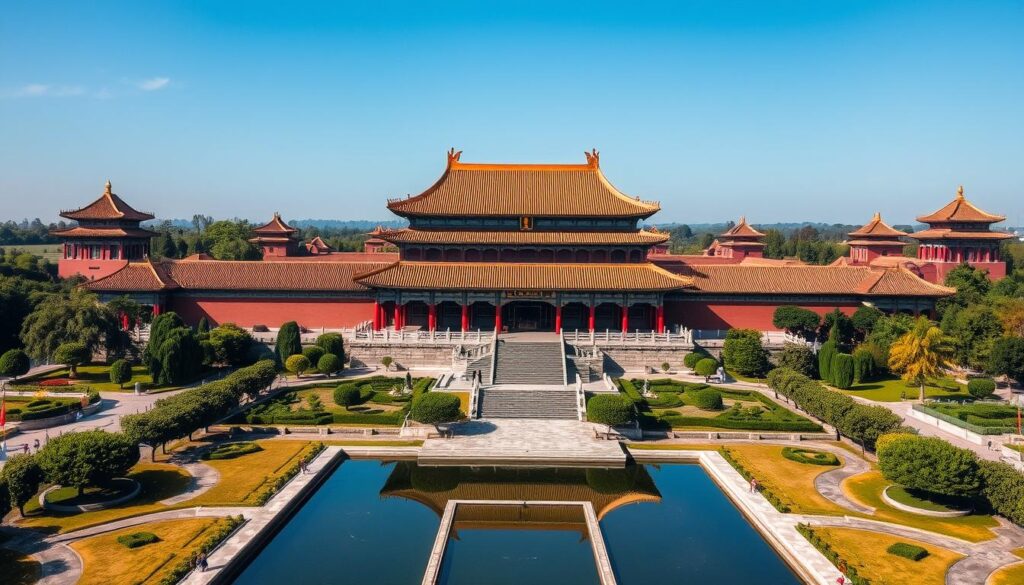
The Qing dynasty, also known as the Manchu dynasty, was the last imperial dynasty in Chinese history. It lasted from 1644 to 1911123. During this time, China’s territory grew, becoming three times larger than it was under the Ming dynasty2.
The Qing dynasty was founded by the Manchus. It played a key role in shaping Chinese history. This makes it a vital part of Chinese history and the Manchu dynasty1.
China’s population grew from 150 million to 450 million during the Qing dynasty2. The empire was the largest in Chinese history, ranking fourth globally in 17901.
The Qing dynasty was a complex and fascinating time in Chinese history. It saw significant cultural, social, and economic changes. As you explore this era, you’ll learn about the Qing dynasty’s impact on Chinese civilization, including the Manchu dynasty and Chinese history3.
Key Takeaways
- The Qing dynasty was the last imperial dynasty in Chinese history, lasting from 1644 to 1911123.
- The empire expanded to three times its size compared to the preceding Ming dynasty2.
- The population of China grew from around 150 million to 450 million during the Qing dynasty2.
- The Qing dynasty controlled the most territory of any dynasty in Chinese history, representing the fourth-largest empire globally in 17901.
- The Qing dynasty played a critical role in shaping Chinese history and the Manchu dynasty1.
- The Qing dynasty had a significant impact on Chinese culture, including the development of ceramics and other art forms3.
Overview of the Qing Dynasty
The Qing dynasty started in 1636 with the Manchus. It began a new chapter in Chinese history4. The Manchus came from Manchuria and took over China in 1644. They ruled for over two centuries4.
Origins and Establishment
Nurhaci was a key figure in starting the Qing dynasty. He united Manchu tribes and set the stage for growth4. The Qing Emperor’s skills helped them take over the Ming dynasty. They built a strong government that lasted for centuries.
Timeline of Major Events
- 1644: Qing conquest of Beijing and establishment of the dynasty4
- 1661-1722: Reign of Emperor Kangxi, a period of prosperity and stability4
- 1735-1796: Qianlong Emperor’s rule, marked by territorial expansion5
- 1850: The Taiping Rebellion causes massive loss of life4
- 1900: Boxer Rebellion exemplifies anti-foreign sentiment4
- 1912: Abdication of the last emperor, Puyi, ends the Qing dynasty
Key Emperors and Their Contributions
Emperor Kangxi was a renowned Qing Emperor who ruled for 61 years5. He played a key role in strengthening the empire5. His leadership brought a golden age of culture and economy.
After Kangxi, Emperor Yongzheng and Emperor Qianlong continued to grow and strengthen the dynasty. They left a lasting impact on China’s history.
| Emperor | Reign | Contributions |
|---|---|---|
| Emperor Kangxi | 1661–1722 | Consolidated power, promoted arts and education |
| Emperor Yongzheng | 1722–1735 | Reformed bureaucracy, strengthened central control |
| Emperor Qianlong | 1735–1796 | Expanded territory, patronized culture |
Culture and Society in the Qing Dynasty
The Qing dynasty was a time of great cultural and societal growth. At its heart was the Forbidden City. It was not just the emperor’s palace but also a center for art and culture.
Art and Literature
Art in the Qing dynasty was stunning, with a focus on ceramics and painting. Artists like Gong Xian and Ye Xin brought new styles to the table. They mixed old techniques with fresh ideas6. Literature also thrived, showing the depth of Qing society.
Social Structure and Class Dynamics
The Qing society was divided into clear classes. At the top were the emperor and his family. Then came the nobility, scholar-officials, merchants, artisans, farmers, and laborers. This setup showed the balance between the ruling Manchu minority and the Han majority7.
| Class | Description |
|---|---|
| Emperor and Imperial Family | Highest authority, resided in the Forbidden City |
| Nobility and Aristocracy | Held significant social and political power |
| Scholar-Officials | Engaged in governance and administration |
| Merchants and Artisans | Driven economic activities and craftsmanship |
| Farmers and Peasants | Formed the backbone of the agricultural sector |
| Laborers and Servants | Performed various manual and domestic tasks |
| Outcasts/Marginalized Groups | Included those outside the traditional class system |
Religion and Belief Systems
Religion in the Qing dynasty was rich and varied. Confucianism, Buddhism, and local beliefs all coexisted. The arrival of Jesuit missionaries brought Western ideas, enriching the culture6. These beliefs greatly influenced society and daily life.
Economy and Trade during the Qing Dynasty
The Qing dynasty’s economy was complex, supporting a huge population and trade. It was both within China and with other countries. Knowing about this period’s economy helps us understand its growth and challenges.
Agricultural Practices and Innovations
Agriculture was key to the Qing economy. The south grew rice, and the north grew wheat. Places like Guangxi and Guangdong grew rice twice a year.
Zhejiang, Hunan, and Jiangxi were famous for rice and tea. This helped feed nearly 400 million people. But, numbers dropped due to wars and natural disasters8. New farming methods kept food safe and helped the economy grow.
Trade Relations with the West
Trade with the West brought both good and bad. It opened new markets and brought new goods. But, the Qing dynasty often had a trade deficit8.
Money sent from overseas Chinese and foreign spending helped balance this8. Remittance banks made transactions easier, solving problems with the old currency system9. The Grand Canal was also important for moving goods across the country.
Impact of the Opium Trade
The opium trade deeply affected the Qing economy and society. By the late Qing, over 2,000 tonnes of opium were produced, causing addiction and problems8. The Opium Wars (1840–42 and 1856–60) weakened China’s economy and power, leading to bad trade deals8.
These wars were a turning point for the Qing dynasty, showing its economic weaknesses.
| Aspect | Details | Source |
|---|---|---|
| Population | Close to 400 million, declining mid-century | 8 |
| Agricultural Specialization | Rice in the south, wheat in the north | 8 |
| Opium Production | Over 2,000 tonnes in Late Qing | 8 |
| Domestic Trade | Exceeds 168 million taels annually | 8 |
| Urbanization Rate | Only 5% in late Qing | 8 |
| Currency System | Bimetallic (copper and silver) with paper money | 9 |
| Remittance Banks | Developed for easier transactions | 9 |
| Market Proximity | 80% within a day’s journey to a market town | 9 |
Decline and Legacy of the Qing Dynasty
The Qing Dynasty faced many challenges that led to its downfall. This marked a big change in Chinese history.
Internal Challenges and Rebellions
In the 19th century, the Qing government faced a lot of internal unrest. The Taiping Rebellion, from 1850 to 1864, killed about 20 million people10. The Boxer Rebellion in 1900 tried to kick out foreign influences but failed, weakening the empire10.
Foreign Influence and Conflicts
External pressures also hurt the Qing Dynasty. The Opium War of 1840-1842 made China fight Great Britain. This led to bad treaties that took away land and hurt China’s pride10. These fights showed China’s weaknesses and made people feel ashamed, speeding up the dynasty’s fall11.
Lasting Impact on Modern China
The Qing Dynasty fell in 1911, thanks to a revolution led by Sun Zhongshan and the Nationalist Party. This led to the Republic of China1011. Today, we can see the Qing Dynasty’s legacy in artifacts that show its culture and art. Modern China’s borders and society were shaped by the Qing era, showing a complex heritage that affects Chinese society today11.
FAQ
What are the origins of the Qing dynasty?
The Qing dynasty started with the Manchu people from Manchuria in the early 17th century. They conquered the Ming dynasty, beginning a 268-year rule that ended China’s imperial era.
Who was Emperor Kangxi and what were his contributions to the Qing dynasty?
Emperor Kangxi ruled from 1661 to 1722. He helped solidify Qing rule, expanded China’s borders, and promoted a cultural and scientific golden age.
What role did the Forbidden City play in the Qing dynasty?
The Forbidden City was the Qing dynasty’s imperial palace and political center. It was the home of the Qing Emperors and a center for culture, housing many artifacts and artworks.
How did the Qing dynasty impact China’s economy and trade relations?
The Qing dynasty saw agricultural growth and extensive trade with Western powers. But, the opium trade and Opium Wars posed big challenges, changing China’s economy and status.
What were the key factors that led to the decline of the Qing dynasty?
The Qing dynasty’s decline was due to internal issues like the Taiping Rebellion and the Boxer Uprising. Foreign influence and unequal treaties also weakened China’s sovereignty, leading to the dynasty’s fall.
What is the lasting legacy of the Qing dynasty on modern China?
The Qing dynasty’s legacy is seen in modern China’s borders, culture, and historical artifacts. These elements give insights into Chinese history and shape today’s cultural identity.
Can you explain the social structure and class dynamics of Qing society?
Qing society had a strict hierarchy with the Manchu rulers at the top and the Han Chinese majority below. This structure influenced governance, culture, and daily life, showing the complexities of a multi-ethnic empire.
What were some of the major cultural achievements during the Qing dynasty?
The Qing dynasty saw a rise in arts and literature. There were advancements in ceramics, painting, and literature. These achievements were centered in the Forbidden City, showing the dynasty’s rich culture.
How did religious and belief systems influence life in the Qing dynasty?
Confucianism, Buddhism, and other philosophies shaped Qing society. They influenced governance, social norms, and culture, adding to the dynasty’s stability and richness.
What are some notable Qing dynasty artifacts and their significance?
Qing dynasty artifacts, like porcelain and jewelry, show the era’s craftsmanship and values. These items highlight the dynasty’s artistic achievements and offer insights into daily life and imperial grandeur.
Source Links
- Qing dynasty – https://en.wikipedia.org/wiki/Qing_dynasty
- Qing dynasty | Definition, History, Map, Time Period, Emperors, Achievements, & Facts | Britannica – https://www.britannica.com/topic/Qing-dynasty
- Qing dynasty (1644–1911) – Smithsonian’s National Museum of Asian Art – https://asia-archive.si.edu/learn/for-educators/teaching-china-with-the-smithsonian/explore-by-dynasty/qing-dynasty/
- History of the Qing dynasty – https://en.wikipedia.org/wiki/History_of_the_Qing_dynasty
- The Qing Dynasty – https://pressbooks.claremont.edu/onesource/chapter/the-qing-dynasty/
- The Qing Dynasty (1644–1911): Loyalists and Individualists | Essay | The Metropolitan Museum of Art | Heilbrunn Timeline of Art History – https://www.metmuseum.org/toah/hd/qing_3/hd_qing_3.htm
- The Qing Dynasty for AP World History – https://www.theproductiveteacher.com/the-qing-dynasty
- Economy of the Qing dynasty – https://en.wikipedia.org/wiki/Economy_of_the_Qing_dynasty
- The Grandeur of the Qing – https://afe.easia.columbia.edu/qing/economy.html
- Qing Dynasty ‑ Flag, Clothing & Date | HISTORY – https://www.history.com/topics/asian-history/qing-dynasty
- Legacy of the Qing dynasty – https://en.wikipedia.org/wiki/Legacy_of_the_Qing_dynasty