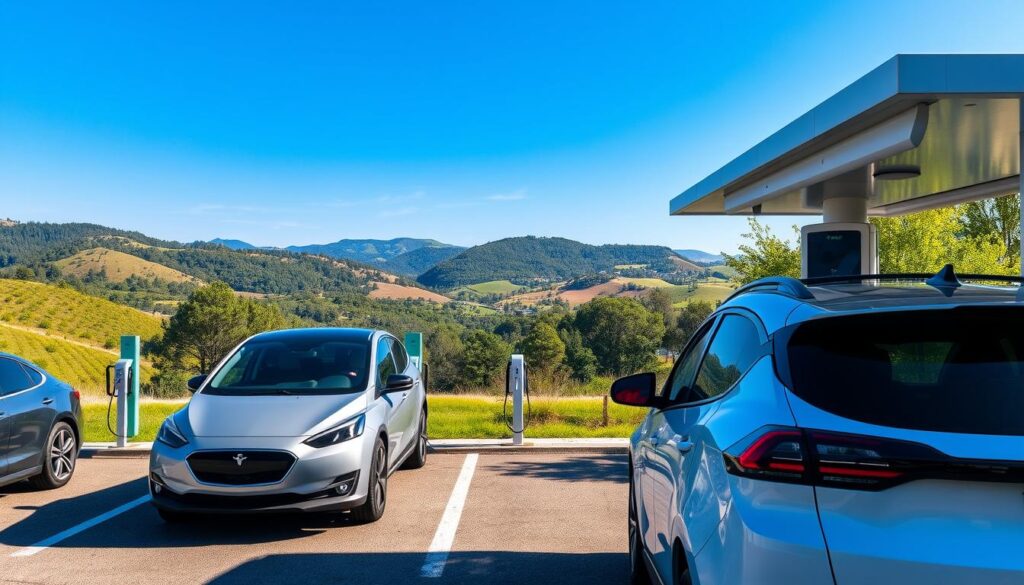
Electric vehicles are revolutionizing travel, offering a zero-emissions option for road trip lovers. Improved charging stations have eased range anxiety, making long-distance trips more feasible. Most Americans only take long drives a few times yearly, making electric vehicles a practical choice.
Knowing about electric vehicle charging is key for a great journey. Charging options differ across regions. California has many stations, while other areas have fewer. For daily drives, EV owners usually keep their battery at 80% to maintain performance.
Plan your road trip charging stops wisely. Tesla’s Supercharger network, now open to various EV brands, offers reliable charging for travelers. Driving speed, weather, and terrain can affect your vehicle’s range and charging needs1.
Key Takeaways
- Electric vehicles are becoming increasingly suitable for road trips
- Charging infrastructure varies by region
- Maintain battery at 80% for optimal daily performance
- Plan charging stops strategically
- Consider external factors affecting vehicle range
Understanding Electric Vehicle Charging Options
Electric vehicle (EV) charging might seem tricky, but it’s easy once you know your options. EVs like the Nissan Leaf use lithium-ion batteries. These batteries need specific charging methods to work their best.
EVs offer various charging solutions to suit different needs. Your charging plan can greatly affect your travel ease and driving experience.
Types of Charging Stations
EV charging stations come in different types. Each type has its own features.
- Home charging units
- Public charging networks
- Tesla Supercharger locations
- Workplace charging stations
Charging Speed Comparisons
Charging levels offer different power outputs and speeds. Level 1 charging uses standard 120-volt outlets, providing 1 to 1.8 kW of power.
It can take 22-40 hours to fully charge a battery electric vehicle with Level 1 charging2.
| Charging Level | Power Output | Charging Time |
|---|---|---|
| Level 1 | 1-1.8 kW | 22-40 hours |
| Level 2 | Up to 19.2 kW | 3-8 hours |
| DC Fast Charging | 50-350 kW | 20-45 minutes |
Fast Charging Solutions
Fast charging stations are key for long trips. They can deliver over 360 kW of power. This allows most EVs to charge significantly in under 20 minutes2.
Tesla and Chevrolet Bolt owners benefit from well-placed fast charging networks. These networks make long road trips more doable.
The future of electric vehicles is powered by intelligent, rapid charging infrastructure.
Most EV drivers prefer charging at home. About 64% regularly use residential charging. Public charging stations are becoming more common too.
Around 31% of EV drivers often use these public networks3.
Planning Your Electric Vehicle Road Trip
Electric vehicle road trips need smart planning. Knowing about charging stations is key for a smooth journey. This applies to both plug-in hybrids and fully electric cars.
Essential Route Planning Strategies
The U.S. now has about 130,000 public charging stations. This makes cross-country travel easier for electric cars. Top electric vehicles can go over 500 miles on one charge.
The average range is about 300 miles. Keep this in mind when planning your trip.
Critical Apps for Charging Locations
- FLO App: Offers comprehensive trip planning4
- PlugShare: Crowd-sourced charging station finder
- A Better Route Planner: Helps optimize charging stops
- Tesla App: Useful for accessing Supercharger networks
Efficient Route Planning Tips
Use these tips for your electric vehicle journey:
- Keep at least 20% battery charge at each stop4
- Check charging station availability using multiple apps
- Plan charging breaks around meal times
- Use regenerative braking to extend vehicle range
| Charging Consideration | Recommendation |
|---|---|
| Battery Percentage | Keep above 20%, below 80% for battery health4 |
| Charging Time | Fast chargers can reach 80% in 15 minutes4 |
| Temperature Impact | Range can decrease by 12% in cold temperatures5 |
“Preparation is key to a successful electric vehicle road trip” – EV Travel Expert
Pro tip: Download charging network apps before your trip. Check station compatibility to ensure a smooth journey5.
Charging Etiquette and Best Practices
Electric Vehicle (EV) charging requires understanding shared infrastructure. As more people choose EVs, good charging habits become crucial. Courteous behavior ensures a smooth experience for all drivers.
How Long Does Charging Usually Take?
EV charging times vary based on your vehicle and station type. Level 2 charging stations often take hours. DC fast charging can finish in 20-60 minutes6.
Most public stations suggest keeping your battery between 20 and 80 percent. This helps optimize your battery’s lifespan6.
Respecting Shared Charging Stations
Good etiquette is vital when using public charging spots. Many stations have time limits for fair access7. Follow these key practices:
- Move your vehicle promptly after charging is complete
- Report any broken chargers to network operators7
- Be patient during peak charging times
Setting Expectations with Travel Companions
Plan charging stops with clear communication. Know about charging station availability and potential wait times. This helps manage range anxiety and ensures smoother trips.
Effective communication and flexibility are key to successful electric vehicle road trips.
Some areas have strict policies for charging station use. Certain regions fine non-electric vehicles parked in EV spots6. Being mindful helps create an efficient charging ecosystem7.
Future of Electric Vehicle Infrastructure
Electric vehicle (EV) infrastructure is changing fast. New tech and plans support your zero-emissions journey. The EV market is growing, offering more car models and charging options8.
Upcoming Charging Technologies
Better lithium-ion batteries are boosting EV performance. Most electric cars now travel over 200 miles per charge. Luxury models can go beyond 300 miles8.
Bidirectional charging is a game-changer. Your EV can now both use and give back power to the grid8.
Government Initiatives Supporting EV Infrastructure
The government is backing EV growth. The Bipartisan Infrastructure Law set aside $7.5 billion for new chargers. The goal is 500,000 new chargers by 20308.
Some states have Zero Emission Vehicle rules. These aim to cut greenhouse gases and promote cleaner transport9.
The Role of Businesses in Expanding Charging Access
Businesses are key to growing EV infrastructure. Charging stations are popping up in many places. You’ll find them at tourist spots and transport hubs9.
By 2030, EVs could make up 40% of new car sales. This shows a big shift in how we’ll get around10. Your electric future looks bright!
FAQ
How long does it take to charge an electric vehicle during a road trip?
Charging times vary based on vehicle and charger type. DC fast charging takes 20-60 minutes. Level 2 charging might need several hours.
Your charging speed depends on your vehicle model and battery capacity. The specific charging station you use also affects charging time.
What apps can help me plan an electric vehicle road trip?
Several apps are crucial for EV road trips. These include A Better Route Planner, Google Maps, and Zap-Map.
PlugShare and the Tesla app are also helpful. These apps locate charging stations and check their reliability. They also plan routes with sufficient charging options.
How many public charging points are available in the United States?
The U.S. has over 57,290 public charging points. Availability varies by region. California has abundant charging infrastructure. Rural areas may have fewer options.
What are the different types of EV charging?
There are three main types of EV charging. Level 1 is slowest, using standard 120V outlets.
Level 2 is faster, using 240V outlets. DC fast charging is quickest. For road trips, DC fast charging is typically most convenient.
How can I maximize my electric vehicle’s range during a road trip?
To maximize range, consider driving speed, terrain, and weather conditions. Vehicle load also affects range. Fully charge your battery and check tire pressure.
Use EV-specific routing apps to plan your journey. Plan your charging stops strategically for best results.
Is charging an electric vehicle during a road trip expensive?
Charging costs vary by location and charger type. Some public stations are free, while others charge fees. Many hotels now offer EV charging.
Costs and availability can differ. Generally, charging an EV is cheaper than fueling a gas-powered vehicle.
What should I do while my electric vehicle is charging?
Use charging stops for meals, rest breaks, or sightseeing. Many stations are near amenities. This allows you to make the most of charging time.
Remember to move your vehicle once it’s fully charged. This shows respect for other EV drivers.
How is the electric vehicle charging infrastructure improving?
EV infrastructure is rapidly expanding through government initiatives and federal funding programs. Businesses are also installing more charging stations.
Technological advances are reducing charging times. They’re also extending vehicle ranges. These improvements make EV road trips increasingly convenient.
Source Links
- A Comprehensive Guide on Planning Long Trips in an EV | Elecology – https://www.elecology.com/a-comprehensive-guide-on-planning-long-trips-in-an-ev
- The Different Levels of EV Charging Explained – EVESCO – https://www.power-sonic.com/blog/levels-of-ev-charging/
- Everything you should know about electric vehicle charging [2023] – https://evbox.com/en/ev-charging-guide
- Travel guide: Planning your electric car road trip – https://www.flo.com/insights/travel-guide-planning-your-electric-car-road-trip/
- Electric Vehicle Road Trip Tips | Via – https://mwg.aaa.com/via/road-trips/electric-vehicle-road-trip-tips
- EV charging etiquette – https://www.mynrma.com.au/electric-vehicles/charging/ev-charger-etiquette
- Best Practices for Using Public EV Chargers | Elecology – https://www.elecology.com/best-practices-for-using-public-ev-chargers
- The Future of Electric Vehicles: 7 Factors Driving EV Growth – https://sepapower.org/knowledge/future-of-electric-vehicles/
- Alternative Fuels Data Center: Electric Vehicle Readiness – https://afdc.energy.gov/fuels/electricity-ev-readiness
- What Is the Future of Electric Cars? – https://www.progressive.com/lifelanes/future-of-electric-cars/