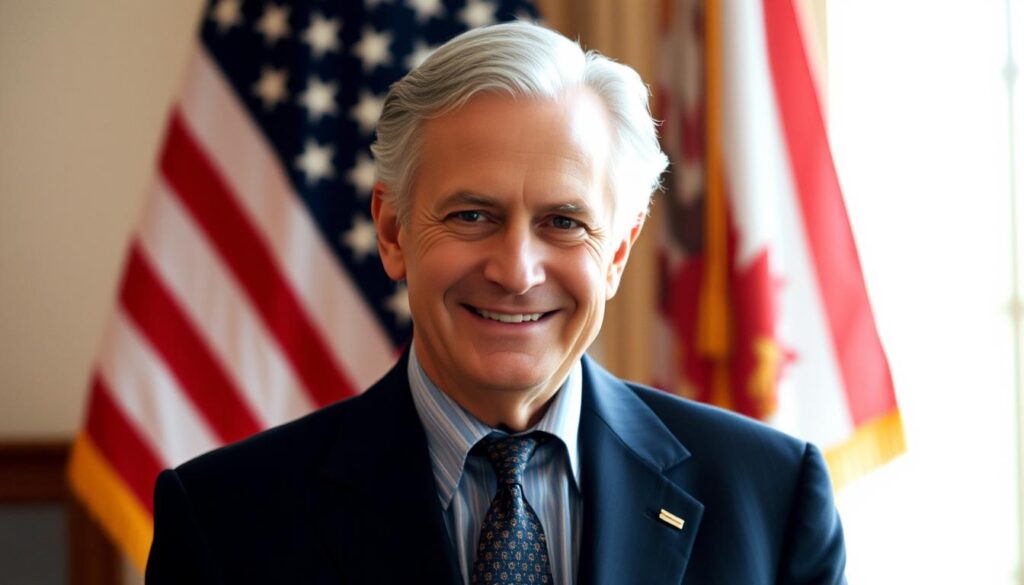
Ronald Reagan was the 40th President of the United States, serving from 1981 to 19891. He was born on February 6, 1911, in Tampico, Illinois, and passed away on June 5, 2004, in Los Angeles, California, at the age of 931. As President Ronald Reagan, he led the country through significant economic and social changes. His policies, like tax cuts and deregulation, helped the economy grow.
His presidency was marked by his charisma and ability to connect with people. This made him one of the most popular presidents in U.S. history.
Ronald Reagan’s life was shaped by his experiences in entertainment and politics. He joined the Republican Party in 1962, after being a Democrat1. As President, he cut $39 billion from the budget in his first year2. His economic policies reduced inflation from 13.5% in 1980 to 5.1% in 19822.
His presidency refocused the U.S. on social, business, and international issues. This left a lasting legacy in American politics.
Key Takeaways
- Ronald Reagan was the 40th President of the United States, serving from 1981 to 19891.
- He was born on February 6, 1911, in Tampico, Illinois, and passed away on June 5, 2004, in Los Angeles, California1.
- President Ronald Reagan implemented significant economic policies, including tax cuts and deregulation2.
- The Reagan administration negotiated the INF Treaty in December 1987 to reduce nuclear arsenals2.
- Ronald Reagan’s presidency had a lasting impact on American history, earning him a reputation as one of the most popular presidents in U.S. history.
- Ronald Reagan enrolled in Army Extension Courses on March 18, 1935, and was appointed Second Lieutenant on May 25, 19373.
- Ronald Reagan became President on January 20, 19813.
Early Life and Career
Ronald Reagan was born on February 6, 1911, in Tampico, Illinois, United States45. He grew up in Dixon, where his father, Jack Reagan, sold shoes but struggled with alcohol4. Despite these challenges, Reagan did well in school. He graduated from Dixon High School in 1928, excelling in sports, acting, and writing for the yearbook4.
Reagan worked as a lifeguard at Lowell Park during his summers. He saved 77 people from drowning4. At Eureka College, he improved his public speaking and leadership, earning a degree in economics in 193245.
Childhood and Adolescence
Reagan’s early life in Illinois taught him about resilience and community service. His school activities helped shape his charismatic personality.
Early Career in Entertainment
Reagan started as a radio sportscaster in 1932. He moved to Hollywood in 1937 and appeared in over 50 films45. His role in “Knute Rockne—All American” made him known as “The Gipper”4. His acting career improved his communication and public engagement skills.
Political Awakening
As president of the Screen Actors Guild from 1947 to 1952, Reagan fought against Communism in the film industry5. This role changed his views from liberal to conservative, a key part of his biography. His leadership was shaped by his belief in freedom and democracy, themes seen in his famous quotes.
“The greatest leader is not necessarily the one who does the greatest things. He is the one that gets the people to do the greatest things.” – Ronald Reagan
Presidency and Policies
Ronald Reagan’s presidency made big changes in the U.S. and around the world. He shaped the nation’s future with bold actions and smart plans.
Key Domestic Policies
The Reagan administration aimed to cut down government’s role. They lowered taxes by 30% over three years6. In his first year, Reagan wanted to cut the budget by $41 billion6.
Though Social Security reform was blocked in the Senate6, Congress passed most of the tax cuts6.
Foreign Policy Initiatives
Reagan stood strong against the Soviet Union. He supported anti-communist groups worldwide with the Reagan Doctrine. A key moment was when he signed the Intermediate-Range Nuclear Forces Treaty with Mikhail Gorbachev6.
This treaty helped reduce Cold War tensions6.
Economic Strategies
Reaganomics was Reagan’s economic plan. It focused on tax cuts, less regulation, and spending cuts to boost growth. By 1988, the top tax rate was 28%, the lowest in 57 years7.
This strategy led to 3.5% real GDP growth each year during his time in office7. Unemployment dropped from over 10% in 1982 to 5.3% in 19887.
Legacy and Impact
Ronald Reagan’s presidency had a lasting impact on America. His leadership and vision changed the country’s culture and politics. This change was deep and lasting.
Cultural Influence
Reagan’s charm and clear communication won over many Americans. His positive view of America brought back patriotism and confidence. This inspired many to believe in a better future.
Political Repercussions
Reagan’s presidency changed the Republican Party. He focused on conservative values and economic policies. His ideas on federalism and privatization influenced future politics and laws89.
Evaluations by Historians
Most historians see Reagan as one of the top U.S. presidents. They praise his role in ending the Cold War and boosting the economy. Yet, his policies also raised the national debt and budget deficits. This has sparked ongoing debates about his legacy89.
FAQ
What were the key accomplishments of President Ronald Reagan?
President Ronald Reagan’s main achievements include his economic plan, Reaganomics. This plan focused on cutting taxes, reducing regulations, and lowering government spending. He also played a key role in ending the Cold War through his strong foreign policy and talks with Soviet leader Mikhail Gorbachev.
Reagan strengthened the U.S. military and promoted conservative values. His efforts had a lasting impact on the Republican Party and American politics.
How did Ronald Reagan transition from an entertainer to the presidency?
Ronald Reagan started in Hollywood, where he developed his communication skills and public image. He became president of the Screen Actors Guild, using his charisma and leadership to enter politics. His ability to connect with people and share his vision for America helped him become the 40th President of the United States.
What is Reaganomics and how did it impact the American economy?
Reaganomics is President Ronald Reagan’s economic plan. It focused on tax cuts, deregulation, and reducing government spending. The goal was to boost economic growth by encouraging investment and entrepreneurship.
In the short term, it led to lower taxes and a booming stock market. But it also caused higher budget deficits and income inequality. In the long term, it changed American economic policy, focusing on supply-side economics and influencing future administrations.
How did Ronald Reagan contribute to the end of the Cold War?
Ronald Reagan played a key role in ending the Cold War. He stood firm against the Soviet Union and engaged in diplomatic efforts with Soviet leader Mikhail Gorbachev. His commitment to reducing nuclear weapons and his vision helped create a détente, leading to the Soviet Union’s dissolution.
What were the major domestic policies of the Reagan administration?
The Reagan administration focused on several key policies. These included economic reforms through Reaganomics, reducing government regulation, and lowering crime rates. He also emphasized education reform and promoted conservative values.
His policies aimed to boost economic growth, enhance national security, and strengthen traditional American values. They left a significant mark on the nation’s domestic landscape.
How is Ronald Reagan’s legacy viewed by historians today?
Historians view Ronald Reagan’s legacy with both praise and criticism. Many admire his leadership, communication skills, and role in ending the Cold War. His economic policies, Reaganomics, are credited with revitalizing the economy, but also criticized for increasing income inequality and national debt.
Reagan is often praised for his ability to inspire and unite the country. Debates continue about the long-term effects of his policies on American society and politics.
In what ways did Ronald Reagan influence the Republican Party?
Ronald Reagan significantly influenced the Republican Party. He solidified its conservative ideology, promoting policies of limited government, free-market capitalism, and strong national defense. His presidency, known as the “Reagan Revolution,” reshaped the party’s platform and attracted a broad coalition of voters.
Reagan’s emphasis on conservative principles set the stage for future Republican leaders. It continues to shape the party’s identity and policy priorities today.
What role did Ronald Reagan’s early life play in shaping his presidency?
Ronald Reagan’s early life in a small-town Illinois family instilled in him strong values of hard work, resilience, and communication. His experiences as a radio announcer and Hollywood actor developed his exceptional public speaking skills and charismatic presence.
Reagan’s leadership as president of the Screen Actors Guild exposed him to political activism. These experiences collectively shaped his worldview, communication style, and leadership approach as President of the United States.
Can you provide some notable quotes from Ronald Reagan?
Of course! Ronald Reagan is known for his memorable quotes. Some include:
- “Mr. Gorbachev, tear down this wall!”
- “The most terrifying words in the English language are: I’m from the government and I’m here to help.”
- “There are no constraints on the human mind, no walls around the human spirit, no barriers to our progress except those we ourselves erect.”
These quotes reflect his optimistic vision, emphasis on limited government, and belief in individual ability.
What is the significance of the Reagan administration in American history?
The Reagan administration is significant in American history. It had a transformative impact on both domestic and foreign policies. Domestically, Reaganomics reshaped the economic landscape, while his focus on deregulation and reducing government intervention influenced future policy directions.
Internationally, his strong anti-communist stance and diplomatic efforts were key in ending the Cold War. The Reagan administration also emphasized revitalizing the military and promoting conservative social values. These efforts left a lasting legacy on the nation’s political and economic frameworks.
Source Links
- https://en.wikipedia.org/wiki/Ronald_Reagan – Ronald Reagan
- https://www.reaganlibrary.gov/reagans/reagan-administration/reagan-presidency – The Reagan Presidency
- https://www.reaganlibrary.gov/reagans/ronald-reagan/military-service-ronald-reagan – Military Service of Ronald Reagan
- https://millercenter.org/president/reagan/life-before-the-presidency – Ronald Reagan: Life Before the Presidency | Miller Center
- https://www.britannica.com/biography/Ronald-Reagan – Ronald Reagan | Biography, Presidency, & Facts | Britannica
- https://millercenter.org/president/reagan/domestic-affairs – Ronald Reagan: Domestic Affairs | Miller Center
- https://en.wikipedia.org/wiki/Domestic_policy_of_the_Ronald_Reagan_administration – Domestic policy of the Ronald Reagan administration
- https://millercenter.org/president/reagan/impact-and-legacy – Ronald Reagan: Impact and Legacy | Miller Center
- https://www.hoover.org/research/ten-legacies-ronald-reagan – The Ten Legacies of Ronald Reagan