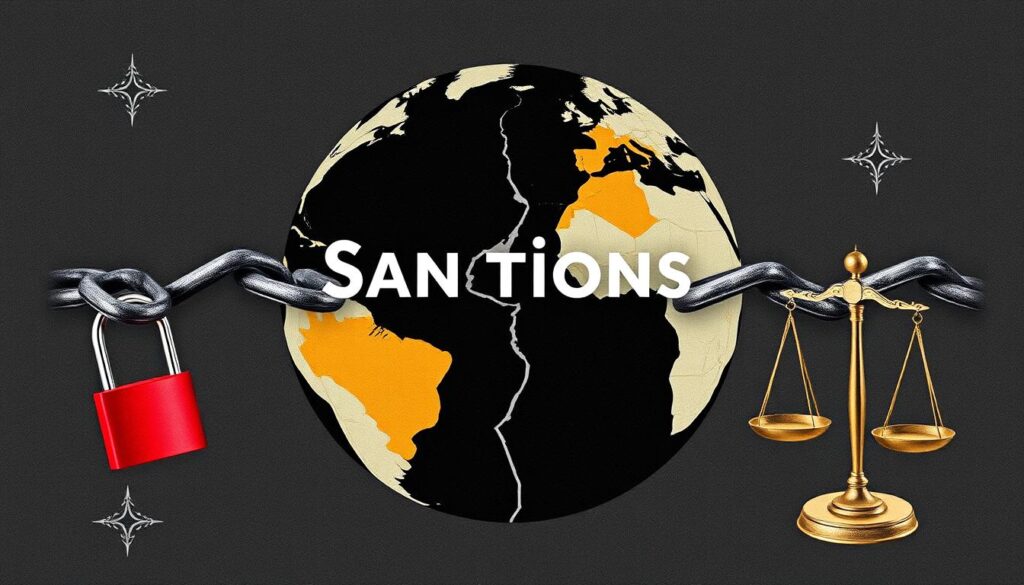
Sanctions are when countries stop trading and giving money to others for political reasons. They are a strong tool for governments and groups to change how other countries act. Knowing what sanctions are is key1.
Sanctions have a deep meaning and are used to make countries change their ways. They are used to protect interests and follow international rules. The U.S. has over 30 sanctions programs now1.
Sanctions are very important in world politics. They are used by big groups like the U.N. and the E.U. to solve problems. The E.U. uses sanctions to protect its interests and keep peace abroad2.
Think about how sanctions affect trade and the economy. They can change how countries and groups act. The U.N. often uses sanctions for things like stopping nuclear weapons and fighting terrorism2.
Introduction to Sanctions
Sanctions are a big part of world politics. Knowing about them is important for anyone interested in global issues. The U.S. has frozen over $330 billion of Russian money because of Ukraine1.
Key Takeaways
- Sanctions are a powerful tool for governments and international organizations to influence the behavior of states and non-state actors.
- The concept of sanctions meaning is complex and multifaceted, encompassing various types, including economic sanctions, diplomatic sanctions, and military sanctions.
- Understanding sanctions definition is vital in international relations, with the United Nations, the European Union, and the Organisation for Security and Cooperation in Europe (OSCE) being the main authorities imposing sanctions2.
- Sanctions play a significant role in global diplomacy, with the European Union imposing sanctions as a key tool of the Common Foreign and Security Policy (CFSP) to defend its strategic interests and protect its fundamental objectives abroad2.
- The implications of sanctions on global trade and economic stability are significant, with federal and state authorities settling at least fifteen cases against banks in recent years for sanctions violations, imposing huge fines and resulting in reputational damage1.
Understanding Sanctions and Their Types
Sanctions are key in international relations. They help influence or punish countries, groups, or people. They can affect a whole country or just certain groups, aiming to cause less harm.
Economic Sanctions
Economic sanctions are the most common. They include trade bans, freezing assets, and limiting money moves. For instance, the United Nations has a sanctions list that stops dealings with certain people and groups3.
Diplomatic Sanctions
Diplomatic sanctions are about kicking out diplomats or stopping talks. They show disapproval without hurting the economy or military. They aim to isolate a country diplomatically4.
Military Sanctions
Military sanctions limit a country’s military power. They stop the sale of arms and military tech. This helps keep a country from getting too strong5.
Travel Bans
Travel bans stop certain people or groups from moving around. They try to pressure leaders or groups by limiting their travel3.
| Type of Sanction | Description |
|---|---|
| Economic Sanctions | Includes trade embargoes, asset freezes, and financial restrictions. |
| Diplomatic Sanctions | Involves expulsion of diplomats and suspension of diplomatic relations. |
| Military Sanctions | Arms embargoes and restrictions on military cooperation and technology. |
| Travel Bans | Restricts the movement of targeted individuals or groups. |
Historical Context of Sanctions in Global Affairs
International sanctions have been a key part of global diplomacy. They allow countries to apply pressure without going to war. These measures have changed over time, showing how politics and strategies have evolved.
Case Study: Sanctions on Apartheid South Africa
Sanctions against South Africa played a big role in ending apartheid. Starting in the late 1960s, the world put economic bans and trade limits in place. This put a lot of pressure on the apartheid regime6.
This effort showed how sanctions can help change politics and society.
Recent Sanctions on Russia
After invading Ukraine, Russia faced tough sanctions. These were meant to hurt its economy and limit its military7. The sanctions targeted banking, trade, and access to key technologies.
But, China’s trade with Russia helped soften the blow of these sanctions7. This shows the challenges of enforcing sanctions in today’s global economy.
Evolution of Sanction Strategies
Sanctions strategies have changed over time. Now, we see more targeted sanctions, or “smart sanctions.” These focus on specific people and groups, aiming to avoid hurting civilians8.
This change shows a better understanding of how to use sanctions. It helps avoid harming innocent people.
| Sanction Type | Description | Impact |
|---|---|---|
| Economic Sanctions | Impose trade and financial restrictions | Can weaken target nation’s economy significantly |
| Targeted Sanctions | Focus on individuals or specific entities | Aim to minimize harm to general population |
| Diplomatic Sanctions | Limit diplomatic relations | Express disapproval without economic impact |
| Military Sanctions | Restrict arms sales and military cooperation | Prevent further military escalation |
Effectiveness of Sanctions in Changing State Behavior
Sanctions are used to change how countries act without using force. We look at their success by checking their economic and political effects.
Measuring Impact on Targeted Nations
To see if sanctions work, we look at different signs. From 2000 to 2021, sanctions grew a lot9. About one-third of them were seen as effective9.
Also, a study of over 200 sanctions found they helped 34% of the time9.
Case Studies of Success and Failure
Sanctions on Russia after it took Crimea in 2014 cost it over $50 billion a year for seven years10. But, Russia found new ways to sell oil to China and India10.
On the other hand, the U.S. embargo on Cuba, started in 1962, hasn’t changed Cuba’s politics11. These stories show sanctions can hurt a country’s economy but don’t always change its politics.
Alternatives to Sanctions
There are other ways to influence countries without sanctions. Using positive actions like trade deals and aid can help. Also, working together and making agreements can achieve goals without the downsides of sanctions.
| Country | Sanctions Imposed | Outcome | Reference |
|---|---|---|---|
| Russia | Economic sanctions post-2014 | Severe economic impact but continued energy exports | 10 |
| Cuba | Embargo from 1962 | Little political change, big humanitarian issues | 11 |
| Global | Over 200 sanctions from WWI | 34% reached some goals | 9 |
The Future of Sanctions in International Diplomacy
The world of international sanctions is always changing. New technologies and shifting global politics play big roles. Digital finance and cryptocurrencies are making sanctions policy both exciting and challenging.
Technological Advancements Impacting Sanctions
Modern tech, like digital finance and cryptocurrencies, is changing sanctions. Digital money can sneak past old financial systems, making it tough to stop bad money flows. This means we need new ways to make sanctions work.
Multilateral Sanctions vs. Unilateral Sanctions
Sanctions can come from many countries working together or just one country. When many countries join forces, like the UN or EU, their sanctions can have a big impact12. But, when just one country acts alone, like the US, it can be faster but might not get as much support1213.
Challenges and Criticisms of Modern Sanctions
Sanctions are used a lot, but they’re not without their problems. They can hurt regular people, making life harder and cutting off basic needs13. Also, countries being sanctioned can find ways to dodge the sanctions, which can actually make them stronger.
FAQ
What are sanctions in the context of international relations?
A: Sanctions are actions taken by countries or groups to change another’s behavior. They are a way to influence without using force. This method is used to encourage change without war.
What is the difference between economic and diplomatic sanctions?
A: Economic sanctions aim at a country’s economy. They include trade blocks, asset freezes, and financial limits. On the other hand, diplomatic sanctions are about actions like kicking out diplomats. They show disapproval and push for change.
How have sanctions been used historically to effect change?
Sanctions against apartheid South Africa are a great example. They helped end apartheid. These sanctions showed the power of international pressure in changing a system.
Are sanctions effective in changing a country’s behavior?
Sanctions work sometimes, like in South Africa. But, they can also have bad effects or not work at all, as seen with Russia.
What are “smart” or targeted sanctions?
A: Smart sanctions aim to hurt only those responsible. They target specific people or groups, not the whole country. This way, they try to avoid harming innocent people.
How do technological advancements impact the implementation of sanctions?
New tech like digital money makes sanctions harder to enforce. It allows for new ways to avoid sanctions. So, new methods are needed to keep up with these changes.
What is the difference between multilateral and unilateral sanctions?
A: Multilateral sanctions are agreed on by many countries or groups. This ensures everyone is on the same page. Unilateral sanctions come from one country. They might be harder to enforce because not everyone agrees.
What are some alternatives to imposing sanctions?
Instead of sanctions, we can use positive actions. This includes incentives, working together, and agreements. These methods encourage good behavior through cooperation, not punishment.
What challenges do modern sanctions face?
Today’s sanctions face many issues. These include ethical doubts, ways to avoid them, and the chance to make things worse. Finding a balance between being effective and caring for people is a big challenge.
What challenges do modern sanctions face?
Today’s sanctions face many issues. These include ethical doubts, ways to avoid them, and the chance to make things worse. Finding a balance between being effective and caring for people is a big challenge.
How have sanction strategies evolved over time?
Sanctions have changed from broad actions to more focused ones. This change comes from learning from past mistakes. It aims to be more effective while protecting civilians.
Source Links
- What Are Economic Sanctions? – https://www.cfr.org/backgrounder/what-are-economic-sanctions
- International sanctions – https://www.exteriores.gob.es/en/PoliticaExterior/Paginas/SancionesInternacionales.aspx
- Sanctions: What You Need to Know – https://www.lexisnexis.com/en-us/professional/risk-management/glossary/sanctions.page?srsltid=AfmBOooakRiWE78FPfi7CIUaPuQqZVABycYSuyfPIBr0JJsOTH-EBig8
- 5 Different Types Of Sanctions Explained – https://financialcrimeacademy.org/different-types-of-sanctions/
- What are the Types of Sanctions? – https://hyperverge.co/glossary/types-of-sanctions/
- Using Economic Sanctions to Prevent Deadly Conflict – https://www.belfercenter.org/publication/using-economic-sanctions-prevent-deadly-conflict
- Everything You Need to Know About Sanctions – https://globalaffairs.org/commentary-and-analysis/blogs/everything-you-need-know-about-sanctions
- A Brief History of Economic Sanctions – Carter-Ruck – https://www.carter-ruck.com/insight/a-brief-history-of-economic-sanctions/
- Are Economic Sanctions Effective Foreign Policy Tools? – https://now.tufts.edu/2024/07/08/are-economic-sanctions-effective-foreign-policy-tools
- Substitute to War – https://www.usmcu.edu/Outreach/Marine-Corps-University-Press/MCU-Journal/JAMS-vol-14-no-2/Substitute-to-War/
- Are government sanctions successful? – Thomson Reuters Institute – https://www.thomsonreuters.com/en-us/posts/government/government-sanctions-successful/
- Analytics – https://valdaiclub.com/a/highlights/future-of-sanctions-policy-in-a-multipolar-world/
- Do sanctions actually work? Experts evaluate the efficacy of this widely used foreign policy tool | Johns Hopkins in Washington, D.C. – https://washingtondc.jhu.edu/news/do-sanctions-actually-work-experts-evaluate-the-efficacy-of-this-widely-used-foreign-policy-tool/