
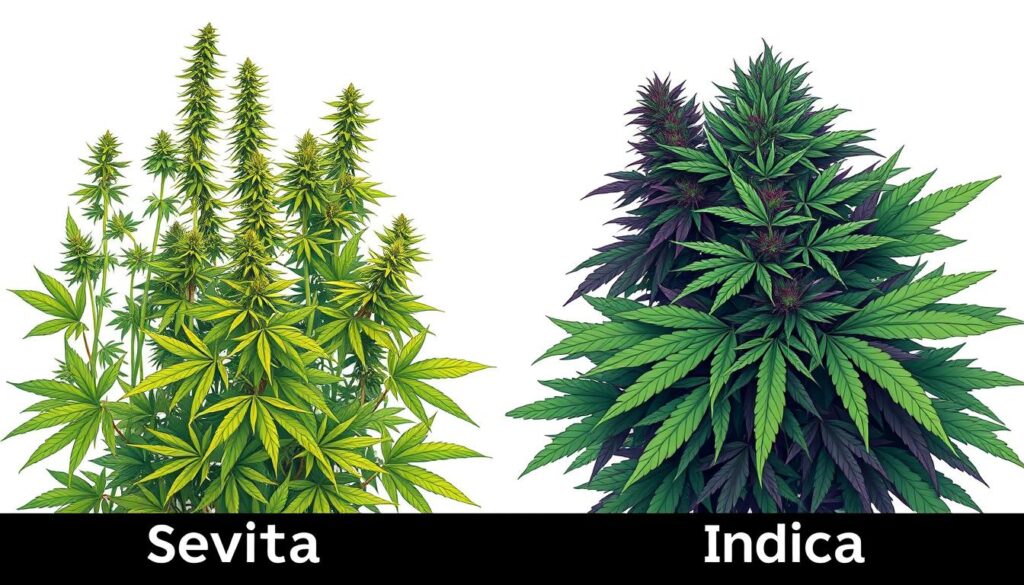
Navigating cannabis strains can be tricky for newcomers. Grasping the differences between marijuana varieties is key for those exploring these plants12. The sativa and indica labels only scratch the surface of their complexity.
Cannabis sativa thrives in hot, dry regions across Africa, Central America, and Southeast Asia. These plants can grow up to 6 feet tall1. They’re known for potentially boosting energy and creativity2.
Indica plants hail from Afghanistan, India, and Pakistan. They tend to be shorter and mature faster12. The marijuana comparison extends beyond physical traits to chemical profiles.
Scientists have identified at least 144 different cannabinoids. THC and CBD are crucial in determining how cannabis affects your body2. The traditional sativa-indica divide is becoming less relevant in modern cannabis research.
Recent studies show that individual strain biochemistry matters more than broad categories2. This shift in understanding helps users make more informed choices about cannabis products.
Key Takeaways
- Cannabis strains are more complex than simple sativa or indica labels
- Chemical composition determines the effects of cannabis
- THC and CBD play crucial roles in strain characteristics
- Plant origins vary from Africa to Central Asia
- Individual strain biochemistry is more important than traditional classifications
Understanding Cannabis Classifications and Chemical Profiles
Cannabis is more complex than traditional classifications suggest. It has a fascinating landscape of chemical interactions. These define its unique characteristics and potential effects.
The Role of Cannabinoids in Cannabis
Two main cannabinoids dominate cannabis chemovars: THC and CBD. THC drives psychoactive experiences, while CBD contributes to potential therapeutic applications3.
Different strains offer unique cannabinoid profiles. These influence their overall impact:
- THC-dominant strains: Powerful euphoric experiences3
- CBD-dominant strains: Minimal psychoactive effects3
- Balanced THC/CBD strains: Moderate euphoria with symptom relief3
Terpenes: Aromatic Powerhouses
Cannabis terpenes are aromatic compounds crucial to the plant’s effects. Researchers found 38 different terpenes in cannabis strains4. Nine key terpenes account for 86% of terpene profile variations4.
The entourage effect suggests these compounds work together. This synergy enhances cannabis experiences.
Beyond Traditional Classification
Modern cannabis research moves past simple indica/sativa labels. Chemovars now provide a more nuanced understanding of cannabis varieties. Hybrid strains combine characteristics from different genetic backgrounds4.
The industry recognizes three main chemovar types:
- Type I: High THC content
- Type II: Balanced THC/CBD
- Type III: High CBD content
Knowing these chemical profiles helps you make informed choices. You can better understand cannabis consumption and potential effects.
Sativa vs. Indica: Effects and Characteristics
Cannabis has evolved dramatically, with over 1,000 strains developed recently5. Understanding sativa and indica differences is crucial for medical marijuana users. These strains have unique profiles that impact their medical uses.
Indica plants are short and stocky with broad leaves. Sativa plants grow taller with thin, pointed leaves5. These visual differences hint at deeper chemical distinctions.
- Indica effects typically include:
- Relaxation and pain relief
- Support for sleep and muscle tension
- Potential treatment for chronic pain conditions6
Sativa strains often provide energizing and uplifting experiences. They’re useful for complex medical marijuana applications. Sativas may help with depression and anxiety5.
| Strain Type | Typical Effects | Medical Applications |
|---|---|---|
| Indica | Relaxation, sedation | Pain management, insomnia |
| Sativa | Energy, mental stimulation | Depression, mood disorders |
Hybrid strains now offer targeted medical properties. Individual chemical profiles matter more than strict classifications6. Modern cultivation has blurred traditional boundaries between strains.
The future of medical marijuana lies in precise chemical understanding, not broad categorizations.
Your cannabis choice should depend on specific medical needs and body chemistry7. Consult healthcare professionals to find the right medical marijuana solution.
Conclusion
Cannabis strain selection has evolved beyond simple indica and sativa labels. Scientific research now reveals the complex chemistry of these plants8. In 2021, Dalhousie University researchers found that traditional classifications are no longer relevant8.
Advanced understanding of cannabinoid and terpene interactions now drives personalized cannabis use9. Precise chemical profiling is replacing broad categories for strain classification. In 2023, the University of New Mexico developed a sophisticated indexing system for accurate strain identification8.
Focus on each strain’s unique chemical makeup when choosing cannabis. Researchers highlight that THC, CBD, and specific terpenes determine the plant’s effects9. Advancing technology will enable more tailored cannabis experiences beyond outdated classifications9.
The future of cannabis classification is rooted in scientific understanding. By grasping cannabinoid and terpene interactions, you can select strains matching your desired outcomes. This approach offers a more precise and personalized cannabis experience.
FAQ
What’s the difference between sativa and indica cannabis strains?
The sativa-indica classification is now seen as too simple. Strain effects depend more on cannabinoid and terpene profiles. These profiles determine the actual impact, not just the plant’s botanical type.
How do THC and CBD affect cannabis experiences?
THC creates psychoactive effects and binds to specific receptors. It can cause euphoria, ease pain, and boost appetite. CBD doesn’t cause a “high” but may help with anxiety and inflammation.
The THC to CBD ratio greatly influences a strain’s effects. This balance also impacts potential medical uses.
What are terpenes and why are they important?
Terpenes are aromatic compounds in cannabis. They shape the plant’s smell, taste, and effects. Over 150 terpenes have been found in cannabis.
Some terpenes, like myrcene, can make you sleepy. Others might perk you up or energize you.
Are hybrid strains better than pure sativa or indica?
Hybrid strains mix sativa and indica traits. They’re not always better, just different. The best strain depends on your needs and desired experience.
Consider your medical conditions when choosing a strain. Each person’s ideal strain can vary.
How are cannabis strains classified now?
The industry now uses chemovars (chemical varieties) instead of sativa/indica labels. Type I has high THC, Type II balances THC/CBD, and Type III has high CBD.
This new system gives a clearer picture of a strain’s likely effects.
Can cannabis help with medical conditions?
Cannabis may help with chronic pain, anxiety, insomnia, and poor appetite. Its effectiveness varies based on the strain’s chemistry and your body.
Always talk to a doctor before using cannabis for medical reasons.
What should I consider when choosing a cannabis strain?
Look at the strain’s cannabinoid and terpene profile, not just sativa or indica labels. Think about your desired effects and potential medical benefits.
Start with small doses. Pay attention to how different strains affect you personally.
Are there different types of cannabis plants?
Yes, there are three main types: Cannabis sativa, indica, and ruderalis. Sativa and indica are most common. Ruderalis is valued for breeding due to its autoflowering traits.
Sativa plants are usually tall with narrow leaves. Indica plants are shorter with broader leaves.
Source Links
- Beginner’s Guide to Cannabis Plants and Strains – https://www.healthline.com/health/sativa-vs-indica
- Indica vs. sativa: What’s the difference? – https://www.medicalnewstoday.com/articles/indica-vs-sativa
- Indica vs. Sativa: Understanding the Differences between Weed Types – https://greenleafmedcenter.com/indica-vs-sativa-understanding-the-differences-between-weed-types/
- Beyond Indica and Sativa: Understanding Cannabis through Terpene Profiles – https://curaleafclinic.com/beyond-indica-and-sativa-understanding-cannabis-through-terpene-profiles/
- Indica vs Sativa – Cresco Labs – https://www.crescolabs.com/indica-vs-sativa/
- Indica vs. Sativa: What’s the Difference? – https://www.webmd.com/mental-health/addiction/indica-vs-sativa-whats-the-difference
- What’s the Difference Between Indica and Sativa? – https://www.verywellhealth.com/indica-vs-sativa-1123887
- Sativa vs Indica: What’s the Difference, Effects & Benefits – https://releaf.co.uk/blog/sativa-vs-indica-the-outdated-debate
- The Myth of Indica vs. Sativa – Lyphe Clinic – https://lyphe.com/indica-vs-sativa/

