
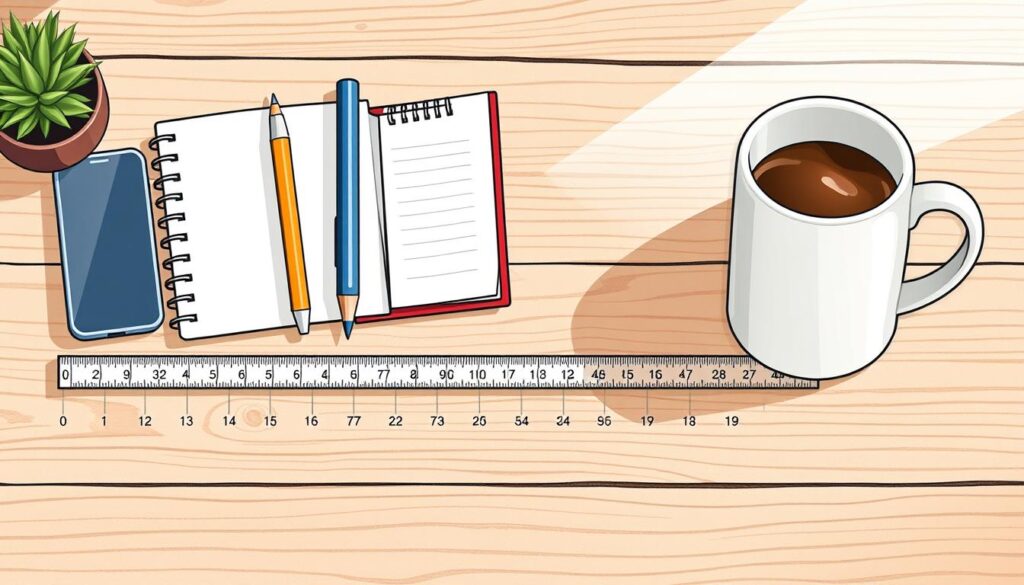
Measuring centimeters is a vital skill for everyday tasks. A centimeter ruler helps you track dimensions accurately1. This skill simplifies crafting, sewing, and DIY projects2.
To use a ruler, align the object’s edge with the first centimeter line. Standard rulers often have both 15 and 30 centimeter markings1. These tools provide flexibility in your measurements.
Centimeters are versatile for measuring various items. You can track the length of pencils, fish, tire radii, and even eye distance1. Each centimeter contains 10 millimeters, allowing for precise readings.
Key Takeaways
- Centimeters provide precise measurements for everyday objects
- A standard ruler helps track lengths up to 30 centimeters
- Millimeters offer additional measurement accuracy
- Metric measurements are used globally for consistency
- Practice improves measurement skills
Why Measuring in Centimeters is Important
The metric system offers precision in quantifying distances and sizes. Centimeter conversion is crucial in our global world. It transforms how we interact with our surroundings.
The metric system is simpler and more consistent than inches. One centimeter equals 0.39 inches. This makes it easy to understand different measurement standards.
Benefits of Using the Metric System
- Easy to understand and calculate
- Consistent scaling (10 mm = 1 cm, 100 cm = 1 meter)3
- Widely used internationally
- Precise measurements for scientific and engineering applications
Common Uses of Centimeters in Daily Life
Centimeters are vital in everyday activities. You’ll find them useful for:
- Measuring clothing sizes
- Determining smartphone dimensions
- Calculating craft project measurements
- Understanding body measurements4
“Precision is the essence of measurement, and centimeters provide just that.” – Measurement Expert
Metric measurements offer unmatched accuracy for small-scale objects. Centimeters provide a universal language for measuring various items. They’re useful for pencil length and rainfall measurements alike4.
Tools You Can Use to Measure Centimeters
Accurate centimeter measurement is vital for many tasks. You have several tools to help you. These tools can make a big difference in your projects.
Traditional Measuring Instruments
Classic tools are still reliable for measuring centimeters. Rulers and measuring tapes come in various lengths. They usually range from 15 to 100 centimeters.
- Simple, direct measurements
- Affordable options
- Easy to use for most objects
Digital Measuring Solutions
Technology has changed how we measure things. Smartphone apps like Prime Ruler now offer digital measuring5. These apps have many useful features.
- AR Ruler functionality
- Distance measurement
- Height calculations
- Area and perimeter tracking
Prime Ruler has a 4.4-star rating from 40,000 reviews6. This shows how digital tools can improve measurement accuracy.
Precision Measurement Instruments
Calipers are the best tool for ultra-precise measurements. They can measure small objects with great accuracy. These tools are ideal for science, engineering, and technical work.
| Tool Type | Accuracy Level | Best Use |
|---|---|---|
| Rulers | Basic | General measurements |
| Digital Apps | Moderate | Quick, convenient measurements |
| Calipers | High | Precision technical work |
“The right tool can transform measurement from a challenge to a simple task.” – Measurement Experts
Pick your measurement tool based on your needs. This will help you get the most accurate centimeter scale possible.
Tips for Accurate Measurements in Centimeters
Accurate centimeter measurement requires practice and attention to detail. A metric tape measure is essential for precise readings. Understanding millimeters and centimeters is key, with 10 millimeters equaling one centimeter7.
How to Measure Objects Effectively
Position your measuring tool flush against the object. The tape measure’s hook helps improve accuracy7. Align the zero mark precisely with the object’s edge.
For curved surfaces, use a flexible measuring tape. Read measurements at eye level to avoid parallax errors. This ensures accurate centimeter measurements.
Avoiding Common Measurement Mistakes
Safety first: wear protective eyewear when using measuring tools7. Watch out for misreading the scale or forgetting the tool’s thickness. A standard metric ruler is 30 cm long8.
Practice with familiar objects to boost your skills. This will help you gain confidence in your measuring technique. Remember, each centimeter has 10 precise millimeters8.
FAQ
What exactly is a centimeter?
A centimeter is a metric unit equal to 0.01 meters or 10 millimeters. It’s used to measure small lengths in the global metric system. Centimeters are handy for sizing everyday items like pencils, gadgets, and clothes.
How do I accurately measure something in centimeters?
Use a ruler with centimeter (cm) or millimeter (mm) marks. Line up the object’s edge with zero and read the length at the other end. Count whole centimeters and any extra millimeters for precision.
Always read at eye level to avoid errors. This helps ensure your measurements are as accurate as possible.
What tools can I use to measure centimeters?
You can use standard rulers, measuring tapes, or digital apps to measure centimeters. Calipers offer precision for smaller objects. For longer measurements, try a meter stick (100 cm).
Digital tools can give super accurate readings for various items. They’re great for both DIY and professional use.
How do centimeters compare to inches?
Centimeters belong to the metric system, while inches are part of the imperial system. One inch equals 2.54 centimeters. The metric system is more precise and consistent.
Centimeters are widely used for international communication and trade. They offer a standardized measurement that’s easy to understand globally.
Can I estimate centimeter measurements without a tool?
Yes, you can use body parts as rough guides. An adult’s hand width is about 10 centimeters. The distance from your nose to fingertips is roughly one meter (100 centimeters).
These estimates aren’t exact but can help with quick guesses. They’re handy when you don’t have a measuring tool nearby.
What are common mistakes to avoid when measuring in centimeters?
Watch out for misreading the scale or not lining up objects correctly. Don’t forget to consider the thickness of your measuring tool. Avoid incorrect rounding of numbers.
Place your measuring tool flush against the object for best results. Always read measurements at eye level to ensure accuracy.
Where are centimeters most commonly used?
Centimeters are key in science, engineering, clothing, electronics, and construction. You’ll spot them on clothes tags, phone specs, and in medical charts. They’re also crucial in scientific research.
Most countries use the metric system, making centimeters a universal unit. This widespread use makes them essential in many fields and everyday life.
Source Links
- What is a Centimeter? Definition, Measurement, Examples, Ruler – https://www.splashlearn.com/math-vocabulary/measurements/centimeter
- How To Measure In Millimeters, Centimeters & Meters – https://www.sciencing.com/measure-millimeters-centimeters-meters-8146016/
- Centimeter – Definition, Units, Tools, Conversions, How to measure – https://www.examples.com/maths/centimeter.html
- Centimeter And Its Conversions With Examples – Turito. – https://www.turito.com/learn/math/centimeter
- Ruler App: AR Tape Measure cm – https://apps.apple.com/us/app/ruler-app-ar-tape-measure-cm/id1020133524
- Ruler App: Measure centimeters – Apps on Google Play – https://play.google.com/store/apps/details?id=net.kosev.rulering
- How to Read a Tape Measure – https://www.thetapestore.co.uk/knowledgebase/How_to_Read_a_Tape_Measure.html
- How to Read a Ruler in Inches and Centimeters · PrepScholar – https://blog.prepscholar.com/how-to-read-a-ruler-inches-cm

