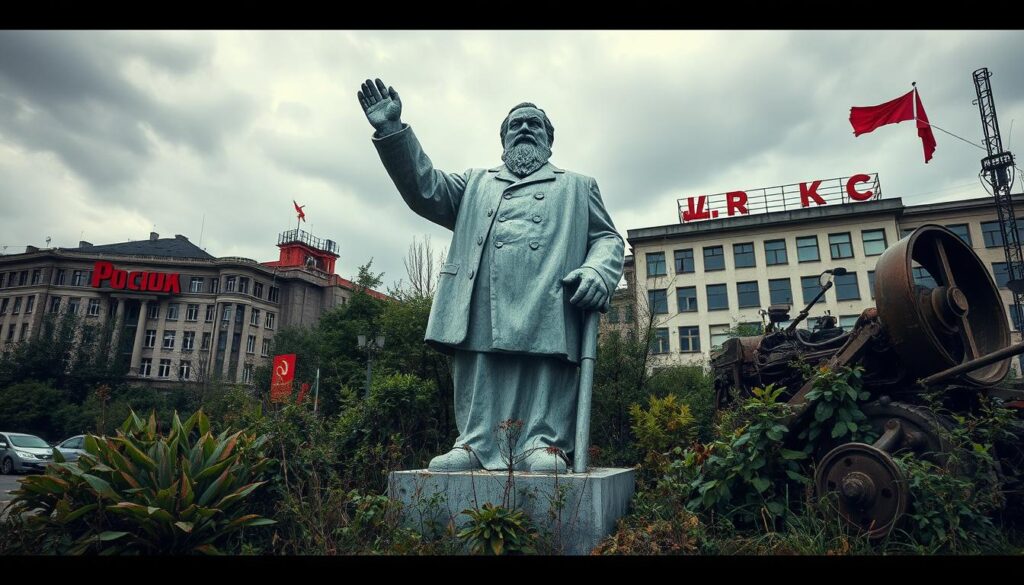
The Soviet collapse was a major event in the 20th century. It ended the Cold War and changed the world’s politics1. It began on November 16, 1988, and ended on December 26, 1991. This led to 15 new countries from the old Soviet Union1.
This event made the United States the only superpower left1.
The Soviet Union fell apart due to economic troubles, political changes, and growing national feelings in its republics2. The war in Afghanistan from 1979 to 1989 hurt the Soviet economy and weakened its military and government2.
The Soviet Union fell in just two years. It started with the Berlin Wall’s fall in November 1989 and ended with the Soviet Union’s breakup in December 19913.
Key Takeaways
- The Soviet collapse marked the end of the Cold War and reshaped the global geopolitical landscape.
- The dissolution of the Soviet Union resulted in the formation of 15 independent states.
- The United States emerged as the world’s sole superpower post the collapse of the Soviet Union.
- The war in Afghanistan drained the Soviet Union’s economy and undermined its military and government strength.
- The collapse of the Soviet Union was a result of a combination of economic stagnation, political reforms, and growing nationalist movements in Soviet republics.
- The Soviet Union’s dissolution had far-reaching consequences, including the emergence of new independent states and a shift in the global balance of power.
Historical Context of the Soviet Union
The Soviet Union started in 1922 after the Russian Revolution. It was based on communist ideology and a planned economy. The goal was to make a society without classes, unlike capitalism.
Formation and Ideology of the USSR
The USSR followed Marxist-Leninist ideas. It wanted the state to own everything and get rid of private property. The aim was to end social differences and create a single socialist state.
Key Leaders and Their Roles
Leaders like Lenin started the revolution, and Stalin ruled with an iron fist. Later, Mikhail Gorbachev tried to change things. He wanted to make the system better, but it was hard4.
Economic Structure and Challenges
The Soviet economy was all about planning and state control. It did well at first but then hit big problems. These issues, like being inefficient and not growing, led to its downfall5.
Rise of Nationalism in Soviet Republics
As the Soviet Union grew, different republics wanted to show their own cultures. This rise in nationalism made it harder for the central government. It made the Soviet Union break apart as republics wanted to be free in the post-Soviet era45.
Major Events Leading to the Collapse
The Soviet Union disintegration was a slow process. It was shaped by key events that weakened the communist state.
The Fall of the Berlin Wall
The Berlin Wall’s fall in 1989 showed the Soviet’s power was fading in Eastern Europe. It was a big step in the Cold War aftermath.
The Impact of Mikhail Gorbachev’s Reforms
Mikhail Gorbachev brought in perestroika and glasnost to boost the economy and open up society. But these moves also made the USSR weaker by bringing more political freedom and economic trouble6.
The 1991 August Coup
A failed coup in August 1991 showed the Soviet leadership was weak. It was a blow to the Soviet’s authority and sped up its fall67.
Independence Movements Across Republics
Nationalism grew strong in places like Lithuania and Latvia. They declared independence, breaking the USSR into fifteen separate countries6.
| Event | Date | Impact |
|---|---|---|
| Fall of the Berlin Wall | 1989 | Symbolized end of Soviet dominance in Eastern Europe |
| Gorbachev’s Reforms | 1985-1991 | Introduced political openness and economic restructuring |
| 1991 August Coup | August 19-21, 1991 | Failed attempt to halt reforms, exposed leadership weaknesses |
| Independence Declarations | 1990-1991 | Led to the emergence of fifteen independent nation-states |
Consequences of the Soviet Collapse
The fall of the Soviet Union changed the world in big ways. It has had lasting effects on politics, economy, society, and today’s politics. These changes are seen all over the globe.
Geopolitical Changes in Eastern Europe
Eastern European countries became free and wanted to join the West. Poland, Hungary, and the Czech Republic joined the European Union. This move changed their politics and reduced Soviet power in Europe8.
Economic Transition and Challenges
Switching to market economies was hard. Many former Soviet states saw their economy drop by 20% from 1989 to 19919. Inflation rose, and corruption grew. Yet, some countries joined global groups, like Russia joining the World Trade Organization in 20129.
Social Impact on Former Soviet States
The fall of the Soviet Union brought big social changes. Crime and corruption rose, like in Russia9. But, it also led to more freedom and civil society. These changes have shaped the future of these countries.
Legacy of the Soviet Union in Modern Politics
The Soviet Union’s legacy is clear in today’s politics. Tensions between the US and Russia have lasted, fueled by old Cold War issues9. Some countries have turned to authoritarian rule, showing old patterns8. The Soviet collapse also weakened US influence, as studies have shown9.
FAQ
What were the primary factors that led to the collapse of the Soviet Union?
The Soviet Union fell due to economic troubles, poor political reforms, and growing nationalism. The economy was inefficient, and Gorbachev’s reforms made things worse. They showed the system’s flaws and sparked public discontent.
How did Mikhail Gorbachev’s reforms contribute to the USSR dissolution?
Gorbachev wanted to fix the economy and increase openness. But his efforts weakened the Communist Party’s control. This allowed for more freedom and led to demands for independence, causing the USSR to break apart.
What was the significance of the fall of the Berlin Wall in the context of the Soviet breakup?
The Berlin Wall’s fall in 1989 ended Soviet control in Eastern Europe. It was a key moment in the Cold War’s end. It inspired other Soviet republics to seek freedom, speeding up the Soviet Union’s collapse.
What were the major consequences of the Soviet collapse on the global geopolitical landscape?
The Soviet collapse changed the world by ending the Cold War. It made the West stronger and led to 15 new countries. It also changed Eastern Europe and the economy, creating new challenges and opportunities.
How did the economic structure of the Soviet Union contribute to its eventual disintegration?
The Soviet economy was once strong but became inefficient over time. It lacked innovation and wasted resources. This led to stagnation, low living standards, and dissatisfaction, weakening the Soviet state.
In what ways did nationalist movements within Soviet republics influence the fall of the Soviet Union?
Nationalism played a big role in the Soviet collapse. It brought out strong regional identities and desires for freedom. As the Soviet Union opened up, these movements grew, leading to independence declarations and the Soviet Union’s end.
What legacy has the Soviet Union disintegration left on modern politics?
The Soviet collapse has shaped modern politics. It led to ongoing tensions with Russia, the rise of authoritarianism, and new alliances. It also influenced global policies and economic systems, serving as a lesson in governance and sovereignty.
How did the Cold War aftermath shape the post-Soviet era?
The Cold War’s end changed the world. It led to new international relations and economic systems. Former Soviet states faced challenges like instability and economic struggles. But it also opened up to diplomacy and cooperation.
Source Links
- Dissolution of the Soviet Union – https://en.wikipedia.org/wiki/Dissolution_of_the_Soviet_Union
- The Fall of the Soviet Union – https://europe.unc.edu/iron-curtain/history/the-fall-of-the-soviet-union/
- Collapse – https://www.bbc.com/historyofthebbc/100-voices/coldwar/collapse/
- Milestones in the History of U.S. Foreign Relations – https://history.state.gov/milestones/1989-1992/collapse-soviet-union
- Collapse of the Soviet Union | Causes, Facts, Events, & Effects | Britannica – https://www.britannica.com/event/the-collapse-of-the-Soviet-Union
- 25.12: The Collapse of the Soviet Union: A Timeline of Key Events – https://communistcrimes.org/en/2512-collapse-soviet-union-timeline-key-events
- The Soviet Collapse – https://origins.osu.edu/article/soviet-collapse-yeltsin-putin-gorbachev-russia
- The Collapse of the Soviet Union and Its Repercussions: A Literature Review – https://digitalcommons.library.uab.edu/cgi/viewcontent.cgi?article=1216&context=vulcan
- Consequences of the Collapse of the Soviet Union – https://online.norwich.edu/online/about/resource-library/consequences-collapse-soviet-union