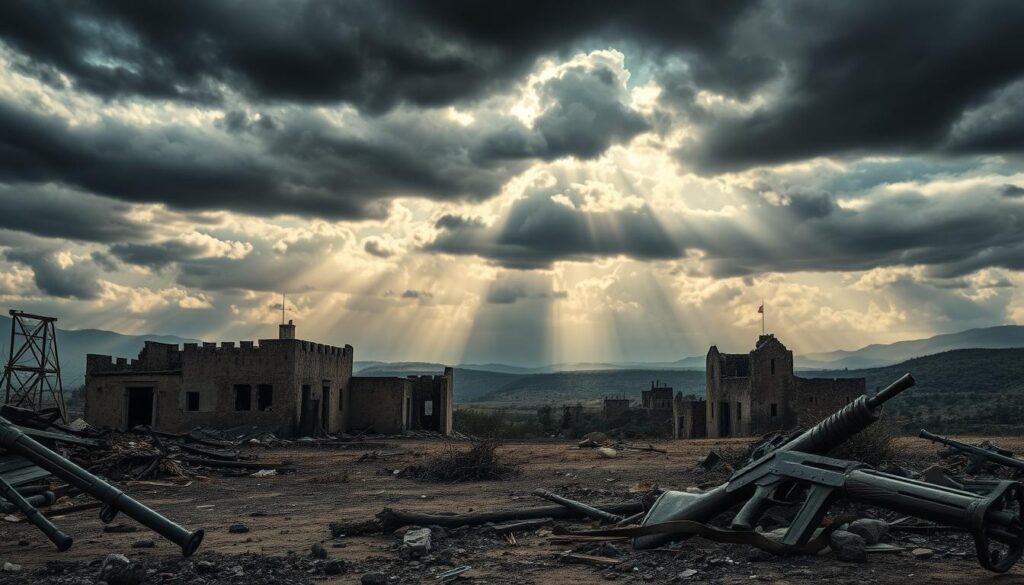
The Spanish Civil War started on July 17, 1936. Generals Emilio Mola and Francisco Franco led an uprising against the elected republic1. This event changed Spanish and European history, becoming a key part of Spanish politics.
The war involved many groups and ideas. Its effects lasted for years, influencing Spanish history and politics.
The conflict wasn’t just a local issue. It drew volunteers from all over, including the International Brigades2. These groups fought against Fascism and imperialism. The Spanish Civil War was a preview of World War II’s ideological battles. Its legacy is important for understanding Spanish history and politics.
The Spanish Civil War was a turning point in Spanish history. It was marked by violence, destruction, and human suffering. About 500,000 people died, and 100,000 were executed by the Nationalists1.
We will look at the war’s causes and effects. We will also see how it impacted Spanish society and politics.
Key Takeaways
- The Spanish Civil War started on July 17, 1936, and lasted for three years, resulting in significant loss of life and destruction1.
- The conflict was a complex struggle involving various factions and ideologies, including the International Brigades, which consisted of between 40,000 and 60,000 volunteers from various countries2.
- The war had significant international implications, drawing in volunteers from around the world and shaping the trajectory of Spanish history and Spanish politics.
- The Spanish Civil War was a microcosm of the ideological struggles that would soon engulf Europe in World War II, and its legacy continues to be felt today, making it an essential topic in understanding Spanish history and Spanish politics.
- The conflict resulted in immense human suffering, with approximately 500,000 people losing their lives, and around 100,000 persons being executed by the Nationalists during the war1.
- The Spanish Civil War was a pivot event in Spanish history, and its impact would be felt for decades to come, shaping the course of Spanish and European history3.
- The war was a complex and multifaceted struggle, involving various factions and ideologies, and its legacy continues to be felt today, making it an essential topic in understanding Spanish history and Spanish politics2.
Overview of the Spanish Civil War
The Spanish Civil War lasted from July 17, 1936, to March 28, 19394. It was fueled by deep political and social divisions in Spain. The Nationalist forces, led by military leaders and conservatives, clashed with the Republican forces. These included urban workers and the educated middle class4.
Causes of the Conflict
Economic gaps and ideological differences were at the heart of the conflict. Nationalists were mostly Roman Catholics, military officers, landowners, and business leaders. Republicans, on the other hand, were urban workers, farmers, and intellectuals4. These divisions led to the war.
Key Players and Factions
General Francisco Franco led the Nationalist forces, establishing the Franco dictatorship5. Manuel Azaña and Dolores Ibárruri were key figures on the Republican side. The Republicans also got support from around 40,000 volunteers in the International Brigades45.
Timeline of Major Events
The war started with a military uprising in July 1936. By November, Nationalist forces had Madrid surrounded, starting a siege that lasted until March 19394. Both sides saw big changes in military power and suffered heavy losses65
Impact on Spanish Society
The Spanish Civil War was a devastating conflict that changed the nation. About 500,000 people lost their lives, with 200,000 dying from systematic killings7.
Social Changes During the War
Society was greatly shaken. Rural and urban areas were hit hard. Families were split, and old social norms were tested by war.
Effects on Culture and Arts
The war sparked a burst of creativity. Artists and writers spoke out through their work. Pablo Picasso’s “Guernica” is a famous example of this8.
Post-War Consequences
After Franco won, the Republican government was destroyed. This led to the suppression of local identities and the rise of the Falangists’ rule. The war’s aftermath included political oppression and a move towards total control in Spain.
International Involvement in the War
The Spanish Civil War drew the world’s attention, becoming a stage for different ideologies. Thousands of volunteers from around the globe joined, shaping Spanish politics.
Foreign Support for Republican Forces
More than 35,000 volunteers from the International Brigades fought for the Republicans. They came from over 50 countries910. The Soviet Union was a big help, sending lots of ammunition and military equipment in October 193610.
Role of the Nazi Germany and Fascist Italy
Nazi Germany and Fascist Italy gave a lot of military aid to Franco’s Nationalists. Germany sent over 6,000 rifles, nearly 500 machine guns, and 10,000 grenades by mid-193610. Italy contributed 130 aircraft, 12,000 machine guns, and 75,000 Blackshirt volunteers10.
The Abraham Lincoln Brigade
The Abraham Lincoln Brigade had about 2,800 American volunteers fighting for the Republicans. This group was the first fully integrated army in U.S. history. Women like Evelyn Hutchins even drove trucks, breaking gender roles11.
| Country | Support Provided | Reference |
|---|---|---|
| Soviet Union | 1,000+ tonnes of ammunition, 500 tonnes of hardware | 10 |
| Germany | 6,000 rifles, 500 machine guns, 10,000 grenades | 10 |
| Italy | 130 aircraft, 12,000 machine guns, 75,000 volunteers | 10 |
| USA | 2,800 volunteers in the Abraham Lincoln Brigade | 11 |
Legacy of the Spanish Civil War
The Spanish Civil War has left a lasting mark on Spanish history and the era of the Franco dictatorship. It has shaped the nation’s collective memory and political landscape.
Historical Interpretations and Controversies
Many groups see the war through different eyes, sparking debates about its causes and effects. These debates show the deep divisions within Spanish society12.
Influence on Future Conflicts
The civil war foreshadowed World War II, showing the battle between authoritarianism and democracy. Its lessons have guided strategies in global conflicts1314.
Commemorations and Memorials
Efforts to honor the Spanish Civil War include removing Francisco Franco’s remains from the Valley of the Fallen in 2019. This move highlights the need to heal historical wounds. The discovery and identification of mass graves have also been key in reconciling Spain’s past with its present12.
FAQ
What were the primary causes of the Spanish Civil War?
The Spanish Civil War started in 1936. It was caused by big economic inequalities, ideological differences, and political instability. Conservative and liberal groups had big disagreements, and extremist groups like the Falangists and Republican forces added to the tension. This led to a military uprising, starting a devastating war that changed Spanish and European history.
Who were the key players and factions in the Spanish Civil War?
The war was mainly between the Nationalist forces led by General Francisco Franco and the Republican forces. Important figures like Manuel Azaña and Dolores Ibárruri played big roles. The Falangists supported Franco, while the Republicans got help from the International Brigades.
How did the Spanish Civil War impact Spanish society?
The war changed Spanish society a lot. It caused social and cultural changes. People from all walks of life were affected, making class divisions worse. The war also influenced the arts and culture, with many artists and writers responding to the turmoil.
After Franco won, Spain became a totalitarian regime. This suppressed regional identities and left a lasting impact on Spain’s society and politics.
What role did the International Brigades play in the Spanish Civil War?
The International Brigades were volunteers from around the world who fought for the Republican forces. The Abraham Lincoln Brigade brought American volunteers to Spain. They provided military and moral support to the Republicans, showing the global fight against fascism.
Their involvement also set a precedent for future global alliances seen in World War II.
How did foreign powers influence the outcome of the Spanish Civil War?
Foreign powers played a big role in the war’s outcome. Nazi Germany and Fascist Italy helped the Nationalist forces a lot. They gave them weapons, troops, and air support, helping Franco win.
The Republican forces got little help from countries that didn’t want to get involved. But they did get some help from the Soviet Union and the International Brigades. This made the Spanish Civil War a proxy war for bigger ideological fights.
What were the long-term consequences of Franco’s victory in the Spanish Civil War?
A: Franco’s dictatorship had big effects on Spain. His regime was very centralized and authoritarian, suppressing dissent and regional identities. It targeted places like Catalonia and the Basque Country a lot.
Economically, Spain stayed isolated and fell behind other European countries for decades. Socially and culturally, Franco enforced conservative values and censored art. It wasn’t until his death in 1975 that Spain started to move towards democracy.
In what ways did the Spanish Civil War serve as a precursor to World War II?
The Spanish Civil War was a small version of the big fights that would soon engulf Europe in World War II. It showed the fight between fascism and republicanism, with foreign powers testing their strategies and alliances. Nazi Germany and Fascist Italy got valuable experience, while the Republicans got little help.
This war also made fascist movements in Europe more confident, setting the stage for the bigger war that followed.
How is the Spanish Civil War remembered and commemorated in contemporary Spain?
The legacy of the Spanish Civil War is complex in modern Spain. There are memorials, museums, and events to honor those who fought. But there are debates about how to deal with Franco’s legacy and the atrocities committed by both sides.
Legislative efforts, like the Law of Historical Memory, aim to recognize the suffering and promote reconciliation. But there are challenges in fully reconciling different historical views.
Source Links
- Spanish Civil War – https://encyclopedia.ushmm.org/content/en/article/spanish-civil-war
- SpanishCivilWar – Department of History – https://hist.fullerton.edu/initiatives/spanishcivilwar.php
- Spanish Civil War breaks out | July 17, 1936 | HISTORY – https://www.history.com/this-day-in-history/spanish-civil-war-breaks-out
- Spanish Civil War | Definition, Causes, Summary, & Facts | Britannica – https://www.britannica.com/event/Spanish-Civil-War
- Spanish Civil War Summary | The Abraham Lincoln Brigade Archives – https://alba-valb.org/lesson/spanish-civil-war-summary/
- Spanish Civil War – https://en.wikipedia.org/wiki/Spanish_Civil_War
- Social Revolution and Civil War in Spain | The National WWII Museum | New Orleans – https://www.nationalww2museum.org/war/articles/social-revolution-spanish-civil-war
- The art that outlives the war: How the Spanish Civil War gave rise to a new visual language | Marquette Today – https://today.marquette.edu/2024/05/the-art-that-outlives-the-war-how-the-spanish-civil-war-gave-rise-to-a-new-visual-language/
- International response to the Spanish Civil War – https://en.wikipedia.org/wiki/International_response_to_the_Spanish_Civil_War
- International involvement in the Spanish Civil War – https://www.tutor2u.net/history/reference/international-involvement-in-the-spanish-civil-war
- The Spanish Civil War: U.S. Foreign Policy Between the World Wars: Introduction | The Abraham Lincoln Brigade Archives – https://alba-valb.org/resource/introduction/
- The Battle Over the Memory of the Spanish Civil War – https://www.smithsonianmag.com/history/battle-memory-spanish-civil-war-180969338/
- The Spanish Civil War: This far and no further – People’s History Museum – https://phm.org.uk/blogposts/the-spanish-civil-war-this-far-and-no-further/
- Spain’s Civil War and the Americans who fought in it: a convoluted legacy – https://theconversation.com/spains-civil-war-and-the-americans-who-fought-in-it-a-convoluted-legacy-62464