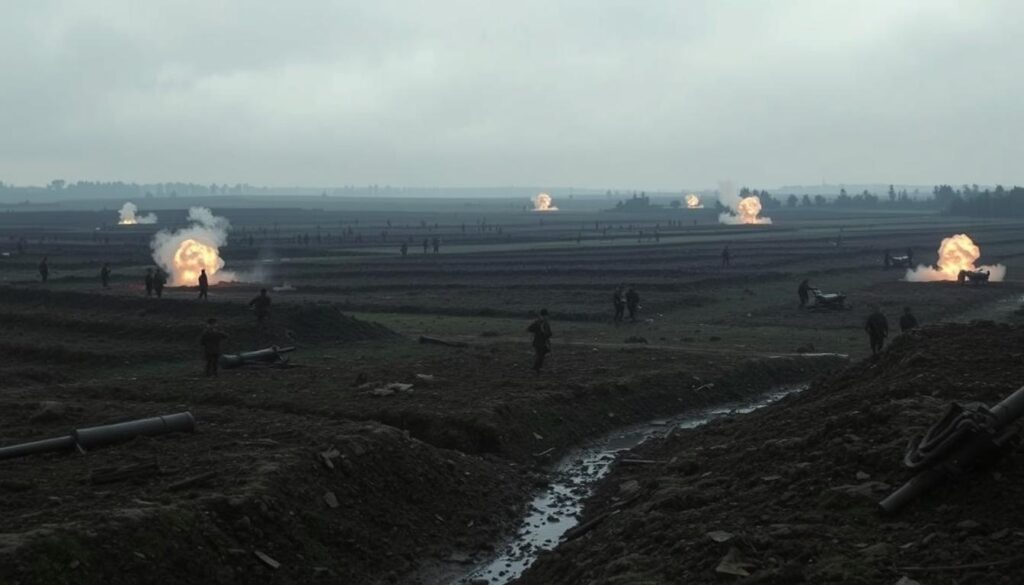
The Battle of St. Mihiel was a key event in World War 1. It happened from September 12-15, 1918. The American Expeditionary Forces (AEF) and 110,000 French troops fought against the Germans under General John J. Pershing of the United States1.
This battle was the first big push by the United States Army in World War I. It was a test of American military power. The American Expeditionary Forces were a big part of the battle. By the summer of 1918, 1.2 million American soldiers were on the Western Front1.
Think about the scale of the St. Mihiel battle. There were 550,000 troops, 3,000 pieces of field artillery, and over 1,000 aircraft ready1. The US Air Service had 226 pursuit aircraft, 219 observation planes, and 42 bombing aircraft1. Two American Army officers, Lieutenant Colonel George S. Patton and Brigadier General Douglas MacArthur, met on a small hill during the battle2.
Key Takeaways
- The Battle of St. Mihiel was a major World War I battle fought from September 12-15, 1918.
- The American Expeditionary Forces played a key role in the battle, with 1.2 million American soldiers present on the Western Front by the summer of 19181.
- The battle marked the first large offensive launched mainly by the United States Army in World War I.
- The St. Mihiel battle involved significant air power, with the US Air Service having 226 pursuit aircraft, 219 observation planes, and 42 bombing aircraft available1.
- Lieutenant Colonel George S. Patton and Brigadier General Douglas MacArthur met for the first time during the First World War on the battlefield of St. Mihiel2.
Overview of the Battle of St. Mihiel
The Battle of St. Mihiel was a key moment in St. Mihiel France. It showed how well American and French forces worked together. This battle was important for the Allies to gain control of the Western Front.
Historical Context of World War I
By 1918, World War I had become a long and tough fight. The St. Mihiel salient in France was a strategic area that threatened the Allies. It needed a strong response to balance the fight3.
Key Objectives of the Offensive
General Pershing wanted to break through the German lines in the St. Mihiel salient. He aimed to move towards Metz. The goal was to remove the bulge, weaken the Germans, and take back lost ground3.
Major Forces Involved
The St. Mihiel offensive brought together 216,000 Allied soldiers. This included American and French troops against 48,000 German defenders3. The Allies used smart strategies and teamwork to fight the enemy.
| Aspect | Allies | Germans |
|---|---|---|
| Strength | 216,000 men, 144 tanks, 1,481 aircraft | 48,000 men, 275 tanks, 213 aircraft |
| Casualties | 7,000 | 22,500 (2,000 KIA, 5,500 WIA, 15,000 POW) |
| Artillery | 2,900 pieces | 450 guns captured |
| Aircraft Engagement | 1,481 involved | 717 French airplanes |
Strategic Importance of St. Mihiel
The St. Mihiel sector was key in World War I, giving the Allies big advantages. To see why, we need to look at military and logistical factors.
Geographic Advantages
The St. Mihiel salient, shown on the St. Mihiel map, had high ground. This was perfect for setting up artillery and watching German movements4. It gave the Allies a big advantage in the area.
Logistical Considerations
Supply lines in the St. Mihiel sector were hard to manage because of the tough terrain and German defenses5. Over 1,500 Allied planes, 40% of the airpower, helped keep troops and artillery moving4.
Impact on Allied Morale
The win at St. Mihiel really lifted Allied spirits. It showed how good American forces and new strategies were5. It also introduced terms like “D-Day” and “H-Hour,” boosting confidence and determination among the troops.
| Aspect | Details |
|---|---|
| Duration | September 12-15, 1918 |
| Participants | France, Germany, United States |
| Allied Airpower | 40% American, 1,500 aircraft4 |
| Casualties | 7,000 US casualties out of 550,000 troops4; 17,500 German, including 10,000 captured5 |
Aftermath and Legacy of the Battle
The Battle of St. Mihiel was a turning point in World War I. It had a big impact on both the Allied and Central Powers. The United States lost about 7,000 soldiers, while Germany lost at least 17,500, including 10,000 captured6. This battle showed the strength of American troops in Europe6.
Casualties and Assessments
The losses on both sides were huge. They showed how brutal and intense the war was. These numbers highlight the human cost and the challenges faced during the battle.
Influence on Future Military Strategies
The victory at St. Mihiel changed military tactics. It showed the value of teamwork and air power. These lessons helped shape American military strategies in future wars6.
Commemoration and Historical Significance
The Battle of St. Mihiel’s legacy lives on at the St. Mihiel American Cemetery and memorials6. These places remember the sacrifices and the battle’s importance. They ensure the battle’s history is kept alive for future generations.
FAQ
What was the Battle of St. Mihiel?
The Battle of St. Mihiel was a key World War I fight. It was led by General John J. Pershing and the American Expeditionary Forces. It happened from September 12 to September 15, 1918, in France. It was the first big fight led by the U.S. Army in the war.
When and where did the Battle of St. Mihiel occur?
The Battle of St. Mihiel happened from September 12 to September 15, 1918. It took place in the St. Mihiel salient in northeastern France. This area was important for both German and Allied forces.
Who were the major forces involved in the Battle of St. Mihiel?
The main forces were the American Expeditionary Forces led by General John J. Pershing and French troops. They faced German defenders in the St. Mihiel salient. The Germans were trying to keep their strong positions.
What were the key objectives of the St. Mihiel offensive?
The main goals were to remove the German salient, cut enemy supply lines, and free French areas. General Pershing wanted to break through the German lines and maybe reach Metz.
Why was the St. Mihiel salient strategically important?
The St. Mihiel salient was key because of its location. It gave the Germans a good view of the area. It was a key spot for attacks and disrupting Allied plans.
How did logistics influence the Battle of St. Mihiel?
Logistics were very important in the Battle of St. Mihiel. Both sides had to manage supplies, move troops, and set up artillery. Good logistics helped keep the fight going and moved troops well.
What role did the U.S. Army Air Service play in the Battle of St. Mihiel?
The U.S. Army Air Service was very important. They did aerial reconnaissance, spotted artillery, and supported ground troops. This battle showed how air power could change warfare.
What were the casualties and human cost of the Battle of St. Mihiel?
The battle was very costly. The American Expeditionary Forces lost about 20,000 people, with over 6,000 killed. The Germans also lost a lot, showing how intense and expensive the battle was.
How did the Battle of St. Mihiel influence future military strategies?
The success of the Battle of St. Mihiel changed military strategies. It showed the power of combined arms and air power. These lessons helped shape American military tactics and improve how battles are fought.
How is the Battle of St. Mihiel commemorated today?
The Battle of St. Mihiel is remembered through memorials and the St. Mihiel American Cemetery in France. These places honor American soldiers and keep the battle’s history alive for future generations.
Source Links
- The Dawn of American Airpower at St. Mihiel | Air & Space Forces Magazine – https://www.airandspaceforces.com/article/the-dawn-of-american-airpower-at-st-mihiel/
- MacArthur and Patton: The St. Mihiel Offensive – The Army Historical Foundation – https://armyhistory.org/macarthur-and-patton-the-st-mihiel-offensive/
- Battle of Saint-Mihiel – https://en.wikipedia.org/wiki/Battle_of_Saint-Mihiel
- No title found – https://vlp.cah.ucf.edu/popups/stmihiel.html
- Battle of Saint-Mihiel (1918) | Summary | Britannica – https://www.britannica.com/event/Battle-of-Saint-Mihiel-1918
- World War I: U.S. Involvement, Battles, and Aftermath – https://twq.ygn.mybluehost.me/american-history-lessons/the-united-states-enters-wwi/