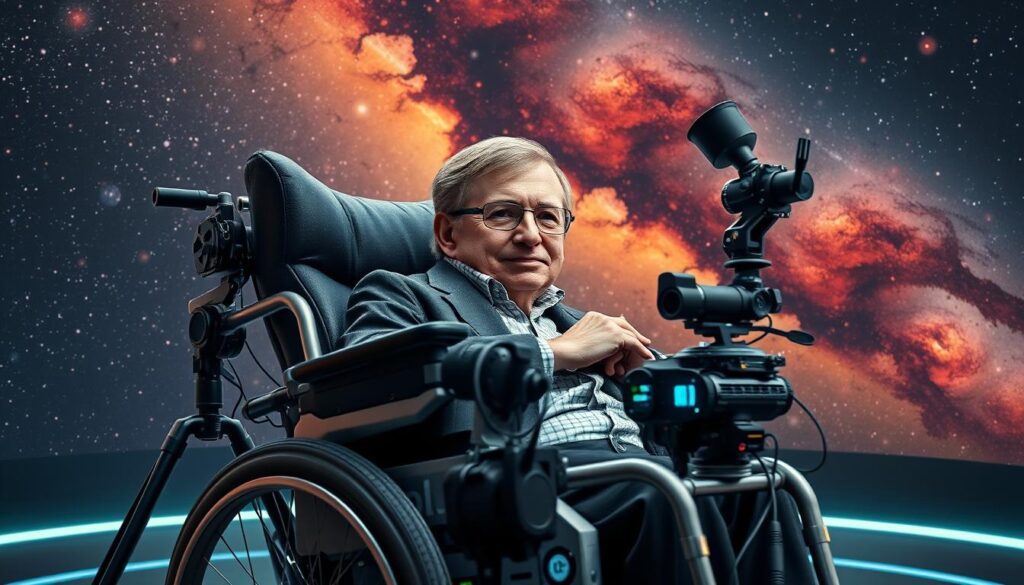
Stephen Hawking was a famous physicist and cosmologist born on January 8, 1942, in Oxford1. He was a leading English theoretical physicist and cosmologist. He worked at the University of Cambridge, making big contributions to physics.
Hawking’s work changed how we see the universe. His legacy inspires scientists and researchers today.
Hawking had a long career, over five decades, despite a serious illness. He came up with the theory of Hawking radiation2. He won many awards, including the Copley Medal and the US Presidential Medal of Freedom in 20093.
As a physicist, Hawking’s work in theoretical physics and cosmology is lasting. It has greatly influenced the scientific world.
Hawking loved to discover and share his knowledge. His book “A Brief History of Time” was a huge hit, staying on the bestseller list for 237 weeks1. His work inspires scientists today, showing the power of curiosity and determination.
Key Takeaways
- Stephen Hawking was a renowned physicist and cosmologist who made significant contributions to the field of theoretical physics.
- He was born on January 8, 1942, in Oxford, and defied the odds of a debilitating disease to produce groundbreaking work1.
- Hawking’s theory on black holes and radiation, now famously known as Hawking radiation, has had a profound impact on our understanding of the universe2.
- He was a recipient of various awards, medals, and prizes, including the Copley Medal of the Royal Society, the Albert Einstein Award, and the US Presidential Medal of Freedom in 20093.
- Hawking’s book “A Brief History of Time” was on the Sunday Times bestseller list for 237 weeks, and his legacy continues to inspire new generations of scientists and researchers1.
Early Life and Education
Stephen Hawking was born on January 8, 1942, in Oxford, England1. His family, full of doctors, encouraged his curiosity and love for learning early on.
Family Background and Childhood
Hawking’s parents created a home full of intellectual excitement. They helped spark his interest in science and math. This environment was key in shaping his analytical mind and love for discovery1.
Academic Journey at Oxford and Cambridge
At 17, Hawking started at University College, Oxford. He excelled in physics, earning a first-class BA in 19621. His success led him to Trinity Hall, Cambridge, for his graduate studies4.
In 1963, at Cambridge University, he was diagnosed with ALS. This early diagnosis would deeply affect his work and resilience1.
Despite his diagnosis, Hawking didn’t give up. He earned his PhD in applied mathematics and theoretical physics in March 19661. His time at Cambridge made him a leading science communicator. He made complex science easy for everyone to understand.
Scientific Contributions
Stephen Hawking’s work has greatly changed how we see the universe. His theories connect different areas of science, giving us new views of the cosmos.
Theoretical Physics and Cosmology
Hawking worked with Roger Penrose on gravitational singularity theorems. These theorems explain when space-time collapses into a single point. Their work combined Albert Einstein’s general relativity with quantum mechanics, giving us a clearer picture of the universe’s start5.
Black Holes and Radiation Theory
Hawking’s most famous idea is that black holes release radiation, known as Hawking radiation. This theory shows that black holes can shrink and eventually disappear. It changed how we see these mysterious objects65.
Popular Science and Publications
Hawking was great at explaining complex science to everyone. His book, A Brief History of Time, is a classic. It has been a key book for over thirty years, making cosmology easy for millions to understand6.
| Year | Achievement | Details |
|---|---|---|
| 1968 | Prediction of Hawking Radiation | Theoretical framework explaining black hole evaporation6 |
| 1976 | Dannie Heineman Prize | Awarded for contributions to Mathematical Physics6 |
| 1979 | Lucasian Professor at Cambridge | Position previously held by Sir Isaac Newton6 |
Legacy and Impact
Stephen Hawking’s work has made a huge impact on science. His ideas keep changing how we see the world. They inspire people everywhere.
Influence on Modern Science
Hawking changed physics with his ideas on the universe’s start and nature7. At Cambridge University, he helped many young scientists. They made big steps in understanding black holes and space-time.
Cultural References and Media Portrayal
Hawking made science easy for everyone to understand. He was on TV and in “The Theory of Everything” film7. His letters and scripts, now in the Science Museum, show his big influence8.
Continuing Research and Inspiration
Stephen Hawking’s work keeps inspiring new research. The Stephen Hawking Programme at Cambridge helps young scientists8. His archives at the Science Museum are a source of knowledge for many.
FAQ
Who was Stephen Hawking?
Stephen Hawking was a famous physicist and cosmologist. He made big contributions to theoretical physics and studied black holes. His book “A Brief History of Time” is a best-seller. He was also known for making science easy to understand for everyone.
What were Stephen Hawking’s major contributions to theoretical physics?
Hawking changed how we see black holes. He showed that they can actually lose mass over time. His work on space-time singularities helped us understand the universe’s beginnings.
How did Stephen Hawking overcome the challenges posed by ALS?
Hawking was diagnosed with ALS at 21 while at Cambridge University. Despite his physical decline, he kept researching. He used a speech device to share his ideas, staying active in science.
What is the significance of “A Brief History of Time”?
A: “A Brief History of Time” made complex science easy for everyone. It talks about the Big Bang, black holes, and the universe. This book made Hawking a top science communicator.
How did Stephen Hawking influence modern scientific research?
Hawking’s ideas on black holes and the universe have shaped theoretical physics. His work inspires new research and discoveries. It continues to guide scientists studying the universe’s laws and phenomena.
In what ways has Stephen Hawking been represented in popular culture?
Hawking has been featured in films like “The Theory of Everything” and TV shows. These portrayals show his life and work. They’ve made him a cultural icon and a symbol of determination.
What role did Cambridge University play in Stephen Hawking’s career?
At Cambridge University, Hawking got his doctorate and did key research. The university supported his love for physics and cosmology. It helped him work with other top scientists and develop his theories.
How did Stephen Hawking contribute to making science accessible to the public?
Hawking was great at explaining science to everyone. He wrote books, gave talks, and was on TV. His clear explanations sparked interest in science and the universe for millions.
Source Links
- Stephen Hawking – https://en.wikipedia.org/wiki/Stephen_Hawking
- ‘Mind over matter’: Stephen Hawking – obituary by Roger Penrose – https://www.theguardian.com/science/2018/mar/14/stephen-hawking-obituary
- Professor Stephen Hawking – https://www.cam.ac.uk/stephenhawking
- Stephen Hawking | Facts, Biography, Books, & Theories | Britannica – https://www.britannica.com/biography/Stephen-Hawking
- Stephen Hawking: The science that made him famous – https://www.bbc.com/news/science-environment-43399340
- Remembering Stephen Hawking | American Institute of Physics – https://www.aip.org/news/remembering-stephen-hawking
- Honoring Stephen Hawking’s scientific legacy – https://blog.google/inside-google/doodles/honoring-stephen-hawkings-scientific-legacy/
- Preserving Stephen Hawking’s legacy for future generations – https://www.maths.cam.ac.uk/features/preserving-stephen-hawkings-legacy-future-generations