
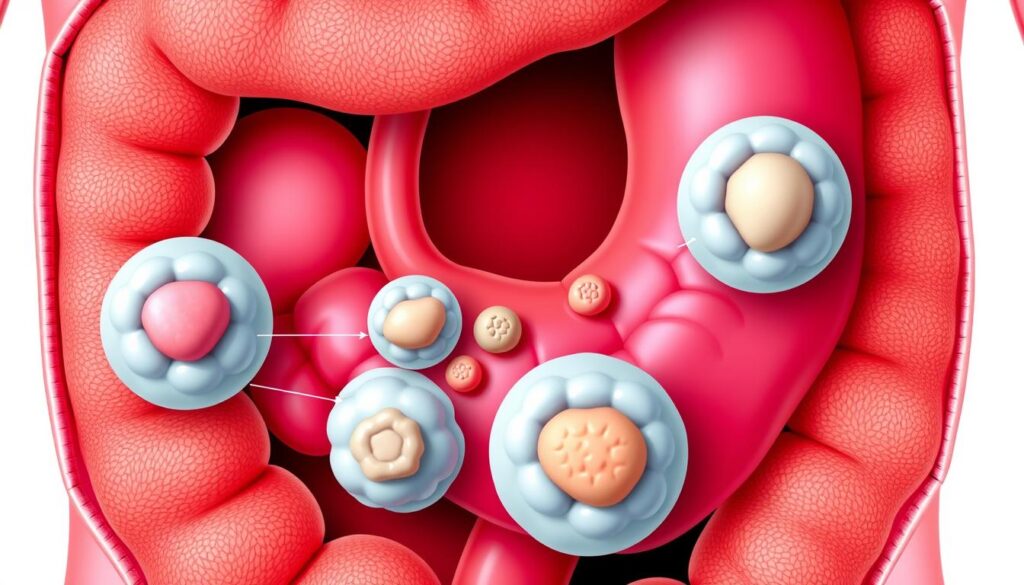
Stomach polyps are small growths on your stomach’s inner lining. They’re usually harmless, but some can be serious. About 6% of Americans have these mucosal abnormalities1.
Polyps often form due to stomach lining damage or inflammation. Chronic inflammation, bacterial infections, and long-term medication use can cause them2. People in mid to late adulthood are more likely to develop stomach polyps2.
There are different types of stomach polyps. Fundic gland polyps make up about 47% of all gastric polyps1. Most polyps are benign, but adenomatous polyps have a higher cancer risk2.
Key Takeaways
- Stomach polyps affect about 6% of people in the United States
- Most stomach polyps are non-cancerous
- Chronic inflammation can trigger polyp formation
- Age and bacterial infections increase polyp risk
- Regular medical check-ups can help monitor polyp development
What Are Stomach Polyps and Their Types
Stomach polyps are small growths on your stomach’s inner lining. They vary in size, type, and potential health risks. Understanding these growths is key to maintaining digestive health3.
Stomach polyps are common during medical exams. About 2-6% of people having endoscopies find these growths. Most polyps are harmless, but some need careful monitoring.
Common Types of Gastric Polyps
Medical experts recognize several types of stomach polyps:
- Fundic Gland Polyps (37-77% of detected polyps)3
- Gastric Hyperplastic Polyps (17-42% of detected polyps)3
- Adenomatous Polyps (0.5-1% of detected polyps)3
Risk Factors and Development
Your chances of getting stomach polyps increase with certain factors. These include age between 45-60 years, smoking habits, and lack of regular exercise.
Chronic stomach inflammation also raises the risk. Over 90% of stomach polyps are found by chance during endoscopies for other reasons3.
- Age between 45-60 years
- Smoking habits
- Lack of regular exercise
- Chronic stomach inflammation
Location and Growth Patterns
Stomach polyps usually form in the upper part of the stomach. They can appear alone or in groups4.
| Polyp Type | Potential Risk | Treatment Approach |
|---|---|---|
| Fundic Gland Polyps | Low | Monitoring |
| Hyperplastic Polyps | Moderate | H. pylori Treatment |
| Adenomatous Polyps | High | Removal Recommended |
Remember that most stomach polyps have no symptoms. Regular check-ups are crucial for early detection3.
Recognizing Stomach Polyps Symptoms and Diagnosis
Stomach polyps often go unnoticed. They’re usually found during routine check-ups. Some subtle signs might prompt a closer look at your digestive health.
While many polyps are harmless, some can cause warning signs. These may include:
- Abdominal tenderness or mild pain
- Unexpected nausea
- Potential gastrointestinal bleeding
- Unexplained weight loss5
Doctors use various methods to spot stomach growths. An upper endoscopy is a common test. It lets doctors see inside your stomach clearly6.
“Early detection is key in managing potential gastric complications”
The diagnostic process includes several steps to check polyps:
- Visual examination via endoscopy
- Tissue biopsy
- Cellular analysis
- Risk assessment for potential malignancy5
Most polyps are not dangerous. However, getting professional medical advice is crucial. It ensures proper care and timely action if needed7.
Conclusion
Stomach polyps need active management for good digestive health. Most are harmless, but knowing their risks is vital. About 6% of upper endoscopies find gastric polyps8, making their detection crucial9.
Your doctor may suggest different plans based on polyp type and size. Polypectomy is needed for polyps over 1 cm or those that might be cancerous9. Cold forceps remove polyps in nearly half of all cases10.
Watching polyps closely is key to gut health. A full medical exam helps create the best plan, especially for high-risk types. Women make up 74.4% of gastric polyp patients10.
Catch polyps early and treat them right to keep your gut healthy. Team up with your doctors to understand your case. Together, you can make a plan that works for you.
FAQ
What are stomach polyps?
Stomach polyps are unusual cell growths on your stomach’s inner lining. They’re typically rare and often harmless. Most develop due to stomach lining damage.
Some types may raise your stomach cancer risk. However, most stomach polyps don’t become cancerous.
What causes stomach polyps to develop?
Several factors can lead to stomach polyps. These include long-lasting stomach inflammation and bacterial infections like H. pylori.
Regular use of certain stomach medications can also contribute. Genetic conditions such as familial adenomatous polyposis play a role too.
Proton pump inhibitors and chronic stomach irritation are other potential causes.
Are stomach polyps dangerous?
Most stomach polyps are harmless and stay benign. However, some types, like adenomatous polyps, can potentially become cancerous.
The risk varies based on the polyp’s type, size, and features. Regular check-ups are crucial for early detection and treatment.
How are stomach polyps diagnosed?
Doctors usually find stomach polyps during an upper endoscopy. They use a thin, flexible tube with a camera to examine your stomach lining.
If they spot a polyp, they’ll take a biopsy. This helps determine the cell type and check for abnormal growth.
What symptoms might indicate stomach polyps?
Most stomach polyps don’t cause noticeable symptoms. However, larger polyps might lead to belly tenderness, pain, or nausea.
In rare cases, they can cause anemia, weight loss, or vomiting. Often, doctors find polyps by chance during other exams.
How are stomach polyps treated?
Treatment depends on the polyp’s type, size, location, and risk. Doctors may monitor small, low-risk polyps through regular check-ups.
They usually remove larger polyps or those with precancerous changes. This removal procedure is called polypectomy.
Your doctor will suggest the best approach based on your specific case.
What are the most common types of stomach polyps?
The main types are fundic gland, hyperplastic, and adenomatous polyps. Fundic gland polyps usually appear in the upper stomach and are often benign.
Hyperplastic polyps often link to chronic inflammation. Adenomatous polyps have a higher chance of becoming cancerous.
Who is at higher risk of developing stomach polyps?
Risk factors include advanced age and H. pylori bacterial infection. Chronic stomach inflammation and certain medications also increase risk.
Genetic conditions like familial adenomatous polyposis play a role too. People with these factors should discuss regular screening with their doctor.
Source Links
- Stomach Polyps: Causes, Treatment, and more – https://www.healthline.com/health/stomach-polyps
- Stomach polyps-Stomach polyps – Symptoms & causes – Mayo Clinic – https://www.mayoclinic.org/diseases-conditions/stomach-polyps/symptoms-causes/syc-20377992
- Stomach polyps: Types, symptoms, causes, treatment – https://www.medicalnewstoday.com/articles/stomach-polyps
- Stomach polyps-Stomach polyps – Diagnosis & treatment – Mayo Clinic – https://www.mayoclinic.org/diseases-conditions/stomach-polyps/diagnosis-treatment/drc-20377996
- Gastric Polyps – https://healthlibrary.brighamandwomens.org/library/Encyclopedia/134,616
- 11 Common Early Signs of Stomach Cancer | The University of Kansas Cancer Center – https://www.kucancercenter.org/news-room/blog/2021/01/11-common-early-signs-stomach-cancer
- Polyps – https://www.healthdirect.gov.au/polyps
- Gastric Polyps: A Review of Clinical, Endoscopic, and Histopathologic Features and Management Decisions – https://pmc.ncbi.nlm.nih.gov/articles/PMC3992058/
- Gastric polyps – UpToDate – https://www.uptodate.com/contents/gastric-polyps
- Gastric polyps: a 10-year analysis of 18,496 upper endoscopies – BMC Gastroenterology – https://bmcgastroenterol.biomedcentral.com/articles/10.1186/s12876-022-02154-8

