
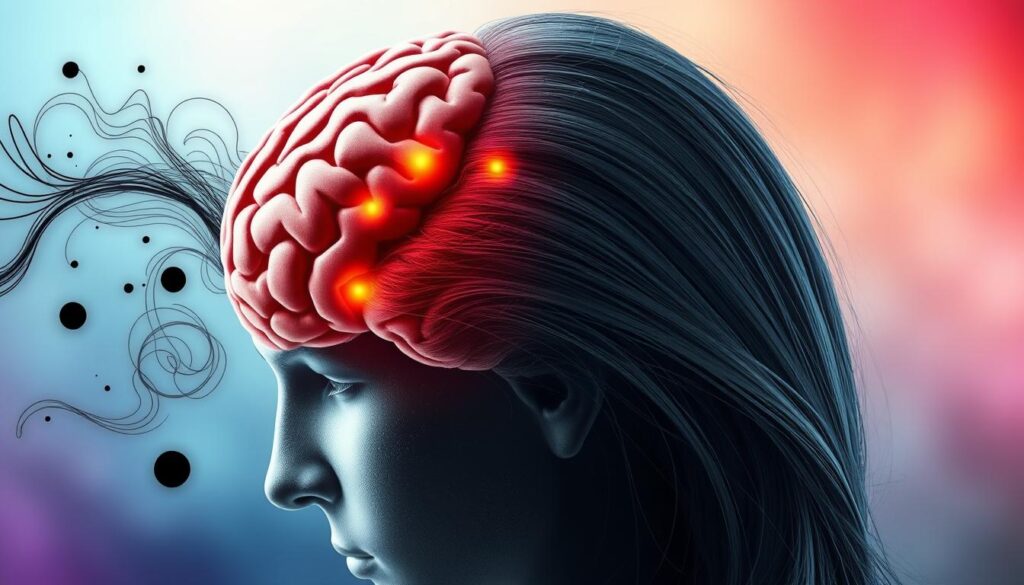
Ever wondered why stress turns your hair gray? Recent studies reveal a fascinating link. Stress triggers a unique response that affects hair pigmentation1. Scientists have found surprising connections between mental strain and silver strands.
Columbia University researchers made a breakthrough in stress and hair color studies. They found that psychological stress can cause hair to lose its natural color2. Stress isn’t just a passive factor; it actively speeds up the graying process.
Stress impacts brain areas that control cellular responses. When you’re under pressure, your nervous system releases neurotransmitters. These chemicals affect hair pigment-producing cells1.
The brain’s structure plays a key role in these stress-induced changes. It mediates how stress alters hair color at a cellular level.
Key Takeaways
- Stress directly influences hair pigmentation
- Scientific research confirms stress can cause premature graying
- Neurological responses trigger hair color changes
- Stress impacts cellular processes in hair follicles
- Potential for hair color reversal exists under certain conditions
Understanding the Connection Between Stress and Gray Hair
Stress affects more than just your mind. It can also change your hair color. This link between stress and hair reveals how our bodies react to mental pressure.
Stress impacts your body’s basic processes, especially in your brain. The connections between neurons are key. They determine how your body handles stressful events3.
How Stress Transforms Hair Pigmentation
Scientists have found links between stress and hair color changes. Stress can activate nerves that harm pigment-making cells in hair follicles3.
These nerves send signals that can cause lasting changes in hair color4.
- Stress activates sympathetic nerves
- Norepinephrine is released during stress responses
- Pigment-producing cells can be permanently depleted
The Science of Hair Color Transformation
New studies show how stress can turn hair gray. Computational models suggest stress can cause reversible color changes in hair5.
Researchers noted interesting patterns of hair color change in different people4.
| Stress Factor | Hair Pigmentation Impact |
|---|---|
| Psychological Stress | Potential Pigment Cell Damage |
| Cortisol Levels | Increased Hair Graying Risk |
“Stress doesn’t just affect your mind—it can literally change the color of your hair” – Research Findings
Can Stress Definitively Turn Your Hair Gray?
Stress greatly impacts hair color, but it’s not always permanent. Some studies show hair graying can be reversed under certain conditions5.
Your body’s response depends on many factors. These include your genes and overall health4.
Common Stress Factors That Lead to Gray Hair
Stress affects your body in complex ways through brain networks. It impacts our physiological responses. Learning about stress factors can help protect your hair’s color and health.
Workplace Pressure and Its Impact
Your job can speed up hair graying. High-stress jobs can quickly deplete melanocyte stem cells6. Work stress can cause noticeable changes in hair color.
Even short-term stress can permanently damage pigment-producing cells6. This happens through constant activation of the cerebral cortex.
- Chronic deadline pressures
- Competitive work environments
- Lack of work-life balance
- Constant performance expectations
Personal Life Challenges
Personal stressors trigger significant biological responses. Acute stress can cause hair to turn grey rapidly7. Some research suggests overnight greying is possible.
UV exposure, smoking, and emotional trauma can speed up hair follicle damage7. These factors contribute to oxidative stress on your hair.
Chronic Health Conditions
Health challenges can increase stress-induced hair graying. The “fight-or-flight” response releases noradrenaline, which affects melanocyte stem cells6. Conditions that raise stress hormones can speed up greying7.
“Stress doesn’t just affect your mind—it fundamentally changes your body’s cellular processes.”
| Stress Factor | Potential Hair Impact |
|---|---|
| Workplace Pressure | Accelerated Melanocyte Stem Cell Depletion |
| Personal Challenges | Oxidative Follicle Damage |
| Chronic Health Issues | Increased Noradrenaline Release |
Tips to Manage Stress for Healthier Hair
Stress can greatly affect your health, including your hair. Managing stress is key for mental well-being and hair health. Brain structure and neuroanatomy influence how our bodies react to stress8.
Your brain’s connections make stress management more than a mental task. The link between brain and stress impacts your hair’s condition.
Effective Stress Relief Techniques
Try these powerful techniques to reduce stress:
- Practice deep breathing exercises9
Inhale for four seconds, hold for four, exhale for six - Use mental counting techniques to disrupt racing thoughts
- Engage in muscle relaxation9
Tense and release each muscle group for 10 seconds
The Role of Nutrition in Hair Health
Nutrition affects your brain’s structure and stress response. A good diet can help prevent stress-related hair changes8.
Focus on foods rich in:
- Protein
- Omega-3 fatty acids
- Vitamins B and D
Lifestyle Changes to Reduce Stress
Making lifestyle changes can improve your stress management. Try these strategies:
- Maintain regular exercise routines
- Practice meditation and mindfulness
- Ensure adequate sleep
- Cultivate supportive relationships
Your mental health is the foundation of your overall well-being, including hair health.
Understanding brain structure details helps manage stress effectively. These strategies can protect your hair from stress-induced changes8.
Other Factors Contributing to Gray Hair
Gray hair isn’t just about stress or aging. Many factors influence this change, including genetics and environment. These elements help explain why hair color shifts over time1011.
Genes play a big role in when hair turns gray. Some people go gray before 30 due to inherited traits. Your family history can hint at early graying10.
Genetic markers affect hair follicle health. These markers influence how well melanocyte stem cells are maintained10.
The environment also impacts hair color changes. UV light, smoking, and chemicals can speed up graying. These factors cause oxidative stress in hair10.
Lack of key vitamins can affect hair color. Certain medicines, like chloroquine, may also impact graying1011.
Medical treatments can unexpectedly alter hair color. DNA damage and radiation can change hair pigment. Stem cell changes in follicles also affect natural hair color10.
Hair rarely regains color on its own. Understanding these processes sheds light on hair aging biology11.
FAQ: Understanding Your Brain’s Incredible Structure and Function
How much does the human brain weigh?
An average adult brain weighs about 3 pounds. It’s made up of 60% fat and 40% other stuff. This includes water, protein, carbs, and salts.
What are the main parts of the brain?
Your brain has three main parts: the cerebrum, brainstem, and cerebellum. Each part plays a key role in your body’s functions.
How many neurons are in the human brain?
Your brain has about 86 billion neurons and glial cells. These cells send and receive electric signals. They also help keep your brain working well.
What is the difference between gray and white matter?
Gray matter is made of neuron cell bodies. It processes information in your brain. White matter contains nerve fibers wrapped in myelin. It sends signals between different brain areas.
What are the four lobes of the cerebrum?
Your cerebrum has four lobes: frontal, parietal, occipital, and temporal. The frontal lobe controls personality and movement. The parietal lobe interprets sensory info. The occipital lobe processes visual info. The temporal lobe handles memory and speech.
How is the brain protected?
Your brain has three layers of protection called meninges. These are the dura mater, arachnoid mater, and pia mater. The skull also shields your brain. Cerebrospinal fluid (CSF) cushions it too.
What does the brainstem do?
The brainstem links your cerebrum to your spinal cord. It controls vital functions like breathing and heart rate. It also manages other essential body processes.
How do brain hemispheres differ?
In right-handed people, the left side handles language and speech. The right side deals with spatial awareness and visual processing. This setup can vary in some folks.
What role do neurotransmitters play?
Neurotransmitters are key to brain function. These include acetylcholine, glutamate, GABA, and serotonin. They’re linked to various brain processes and potential disorders.
What is brain plasticity?
Brain plasticity is your brain’s ability to change. It can shift how it works, especially after an injury. This helps your brain adapt to new situations.
Source Links
- How stress turns hair gray – https://www.sciencenews.org/article/how-stress-turns-hair-gray-triggers-body-fight-flight-response
- It’s True: Stress Does Turn Hair Gray (And It’s Reversible) – https://wms-site.com/press-media/932-it-s-true-stress-does-turn-hair-gray-and-it-s-reversible
- Solving a biological puzzle: How stress causes gray hair | HSCRB – https://hscrb.harvard.edu/news/solving-a-biological-puzzle-how-stress-causes-gray-hair/
- Quantitative mapping of human hair greying and reversal in relation to life stress – https://pmc.ncbi.nlm.nih.gov/articles/PMC8219384/
- Human Hair Graying is Naturally Reversible and Linked to Stress – preLights – https://prelights.biologists.com/highlights/human-hair-graying-is-naturally-reversible-and-linked-to-stress/
- How stress causes gray hair – https://www.nih.gov/news-events/nih-research-matters/how-stress-causes-gray-hair
- Does Stress Lead to Premature Hair Graying? – Neuroscience News – https://neurosciencenews.com/stress-graying-genetics-27797/
- Chronic stress puts your health at risk – https://www.mayoclinic.org/healthy-lifestyle/stress-management/in-depth/stress/art-20046037
- Stress management tools – https://www.apa.org/topics/stress/manage-stress-tools
- Three Streams for the Mechanism of Hair Graying – https://pmc.ncbi.nlm.nih.gov/articles/PMC6029974/
- Quantitative mapping of human hair greying and reversal in relation to life stress – https://elifesciences.org/articles/67437

