
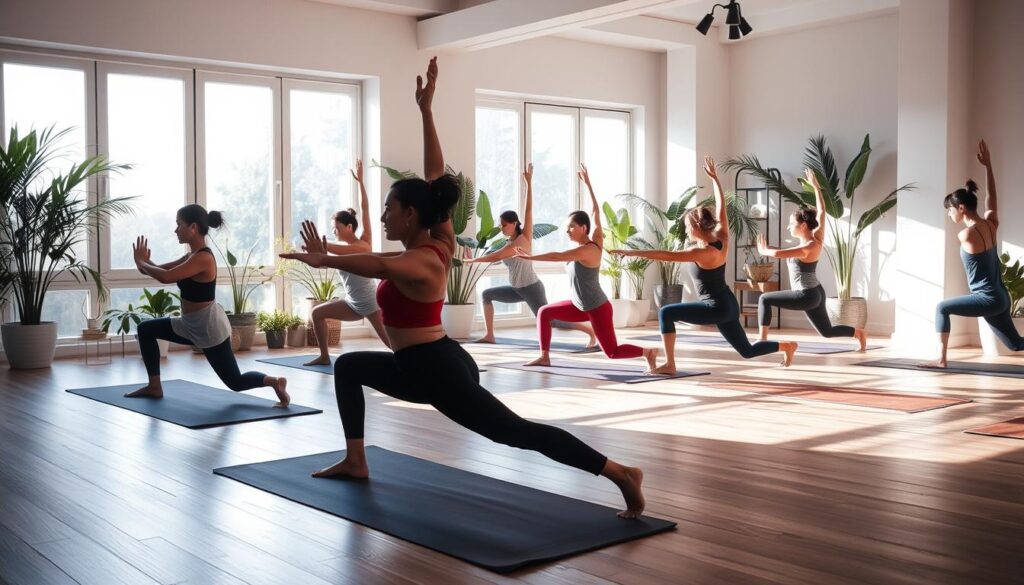
Mobility exercises can boost your physical wellness through smart stretching. Your body’s range of motion is key to overall fitness. Stretching builds a base for better performance and injury prevention1.
Every move you make relies on flexible muscles and mobile joints. Muscle lengthening can improve your body’s efficiency. It also lowers the risk of strain or injury2.
Stretching keeps muscles healthy and boosts blood flow. It also helps you understand your body’s limits better1.
Stretching routines can benefit athletes, office workers, and weekend warriors alike. Experts suggest stretching 2-3 days a week for best results2.
Key Takeaways
- Stretching improves overall muscle performance and flexibility
- Regular mobility exercises reduce injury risks
- Proper stretching enhances body awareness
- Aim for 2-3 stretching sessions per week
- Always listen to your body and avoid pain during stretches
Understanding the Fundamentals of Stretching for Flexibility
Flexibility is crucial for overall fitness. It allows your body to move joints and muscles fully. This creates a foundation for better performance and injury prevention3.
Benefits of Regular Stretching Routines
Regular flexibility training offers numerous advantages for your physical well-being. Incorporating stretching into your routine can bring several benefits.
- Improved muscle elasticity
- Enhanced joint mobility
- Reduced risk of injury during physical activities4
- Better posture and muscle balance
When to Incorporate Stretching into Your Day
Timing is critical for effective stretching. The American College of Sports Medicine suggests stretching 2 to 3 times weekly. The ultimate goal is daily practice4.
Each stretching session should include:
- Holding static stretches for 15 to 30 seconds5
- Repeating each stretch 2 to 4 times
- Focusing on controlled, gentle movements
The Science Behind Muscle Flexibility
Flexibility training involves more than just elongating muscles. Dynamic stretching uses controlled movements to prepare your body for activity3.
Understanding muscle extension science helps develop a more effective stretching routine. This supports overall mobility and reduces potential injuries.
“Flexibility is not about being extreme, but about creating balance and control in your body’s movements.”
Consistent practice of static and dynamic stretching improves muscle extensibility. It also enhances joint health and overall physical performance45.
Essential Stretching Techniques and Best Practices
Stretching exercises are vital for better fitness and injury prevention. They can boost your physical performance through proper warm-ups and cool-downs. Focus on safe, strategic stretching for the best results.
- Dynamic stretching: Ideal for pre-workout preparation6
- Static stretching: Best for post-workout recovery6
- Proprioceptive Neuromuscular Facilitation (PNF): Most effective for increasing flexibility7
Remember these key stretching guidelines:
- Hold each stretch for 10-30 seconds7
- Avoid bouncing during stretches8
- Breathe normally and maintain relaxed muscles
- Stop if you experience pain
“Flexibility is not just about touching your toes, it’s about what you learn on the way down.” – Unknown
Your stretching routine can match your fitness level:
| Fitness Level | Recommended Stretches |
|---|---|
| Beginner | Neck stretches, shoulder shrugs, seated hamstring stretches7 |
| Intermediate | Cat-cow stretches, piriformis stretches, standing calf stretches7 |
| Advanced | Pigeon poses, standing quad stretches, bridge poses7 |
For better flexibility, stretch at least three times per week. Regular stretching improves mobility and lowers injury risk.
Stay consistent with your stretching routine. This habit will help you move better and feel great.
Conclusion
Stretching can transform your fitness journey. It unlocks your body’s potential, helping you move easier and prevent injuries9. Your daily strategy should include various techniques targeting different muscle groups10.
Static stretching for 10-30 seconds improves joint range of motion10. Pre-workout dynamic stretches boost coordination. Post-workout routines aid muscle recovery and maintain length9.
Stretching offers mental wellness benefits too. It can increase serotonin levels, reducing anxiety and improving mood9. Regular stretching enhances both physical flexibility and mental resilience9.
Committing to stretching invests in your long-term health. It prevents age-related stiffness and maintains joint health9. Start small and be consistent as you explore strategic stretching’s power.
FAQ
How long should I hold a stretch?
Hold each stretch for at least 20 seconds. This allows your muscles to relax and lengthen effectively. Repeat the stretch to maximize flexibility and improve range of motion.
Is it okay to stretch before exercising?
Yes, but do a light warm-up first. Then perform dynamic stretching. This loosens your muscles and prepares them for activity while reducing injury risk.
Can stretching help prevent injuries?
Absolutely! Regular stretching improves muscle flexibility and joint mobility. This can greatly reduce your risk of exercise-related injuries. It helps muscles become more pliable and absorb sudden movements better.
What’s the difference between static and dynamic stretching?
Static stretching involves holding a position for 20-30 seconds. Dynamic stretching uses active movements through full range of motion.
Dynamic stretching is better before exercise. Static stretching is ideal for post-workout cooldowns.
How often should I stretch?
Try to stretch major muscle groups 2-3 times per week. Daily stretching is even better. This helps maintain and improve your overall flexibility and mobility.
Can stretching improve my posture?
Yes, regular stretching can help improve your posture. It lengthens tight muscles and reduces imbalances. Stretching also increases overall body awareness.
Focus on stretches targeting your core, back, and hip muscles. These can be particularly beneficial for posture.
Should stretching hurt?
No, stretching should never be painful. You should feel a mild tension or slight discomfort. If you experience sharp pain, you’re stretching too far.
Always listen to your body. Stretch within a comfortable range of motion.
What are the best stretches for beginners?
Great beginner stretches include child’s pose and seated butterfly stretch. Standing quad stretch and cat-cow pose are also good options.
These stretches target multiple muscle groups. They’re easy to perform for those new to flexibility training.
Source Links
- PDF – https://hr.umich.edu/sites/default/files/mh-stretching-booklet.pdf
- A guide to basic stretches – https://www.mayoclinic.org/healthy-lifestyle/fitness/in-depth/stretching/art-20546848
- Understanding Flexibility, Mobility, and Stability: Key Components of Functional Fitness – Central Ohio Spine and Joint – https://cospineandjoint.com/improve-flexibility-mobility-stability-with-personal-training/
- Flexibility and Stretching – https://www.verywellfit.com/flexibility-and-stretching-4157128
- Definition of Procedure: – https://www.brighamandwomens.org/assets/BWH/patients-and-families/rehabilitation-services/pdfs/stretching-and-flexibility.pdf
- Types of Stretching: Static, Dynamic, and Other Techniques to Improve Flexibility – https://www.everydayhealth.com/fitness/types-of-stretching-different-techniques-to-foster-flexibility/
- Stretching and Flexibility: Benefits, Techniques, and Tips – https://www.opaortho.com/the-importance-of-stretching-and-flexibility/
- Flexibility Exercises for Young Athletes – OrthoInfo – AAOS – https://orthoinfo.aaos.org/en/staying-healthy/flexibility-exercises-for-young-athletes/
- The Science of Stretching: How and When to Stretch – NPTI – https://nptiflorida.edu/the-science-of-stretching/
- CURRENT CONCEPTS IN MUSCLE STRETCHING FOR EXERCISE AND REHABILITATION – https://pmc.ncbi.nlm.nih.gov/articles/PMC3273886/

