
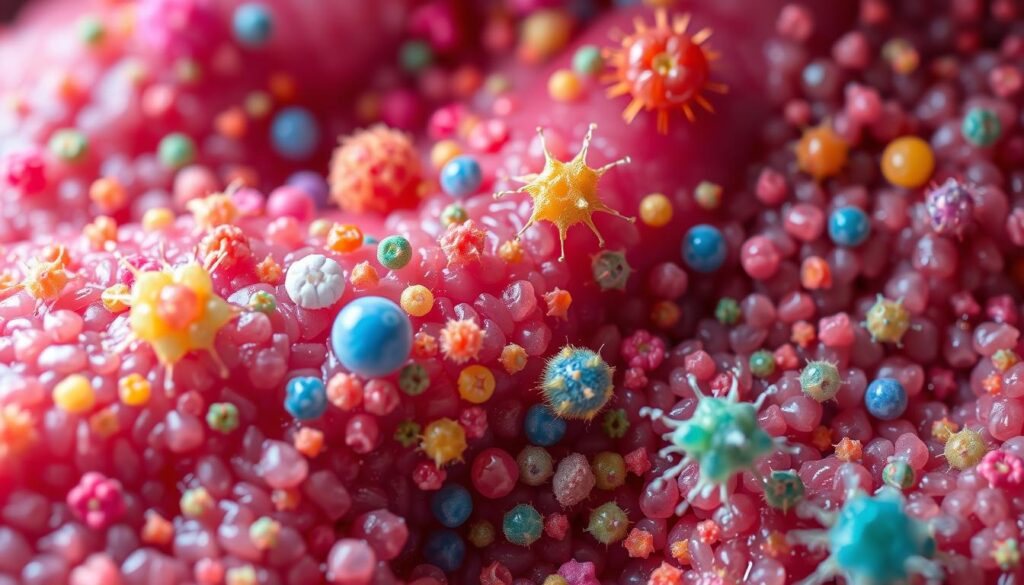
Your mouth is a complex ecosystem filled with tiny organisms. Scientists have made exciting discoveries about the oral microbiome. They found that bacteria on your tongue form fascinating patterns1.
These bacterial communities play a crucial role in your oral health. Understanding tongue health means exploring these intricate microorganisms.
Researchers identified three main ways bacteria spread on the tongue. These are clustered, spread out, and evenly distributed arrangements1. Each arrangement affects your oral health differently.
Most people have spread-out bacteria, about 59%. Around 29% have evenly distributed bacteria. Only 12% have clustered bacterial formations1.
The bacterial balance on your tongue can greatly affect your breath. People with clustered bacteria often have worse breath. Those with evenly distributed bacteria typically enjoy fresher breath1.
Key Takeaways
- Your tongue hosts a diverse bacterial ecosystem
- Bacterial arrangements vary among individuals
- Tongue bacteria impact breath and oral health
- Most people have spread-out bacterial distributions
- Understanding your oral microbiome can improve hygiene practices
Understanding Bacteria on the Tongue
Your mouth hosts a bustling world of tiny life. Thousands of bacterial species thrive on your tongue. These microbes play vital roles in your oral health and overall well-being.
Learning about tongue bacteria can improve your oral care habits. This knowledge helps you maintain a healthier mouth ecosystem.
The Role of Bacteria in Oral Health
Tongue bacteria are active participants in your mouth’s health. Over 750 bacterial species live in complex biofilms in your mouth. These communities interact in sophisticated ways, greatly influencing your oral health.
- Protect against harmful pathogens
- Help break down food particles
- Contribute to initial stages of digestion
- Maintain pH balance in the mouth
Good vs. Bad Bacteria
Not all bacteria harm your health. Some bacterial groups are crucial for oral health. Scientists found three main genera in almost all human tongue samples2.
These bacteria – Actinomyces, Rothia, and Streptococcus – form complex structures on the tongue. They work together to maintain a healthy balance.
| Bacteria Type | Function | Location on Tongue |
|---|---|---|
| Actinomyces | Nitrate reduction | Near consortia core |
| Rothia | Exterior protection | Large exterior patches |
| Streptococcus | Surface colonization | Thin exterior/interior crust |
How Tongue Bacteria Affect Breath
The arrangement of bacteria on your tongue affects your breath. Certain bacterial groups can produce volatile compounds that cause bad breath. Scientists have mapped these bacterial neighborhoods3.
“Understanding bacterial arrangements helps maintain a healthy oral ecosystem”
Knowing about tongue bacteria helps you make smart choices for your oral health. This knowledge can guide your daily oral care routine and improve your overall well-being.
The Anatomy of the Tongue
Your tongue is a remarkable organ with a complex structure. It plays a crucial role in bacterial balance and overall tongue health. Understanding its anatomy helps you appreciate its intricate design and functionality.
The human tongue is an impressive muscular organ. It’s about 3 inches long and 2.52 inches wide4. Its surface isn’t uniform but a dynamic terrain with unique regions.
These regions significantly impact bacterial colonization. The tongue’s texture creates distinct habitats for various microorganisms.
Regions and Papillae of the Tongue
Your tongue contains several specialized regions with distinct characteristics:
- Vallate papillae: Located at the back of the tongue, with 8-12 present5
- Fungiform papillae: Dispersed along the tongue’s tip and sides, numbering around 200-3005
- Taste buds: Distributed across different papillae types, totaling approximately 30005
Surface Texture and Bacterial Interactions
The tongue’s surface texture creates unique microenvironments that influence bacterial balance. Different papillae provide varied habitats for bacterial communities. Some areas support more diverse microorganisms than others.
| Papillae Type | Bacterial Preference | Unique Characteristics |
|---|---|---|
| Circumvallate | Complex bacterial communities | Average of 9 papillae present6 |
| Fungiform | Dense bacterial colonization | Located on tongue tip and sides |
| Foliate | Potential bacterial reservoir | Embedded in lateral tongue epithelium6 |
“The tongue’s surface is a complex ecosystem where bacterial communities thrive in unique microenvironments.” – Oral Microbiome Research Team
Knowing your tongue’s anatomy helps manage its bacterial balance. This knowledge aids in maintaining optimal tongue health. Proper oral hygiene practices are key to keeping your tongue healthy.
The Importance of a Healthy Microbiome
Your oral microbiome is a complex ecosystem crucial for your overall health. The tongue plays a significant role in this delicate bacterial balance. Scientists have uncovered an amazing world of microorganisms in your mouth7.
The human mouth hosts an incredible variety of bacterial species. Researchers have identified over 700 different types in our oral cavity8. These tiny inhabitants actively participate in your health ecosystem.
Microbiome and Overall Health
Your oral microbiome affects many aspects of your health. Here are key ways it influences your body:
- Supports immune system function8
- Helps regulate inflammatory responses8
- Connects to systemic health through the oral-gut axis8
Impact on Immune System Function
Mouth bacteria actively communicate with your immune system. They help protect against harmful pathogens8. Some oral bacteria can migrate to other body parts.
These bacteria may influence conditions like atherosclerosis and neurological disorders8.
“The mouth is a gateway to understanding overall health” – Modern Oral Microbiome Research
Keeping a balanced oral microbiome needs intentional care. Quitting smoking, managing stress, and good oral hygiene can greatly impact your microbiome’s health8.
| Microbiome Characteristic | Key Insights |
|---|---|
| Total Species | Over 700 bacterial species7 |
| Phyla Diversity | 12 different bacterial phyla7 |
| Identification Status | 54% formally named, 14% cultivated but unnamed7 |
Factors Influencing Tongue Bacteria
Your tongue’s bacterial world is complex and influenced by many factors. The oral microbiome is a delicate ecosystem. Various elements can impact tongue bacteria buildup prevention.
Your mouth is home to about 700 bacterial species. They mostly live on the tongue and soft tissues. These tiny organisms form complex communities that react to many influences.
Diet and Bacterial Dynamics
What you eat shapes your oral health and bacterial mix. Some foods can help or harm bacterial growth:
- Sugary foods encourage harmful bacterial proliferation
- Probiotic-rich foods support beneficial bacteria
- Acidic substances can alter tongue microbiome balance
Oral Hygiene Practices
Regular cleaning directly affects tongue bacteria buildup prevention. CLASI-FISH imaging showed distinct bacterial patterns on the tongue. This highlights the need for targeted oral care9.
Environmental Influences
Several factors shape your tongue’s bacterial ecosystem:
- Moisture levels
- Oxygen concentration
- Salivary flow
- Mouth temperature
Your oral microbiome is a dynamic, responsive system that reflects your overall health and lifestyle choices.
A balanced oral microbiome needs constant attention to these linked factors. This ensures proper tongue bacteria organization. It also supports your overall well-being.
Identifying and Measuring Tongue Bacteria
Scientists use advanced methods to explore tongue bacteria. These techniques reveal fascinating insights into bacterial communities on your tongue. They help us understand the complex oral microbiome.
Modern approaches to studying tongue bacteria include cutting-edge methods. These methods help researchers delve deeper into the oral microbiome. They provide valuable information about bacterial organization.
- DNA-encoded nanozyme sensor arrays for bacterial identification10
- Fluorescence microscopy techniques
- Metatranscriptomic analysis of bacterial populations
Advanced Bacterial Identification Techniques
Scientists have created tools to map tongue bacteria. A new sensor array can identify 11 dental bacteria species in artificial saliva samples10. This technology distinguishes between healthy and cavity-affected dental plaque with high precision10.
Scientific Analysis of Oral Microbiome
Researchers use complex methods to study tongue bacteria organization. The 16S rRNA gene sequencing is a powerful tool for identifying bacterial communities11.
Metatranscriptomic analysis reveals details about bacterial interactions. It helps scientists map the complex ecosystem of your tongue12. This method provides insights into the oral microbiome’s structure.
| Research Technique | Primary Purpose |
|---|---|
| Nanozyme Sensor Array | Bacterial Species Identification |
| 16S rRNA Sequencing | Bacterial Community Mapping |
| Metatranscriptomic Analysis | Metabolic Pathway Examination |
The tongue is not just a muscle, but a complex ecosystem hosting millions of bacteria waiting to be discovered.
Researchers are constantly improving these scientific techniques. They uncover the intricate world of tongue bacteria. These studies offer new insights into oral and overall health.
The Link Between Tongue Bacteria and Diseases
Your tongue is more than a taste receptor. It’s a complex ecosystem with millions of bacteria affecting your overall health. Understanding this relationship is crucial for oral and systemic wellness. Tongue health research keeps uncovering fascinating connections.
The human oral microbiome is vital for our body’s health. 10^11 bacterial cells flow from the oral cavity to the stomach daily. This creates complex links between oral and systemic conditions13.
Oral Diseases Linked to Bacterial Imbalances
Tongue bacteria can contribute to several oral health challenges:
- Chronic periodontitis
- Tooth decay
- Gum inflammation
- Bad breath
Systemic Diseases and Bacterial Connections
Studies show tongue coating microbiota can be bacterial markers for various systemic conditions13:
| Disease Category | Potential Bacterial Influence |
|---|---|
| Inflammatory Conditions | Rheumatoid arthritis, Inflammatory bowel disease |
| Cancer | Colorectal cancer, Gastric cancer |
| Infectious Diseases | COVID-19 markers |
The oral microbiota represents a critical interface between environmental exposures and human health.
Your oral habits shape your tongue’s bacterial makeup. Regular tongue cleaning can greatly reduce total bacteria. This promotes better overall health14.
Understanding these complex microbial relationships is key. It helps you take proactive steps for a balanced, healthy oral ecosystem.
Maintaining a Balanced Tongue Bacteria Organization
A healthy oral microbiome is vital for your overall well-being. The balance of bacteria on your tongue prevents buildup and supports optimal oral care. Your tongue’s bacteria impact your oral and overall health.
Millions of bacteria live on your tongue. Managing these tiny organisms keeps your breath fresh. It also prevents potential health issues.
Proper Oral Hygiene Practices
Good oral care helps control tongue bacteria. Tongue cleaning is crucial for preventing bacterial buildup15. Tongue scrapers beat toothbrushes at reducing bad breath compounds15.
- Use a tongue scraper daily
- Clean your tongue from back to front
- Be gentle to avoid damaging tongue tissue
Diet Adjustments for Balance
Your diet affects tongue bacteria. Some foods help maintain a healthy oral microbiome16:
| Food Category | Benefit for Oral Health |
|---|---|
| Crunchy Fruits/Vegetables | Stimulate saliva production |
| Probiotic-rich Foods | Support beneficial bacteria |
| Water | Flush out harmful bacteria |
Probiotics and Their Benefits
Probiotics balance bacteria and support natural defenses16. Add probiotic-rich foods or supplements to your diet. This can boost your oral microbiome.
“Your mouth is a gateway to your overall health. Maintaining a balanced bacterial environment is key to preventing potential health issues.”
Preventing tongue bacteria buildup needs consistent oral care. Clean your tongue regularly. Eat a balanced diet. Stay hydrated for the best oral health1516.
Future Research on Tongue Bacteria
Tongue bacteria organization fascinates researchers and medical professionals. The oral microbiome holds exciting potential for groundbreaking discoveries. Innovative health solutions may emerge from this fascinating field17.
Emerging Areas of Scientific Exploration
Scientists are uncovering remarkable insights about microbial communities on tongues. Recent studies have revealed complex interactions within these tiny ecosystems.
- The human oral microbiome contains 756 species-level taxa17
- 17 bacterial genera are consistently found on human tongues17
- Spatial analysis reveals intricate microbial interactions17
Potential Innovations in Oral Health
Cutting-edge research is shaping personalized oral health strategies. Scientists are exploring how different bacterial genera interact. These interactions could influence overall health in surprising ways18.
Understanding the spatial ecology of tongue microbiota requires high-resolution taxonomic analysis17.
Exciting innovations are on the horizon. These may transform how we approach oral health.
- Personalized microbiome mapping
- Targeted probiotic treatments
- Advanced diagnostic techniques
Technology Driving Future Research
Advanced imaging techniques are revolutionizing our understanding of oral microbiomes. Multi-spectral fluorescence imaging reveals intricate spatial organization of tongue bacteria17.
| Research Focus | Key Objectives |
|---|---|
| Microbial Interactions | Understand complex bacterial relationships |
| Genetic Mapping | Identify unique microbiome signatures |
| Health Correlations | Link microbiome variations to systemic conditions |
Technology keeps advancing at a rapid pace. Soon, you’ll have access to more precise and personalized oral microbiome insights19.
Tongue Cleaning Techniques
Proper tongue hygiene is key for managing mouth bacteria. Your tongue hosts millions of bacteria that affect oral health. Learn the right techniques to improve your daily oral care.
Regular tongue cleaning offers many health perks. It reduces bad breath and enhances taste. It also helps prevent oral health problems.
Bacteria on your tongue can cause issues if left unchecked. Cleaning your tongue daily can help avoid these problems20.
Benefits of Regular Tongue Cleaning
- Reduces bacterial load on tongue surface
- Improves breath quality21
- Enhances taste perception20
- Prevents potential oral health risks
Recommended Tools for Tongue Hygiene
Several tools can help with tongue cleaning:
| Tool | Effectiveness | Recommended For |
|---|---|---|
| Tongue Scraper | High | General tongue cleaning |
| Soft-Bristled Toothbrush | Moderate | Sensitive mouths |
| Specialized Tongue Brushes | High | Detailed cleaning |
If you have a sensitive mouth, start cleaning from the middle. This helps you adjust and reduces discomfort20.
Up to 90% of bad breath comes from inside the mouth. That’s why tongue cleaning is so important21.
Remember, a clean tongue is your first defense against oral bacteria buildup.
Make tongue cleaning part of your daily routine. It’s a simple way to boost your oral health20.
Conclusion: The Role of Tongue Bacteria in Our Lives
The oral microbiome is a complex world in your mouth. Tongue bacteria are key health indicators22. Diverse bacterial communities on your tongue can impact your overall health.
Good tongue health needs consistent oral care. Your mouth’s bacterial landscape changes throughout life22. Streptococcus dominates in infancy, but your oral microbiome evolves as you grow23.
Understanding this ecosystem helps you make smart oral hygiene choices. It’s crucial for your health and well-being.
Summary of Key Takeaways
The oral microbiome is a dynamic system linked to various health conditions. Tongue bacteria can be associated with periodontal issues and cardiovascular problems22.
Good oral care practices can help reduce health risks. They support your overall wellness too.
Encouraging Healthy Habits for Oral Care
Understanding your oral microbiome can improve your health approach. Regular tongue cleaning and proper nutrition help manage mouth bacteria22.
Good oral care contributes to long-term health. Every small step matters in maintaining your wellness.
FAQ
What exactly are tongue bacteria?
Your tongue hosts billions of bacteria in complex communities. They form “microbial skyscrapers” on your tongue’s surface. Some bacteria are beneficial, while others may cause oral health problems.
How many types of bacteria are typically found on the tongue?
Scientists have found about two dozen bacterial types on the tongue. These bacteria form unique structures in different tongue areas. They prefer specific microenvironments based on the tongue’s surface texture.
Can tongue bacteria affect my overall health?
Yes, your oral microbiome is crucial for overall health. Tongue bacteria can influence immune function and blood pressure. They may also link to conditions like heart disease and diabetes.
What factors influence tongue bacteria composition?
Diet, oral hygiene, and environmental conditions affect tongue bacteria. Temperature, pH levels, and oxygen availability also play a role. Your overall health can impact the bacterial communities on your tongue.
How can I maintain a healthy balance of tongue bacteria?
Clean your tongue regularly with scrapers and practice good oral hygiene. Eat a balanced diet with probiotic-rich foods. Avoid too many sugary or acidic foods.
Remember, the goal is to maintain a healthy balance, not eliminate all bacteria.
Do tongue scrapers really help manage bacteria?
Tongue scrapers effectively reduce bacterial load and improve oral hygiene. They remove debris and temporarily reduce bacteria. Consistent, gentle cleaning is key to maintaining oral health.
Can tongue bacteria cause bad breath?
Yes, some tongue bacteria can contribute to bad breath. Their metabolic processes can produce smelly compounds. Regular tongue cleaning helps manage and reduce unpleasant breath odors.
Are all bacteria on the tongue harmful?
No, many tongue bacteria are beneficial. Some help break down food and support immune function. Others convert dietary nitrates into compounds that regulate blood pressure.
How do scientists study tongue bacteria?
Scientists use advanced techniques like CLASI-FISH to identify bacterial species. They collect samples with tongue scrapers. Then, they analyze the locations and interactions of bacterial communities.
What future research is happening in this field?
Research focuses on understanding relationships between bacterial species and their impact on taste. Scientists are developing personalized treatments based on individual tongue microbiomes. They aim to create targeted strategies for oral and overall health.
Source Links
- Here’s where bacteria live on your tongue cells – https://www.sciencenews.org/article/where-bacteria-live-your-tongue-cells-map
- Images reveal how bacteria form communities on the human tongue – https://www.eurekalert.org/news-releases/640369
- PDF – https://www.sciencenews.org/wp-content/uploads/2020/04/042520_FullGuide.pdf
- Tongue: Definition, Location, Anatomy & Function – https://my.clevelandclinic.org/health/body/22845-tongue
- Overview, Gross Anatomy, Pathophysiologic Variants – https://emedicine.medscape.com/article/1899434-overview
- Physiology of the tongue with emphasis on taste transduction – https://pmc.ncbi.nlm.nih.gov/articles/PMC9942923/
- Oral microbiome: Unveiling the fundamentals – https://pmc.ncbi.nlm.nih.gov/articles/PMC6503789/
- The oral microbiome: a double face in health and disease – https://www.gutmicrobiotaforhealth.com/the-oral-microbiome-a-double-face-in-health-and-disease/
- How Do Tongue Microbes Form Clusters? – https://www.news-medical.net/life-sciences/How-Do-Tongue-Microbes-Form-Clusters.aspx
- ‘Artificial tongue’ detects and inactivates common mouth bacteria – American Chemical Society – https://www.acs.org/pressroom/presspacs/2024/february/artificial-tongue-detects-and-inactivates-common-mouth-bacteria.html
- Tongue microbes provide window to heart health – https://www.escardio.org/The-ESC/Press-Office/Press-releases/Tongue-microbes-provide-window-to-heart-health
- The tongue biofilm metatranscriptome identifies metabolic pathways associated with the presence or absence of halitosis – npj Biofilms and Microbiomes – https://www.nature.com/articles/s41522-022-00364-2
- Frontiers | Relationships Between Diurnal Changes of Tongue Coating Microbiota and Intestinal Microbiota – https://www.frontiersin.org/journals/cellular-and-infection-microbiology/articles/10.3389/fcimb.2022.813790/full
- Effects of tongue cleaning on bacterial flora in tongue coating and dental plaque: a crossover study – BMC Oral Health – https://bmcoralhealth.biomedcentral.com/articles/10.1186/1472-6831-14-4
- How to Clean Your Tongue: Three Proven Methods – https://www.healthline.com/health/how-to-clean-your-tongue
- Tongue Hygiene: Unmasking the Forgotten Factor – https://www.drscharf.com/blog/tongue-hygiene-unmasking-the-forgotten-factor/
- Spatial Ecology of the Human Tongue Dorsum Microbiome – https://pmc.ncbi.nlm.nih.gov/articles/PMC7179516/
- How bacteria form communities on the human tongue – https://www.sciencedaily.com/releases/2020/03/200324202035.htm
- Frontiers | Oral, Tongue-Coating Microbiota, and Metabolic Disorders: A Novel Area of Interactive Research – https://www.frontiersin.org/journals/cardiovascular-medicine/articles/10.3389/fcvm.2021.730203/full
- Tongue Cleaning: A Key to Better Oral Hygiene – Tulsa Precision Dental – https://tulsaprecisiondental.com/unlocking-the-benefits-of-tongue-cleaning-for-oral-health/
- The Effect of Mechanical Tongue Cleaning on Oral Malodor and Tongue Coating – https://pmc.ncbi.nlm.nih.gov/articles/PMC8751028/
- Microbiota of the Tongue and Systemic Connections: The Examination of the Tongue as an Integrated Approach in Oral Medicine – https://www.mdpi.com/2673-947X/1/2/6
- Establishment of tongue microbiota by 18 months of age and determinants of its microbial profile – https://pmc.ncbi.nlm.nih.gov/articles/PMC10653898/

