
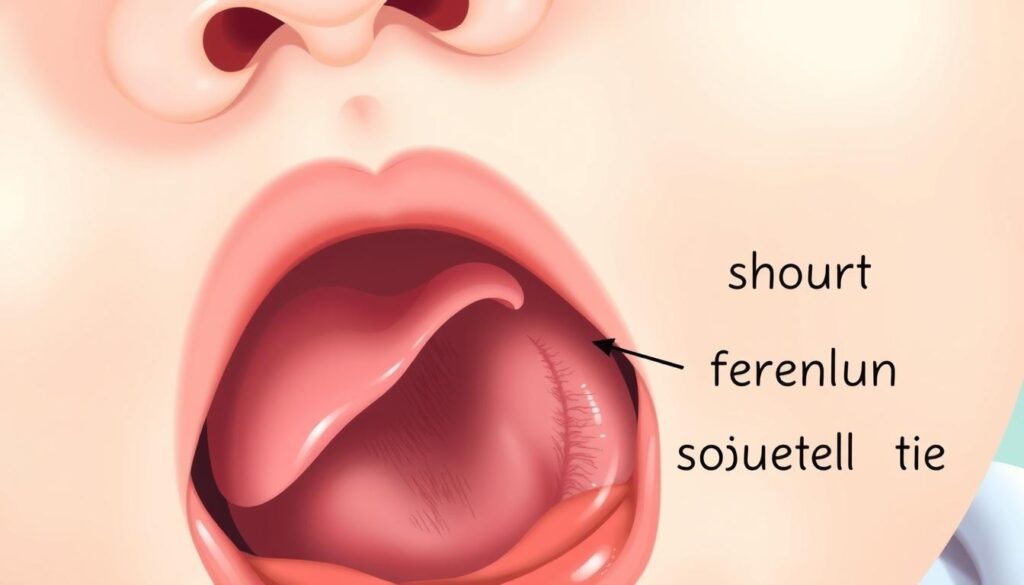
Tongue-Tie, or Ankyloglossia, is a key issue for your child’s oral growth. It limits tongue movement, affecting how babies feed and communicate1.
This condition occurs when the tongue’s connecting tissue is too short. It can make breastfeeding tough for babies and moms. Boys are more likely to have it, hinting at genetic factors1.
Tongue-Tie doesn’t always cause problems. However, it may affect speech and oral health. Some kids might struggle with pronouncing certain sounds1.
Key Takeaways
- Tongue-Tie is a congenital condition affecting tongue movement
- More common in male infants
- Can potentially impact breastfeeding and oral development
- Not always requiring medical intervention
- Professional assessment helps determine necessary treatments
Understanding Tongue-Tie (Ankyloglossia)
Tongue-tie is an oral anomaly affecting a child’s early development. It happens when the lingual frenulum is too tight or short2. The lingual frenulum is a small tissue band connecting the tongue to the mouth floor.
This condition affects about 5% of newborns, with boys more likely to have it3. Knowing about tongue-tie helps parents spot potential oral development issues in their children.
What Causes Tongue-Tie
The exact cause of tongue-tie is still unclear. Genes play a big role, suggesting it can run in families2. Unusual fetal growth before birth often leads to limited tongue movement.
Types of Tongue-Tie
Doctors use the Coryllos ankyloglossia grading scale to sort tongue-tie types:
- Type I: Thin, elastic frenulum anchored to the tongue tip4
- Type II: Frenulum extending 2-4 millimeters from the tongue tip4
- Type III: Thick, stiffened frenulum in the middle of the tongue4
- Type IV: Posterior or invisible frenulum detectable by touch4
Signs and Symptoms
Spotting tongue-tie early can prevent growth issues. Common signs include:
- Trouble breastfeeding3
- Limited tongue movement2
- Problems with certain speech sounds3
- Possible oral hygiene challenges2
“Early detection and intervention can significantly improve a child’s oral development and communication skills.”
Not all cases need immediate treatment. However, talking to a doctor can help manage this oral issue4. They can provide advice tailored to your child’s needs.
Impact on Feeding and Development
Tongue-tie can greatly affect your baby’s early growth, especially in eating and talking. It affects 4% to 10% of newborns, causing breastfeeding problems for babies and moms5. Babies with tongue-tie may have trouble latching on properly.
A lactation expert can help with feeding issues. Not all babies with tongue-tie have nursing problems. Only half of those with physical signs face these challenges5.
- Potential feeding challenges include:
- Difficulty maintaining a steady latch
- Clicking sounds during feeding
- Frequent loss of nipple contact
Speech impairment can be a long-term issue with tongue-tie. It may affect how clearly kids say sounds like d, l, t, or th. About 54% of patients aged 1-14 show changes in their mouth system6.
“Early intervention and professional guidance can make a significant difference in managing tongue-tie impacts.”
Tongue-tie surgeries have gone up by 110% since 20125. But not every case needs surgery. Good teamwork between doctors is key to avoid wrong diagnoses.
This condition is more common in boys. The ratio is about 2.5 boys for every girl6. Knowing these facts can help you deal with problems and get the right help.
Diagnosis and Treatment Options
Tongue-tie can affect your child’s feeding, speech, and oral mobility. Professional assessment is key for proper diagnosis and treatment.
Timely intervention can make a big difference in your child’s development. Seeking expert help is crucial for the best outcome.
Professional Assessment Methods
Healthcare experts use various tools to diagnose tongue-tie. The condition affects 4.2% to 10.7% of newborns, with boys more likely than girls7.
Lactation consultants use special tools to check tongue movement and function8. These assessments help determine the best course of action.
- Physical examination of tongue mobility
- Hazelbaker Assessment Tool for Lingual Frenulum Function (HATLFF)
- Evaluation of breastfeeding challenges
Surgical Procedures
Two main surgical options exist for tongue-tie release: frenotomy and frenuloplasty. Frenotomy is a simple procedure that may not require anesthesia8.
About 25% of newborns with a short lingual frenulum have trouble breastfeeding7. Surgery can often help resolve these issues.
| Procedure | Description | Complexity |
|---|---|---|
| Frenotomy | Quick release of lingual frenulum | Minor |
| Frenuloplasty | More extensive surgical repair | Complex |
Recovery and Aftercare
Recovery after tongue-tie surgery is usually quick. Lactation consultants may suggest tongue exercises to improve mobility and reduce scarring8.
Most babies can feed right after the procedure. However, it’s important to watch for any possible complications.
“Early intervention can prevent potential long-term developmental challenges associated with tongue-tie.” – Pediatric Oral Health Specialist
Complications from frenectomy are rare but may include minor bleeding or infection. Always talk to your doctor about the best treatment plan.
They can help you decide if surgery is needed and guide you through the process. Your child’s health is the top priority.
Conclusion
Tongue-Tie (Ankyloglossia) is a complex pediatric condition. It affects 0.1% to 12% of infants, mostly males. This issue can impact breastfeeding and early childhood growth.
Not all tongue-tied kids face big problems. But it’s vital for parents to understand possible effects. A lactation expert can help decide if treatment is needed.
Studies show 90-95% of babies with feeding issues may have tongue-tie. Careful assessment and personalized care are crucial. An accurate evaluation of tongue mobility can reveal potential feeding and oral health impacts9.
Your doctor can guide you through treatment options if needed. Most tongue-tied babies can still breastfeed well. Many cases improve on their own as kids grow.
Stay informed and seek expert advice. This approach ensures the best outcomes for your child’s oral health and overall growth.
FAQ
What exactly is tongue-tie?
Tongue-tie is a condition where the tissue under the tongue is too short or tight. This can limit a baby’s tongue movement, causing various problems. It may affect breastfeeding, speech, and oral health.
How common is tongue-tie?
Tongue-tie affects about 4-10% of newborns, more often in boys. It’s being diagnosed more frequently as breastfeeding awareness grows.
Can tongue-tie affect breastfeeding?
Tongue-tie can indeed impact breastfeeding. Babies might struggle to latch properly or make clicking sounds while feeding. This can result in poor weight gain and discomfort for the mother.
Will tongue-tie cause speech problems?
Tongue-tie doesn’t directly cause speech delay. However, it can make it hard to form certain sounds like d, l, t, or th. Some children may need speech therapy, but not all will have issues.
How is tongue-tie diagnosed?
Diagnosis involves a professional assessment of tongue movement and function. Healthcare providers may use special tools to evaluate tongue mobility. These tools help determine the severity of the condition.
What treatment options are available?
Treatment depends on how severe the tongue-tie is. Options include frenotomy, a simple procedure to release the tissue. For more complex cases, frenuloplasty might be necessary.
Not all cases need treatment. Many children’s tongues naturally become more flexible as they grow.
What are the risks of tongue-tie surgery?
Tongue-tie procedures are generally safe. Risks may include minor bleeding, infection, or temporary discomfort. Most babies can feed right after the procedure, with quick recovery times.
When should I seek professional help?
Seek help if you notice ongoing breastfeeding problems or speech issues. Consult a specialist if you see limitations in tongue movement. Pediatric specialists, lactation consultants, or otolaryngologists can provide thorough evaluations.
Source Links
- Tongue Tie (Ankyloglossia) (for Parents) – https://kidshealth.org/en/parents/tongue-tie.html
- Tongue-tie (ankyloglossia) – Symptoms and causes – https://www.mayoclinic.org/diseases-conditions/tongue-tie/symptoms-causes/syc-20378452
- Ankyloglossia (Tongue Tie) – https://www.chop.edu/conditions-diseases/ankyloglossia-tongue-tie
- Tongue-Tie (Ankyloglossia) – https://www.hopkinsmedicine.org/health/conditions-and-diseases/tongue-tie-ankyloglossia
- Tongue Tie in Babies: How Ankyloglossia Affects Breastfeeding & Other Concerns – https://www.healthychildren.org/English/ages-stages/baby/breastfeeding/Pages/tongue-tie-in-babies-how-ankyloglossia-affects-breastfeeding.aspx
- ANKYLOGLOSSIA AND ITS INFLUENCE ON GROWTH AND DEVELOPMENT OF THE STOMATOGNATHIC SYSTEM – https://pmc.ncbi.nlm.nih.gov/articles/PMC5496731/
- Diagnosis, Classification and Management of Ankyloglossia Including Its Influence on Breastfeeding – https://pmc.ncbi.nlm.nih.gov/articles/PMC8522341/
- Tongue-tie (ankyloglossia) – Diagnosis and treatment – https://www.mayoclinic.org/diseases-conditions/tongue-tie/diagnosis-treatment/drc-20378456
- Tongue-tie in neonates – https://tidsskriftet.no/en/2021/08/perspectives/tongue-tie-neonates

