
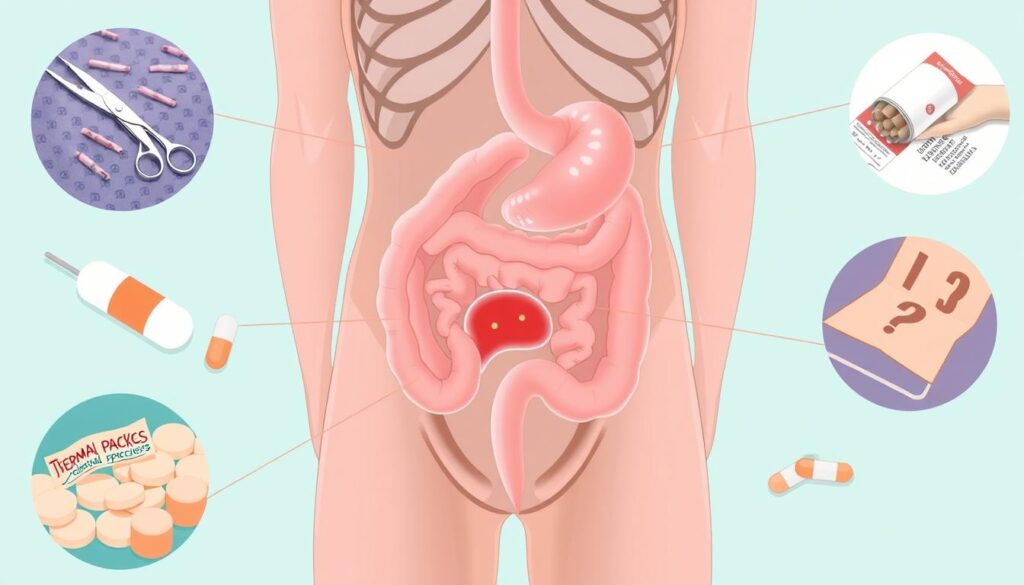
Appendicitis needs quick medical help. Knowing about treatment options can help you handle this tough health problem. Quick action can make a big difference in getting better1.
An appendectomy is the main fix for appendicitis. You can choose open surgery or laparoscopic surgery. Laparoscopic surgery heals faster and leaves smaller scars2.
Doctors pick the best treatment based on how bad your appendicitis is. Sometimes, they use antibiotics for a short time. But surgery is still the safest way to avoid problems2.
Your healing time depends on the surgery type. Most people stay in the hospital for 1 to 2 days. Full recovery usually takes a few weeks21.
Kids might go back to school soon. But they should avoid hard activities for several weeks2.
Key Takeaways
- Appendectomy is the primary treatment for appendicitis
- Laparoscopic surgery offers faster recovery times
- Hospital stays typically range from 1-2 days
- Recovery can take a few weeks depending on surgery type
- Prompt medical intervention prevents serious complications
Understanding Appendicitis Symptoms and Diagnosis
Spotting appendicitis signs is vital for your well-being. Symptoms vary widely, making early detection tricky3. Knowing the warning signs helps you get timely medical help.
Early Warning Signs and Pain Patterns
Appendicitis pain often starts in the middle of your belly. It then moves to the lower right side. The pain usually gets worse and more focused4.
Key symptoms include:
- Sudden abdominal pain
- Nausea and vomiting
- Loss of appetite
- Mild fever
- Changes in bowel movements
Note: Only about half of patients exhibit classic appendicitis symptoms3. This makes diagnosis complex.
Diagnostic Tests and Procedures
Doctors use several tests to confirm appendicitis. These may include:
- Physical examination
- Blood tests to check for infection
- Urine analysis
- Imaging studies:
- Abdominal X-rays
- Ultrasound
- CT scans
When to Seek Emergency Care
Get medical help right away if you have:
- Severe abdominal pain
- High fever
- Persistent vomiting
- Swollen abdomen
“Delaying treatment can lead to serious complications like peritonitis”
Appendicitis mostly affects people between 10 and 30 years old4. Men face a slightly higher risk of this condition4.
Appendicitis Treatment: Surgical and Non-Surgical Options
Appendicitis treatment options are vital to understand after diagnosis. The main approach is usually appendectomy surgery, which can be done in different ways5.
- Surgical Removal (Appendectomy)
- Antibiotic Treatment
Surgical options include open surgery and laparoscopic appendectomy. Laparoscopic procedures offer quicker recovery and less scarring6.
Antibiotics are a promising option, working in up to 70% of cases5. Your doctor can help decide which treatment is best for you.
“The choice between surgery and antibiotics depends on individual patient factors and clinical assessment.”
Your treatment choice may depend on:
- Severity of appendicitis
- Patient health conditions
- Potential surgical risks
| Treatment Option | Cost | Recovery Time |
|---|---|---|
| Laparoscopic Appendectomy | $236,200 | 1-2 weeks |
| Antibiotic Treatment | $233,700 | Variable |
Antibiotics can work well, but 40% of patients might still need surgery later5. Talk to your doctor to find the best treatment for you6.
Conclusion
Understanding your health is crucial for managing appendicitis. Medical advances offer more options for prevention and recovery. Appendicitis affects about 250,000 people yearly in the US, mainly kids and young adults.
Early detection and proper treatment can reduce complications. Surgery is common, but antibiotics may work for some patients. Studies show 70% of patients might avoid surgery with antibiotic treatment.
Recovery requires understanding risks and following medical advice. Personalized care is key to successful management. Your doctor can help choose the best treatment for you.
Be proactive about your health. Ask questions and stay informed about your condition. This approach ensures the best possible outcome for your appendicitis treatment78.
FAQ
What are the most common symptoms of appendicitis?
Key symptoms include abdominal pain that shifts to the lower right side. Nausea, vomiting, and loss of appetite often occur too. Fever and changes in bowel movements may also be present.
Seek medical help right away if you have severe pain that gets worse quickly.
How is appendicitis diagnosed?
Doctors use various methods to diagnose appendicitis. These include physical exams, blood tests, and urine tests. Imaging studies like ultrasounds, CT scans, or X-rays are also used.
Sometimes, doctors perform digital rectal or pelvic exams to confirm the condition.
What is the primary treatment for appendicitis?
Surgical removal of the appendix, called an appendectomy, is the main treatment. This can be done through open surgery or laparoscopic methods.
Laparoscopic surgery often leads to faster recovery and less scarring. Antibiotics are given before surgery to fight infection.
Can appendicitis be treated without surgery?
In some cases, doctors may use antibiotics instead of surgery. This is more common for less severe cases or high-risk patients.
However, surgical removal remains the top choice for most people with appendicitis.
How long does recovery from appendicitis take?
Recovery usually takes 1 to 2 weeks for simple cases. You’ll need to limit activities and support your belly when coughing.
Gradually increase movement as you heal. Full recovery depends on your health and any complications.
What are the potential complications of appendicitis?
Untreated appendicitis can lead to serious issues. These include perforation, abscess formation, peritonitis, and sepsis.
After surgery, possible risks are wound infection, bleeding, and adhesions. In rare cases, appendicitis may come back.
Who is most at risk for appendicitis?
Appendicitis mostly affects people aged 5 to 45, with males slightly more at risk. It’s the top cause of abdominal surgery in kids.
It’s also the most common abdominal surgical emergency worldwide.
When should I seek emergency medical care?
Get immediate medical help if you have severe abdominal pain or confusion. Difficulty breathing or signs of a burst appendix are also urgent.
These symptoms could mean you have a serious condition that needs quick treatment.
Source Links
- Appendicitis – https://www.nhs.uk/conditions/appendicitis/
- Appendicitis – Diagnosis and treatment – https://www.mayoclinic.org/diseases-conditions/appendicitis/diagnosis-treatment/drc-20369549
- Appendicitis: Signs, Symptoms and Treatment – https://my.clevelandclinic.org/health/diseases/8095-appendicitis
- Appendicitis – Symptoms and causes – https://www.mayoclinic.org/diseases-conditions/appendicitis/symptoms-causes/syc-20369543
- Antibiotics, Not Surgery, for Uncomplicated Appendicitis Now Routine – https://www.uspharmacist.com/article/antibiotics-not-surgery-for-uncomplicated-appendicitis-now-routine
- Operative Versus Nonoperative Management of Appendicitis: A Long-Term Cost Effectiveness Analysis – https://pmc.ncbi.nlm.nih.gov/articles/PMC6699012/
- Appendicitis management: Is it time for a change? – https://www.ccjm.org/content/89/6/309
- Antibiotics versus appendectomy in the management of acute appendicitis: a review of the current evidence – https://pmc.ncbi.nlm.nih.gov/articles/PMC3195652/

