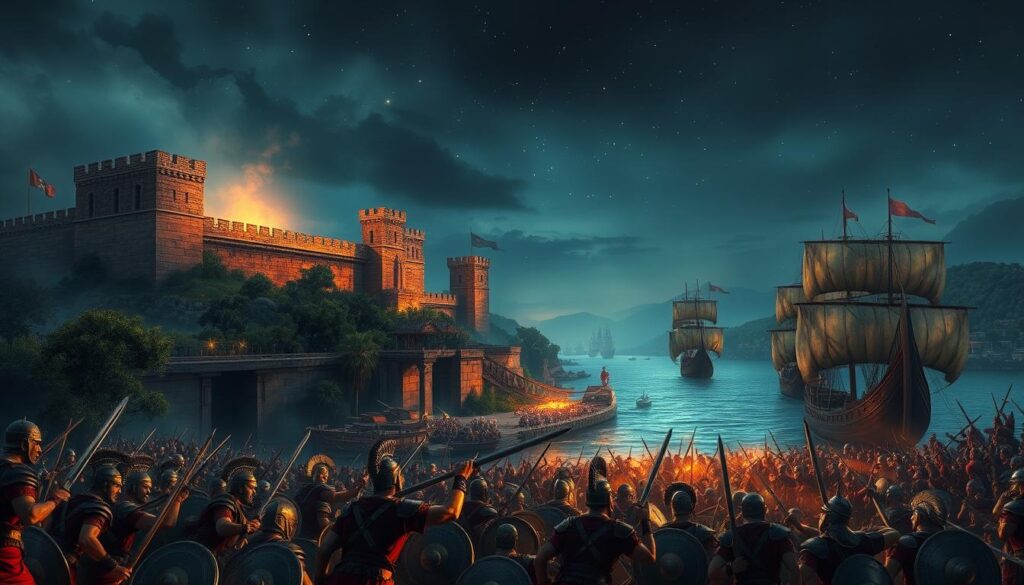
The Trojan War has fascinated people for centuries. It’s filled with epic battles, legendary heroes, and timeless themes1. This legendary conflict happened around the 12th or 13th century BC. It was between the Achaeans (Greeks) and the city of Troy. The war started when Paris of Troy took Helen from her husband Menelaus, king of Sparta2.
This event became a key part of Greek mythology and Western literature2. The war’s role in Homer’s epic poems, the Iliad and the Odyssey, makes it very important3.
The Trojan War has greatly influenced Western literature and art1. Its themes and characters continue to inspire new works and adaptations1. As we explore the Trojan War, we’ll look at its historical context, key figures, and major events. We’ll also see how it has shaped our understanding of Greek mythology and Homer’s world2.
Key Takeaways
- The Trojan War was a legendary conflict in Greek mythology that took place around the 12th or 13th century BC2.
- The war was sparked by the abduction of Helen by Paris of Troy, leading to a decade-long battle between the Achaeans and the Trojans1.
- The Trojan War has had a profound impact on Western literature and art, with its themes and characters continuing to inspire new works and adaptations3.
- The war’s significance in ancient literature, particularlly its central role in Homer’s epic poems, solidifies its importance in the realm of Greek mythology1.
- The Trojan War poses complex ethical and moral dilemmas, forcing characters to make difficult decisions with long-lasting consequences2.
Overview of the Trojan War
The Trojan War is a key event in ancient history. It mixes myth and reality from the Bronze Age Mediterranean4. Troy, near the Dardanelles, was the center of a ten-year war. This war has captivated scholars and fans for centuries.
Historical Context
The war likely happened in the 12th or 13th century BC. It was between the Achaeans and Troy5. Archaeology shows Troy VII was destroyed during this time45.
Key Figures
Well-known Greek heroes like Agamemnon, Achilles, and Odysseus played big roles46. Hector and Paris, on the Trojan side, were also key. Paris’s taking of Helen of Troy started the war4.
Major Events
The story begins with the Judgment of Paris and ends with Troy’s fall46. It includes fierce battles, strategic moves, and heroic acts. These moments are famous in epic stories4.
| Aspect | Details |
|---|---|
| Duration | 10 years |
| Key Greek Figures | Agamemnon, Achilles, Odysseus |
| Key Trojan Figures | Hector, Paris |
| Cause | Abduction of Helen of Troy |
| End | Fall of Troy via Trojan Horse |
The Role of the Gods in the Trojan War
The Trojan War was more than a fight between humans; Greek mythology shows gods and goddesses played a big role. Their actions made the war a deep mythological conflict, with divine help being key.
Divine Intervention
Gods sided with mortals, affecting battles and protecting their heroes. For example, Apollo sent a plague to the Greeks, weakening them7. Athena also took the Palladium statue, a sacred item that protected Troy, helping the Greeks7.
The Olympian Gods’ Favorites
Gods chose sides based on personal likes. Hera and Athena backed the Greeks, while Aphrodite supported the Trojans8. Their choices were not random; each god had reasons that made them pick a side, adding to the mythological conflict.
Consequences of Divine Quarrels
Gods’ fights had big effects on humans. Zeus, though leaning towards the Trojans, stayed out due to Hera’s opposition7. These divine disputes led to chaotic battles and tragic losses, showing how godly conflicts deeply affected human lives.
| God/Goddess | Allegiance | Role in the War |
|---|---|---|
| Zeus | Neutral/Trojans | Attempted to mediate but remained largely uninvolved |
| Hera | Greeks | Supported Greek heroes and strategies |
| Athena | Greeks | Influenced key battles and favored strategic maneuvers |
| Aphrodite | Trojans | Protected Paris and influenced Trojan decisions |
| Apollo | Trojans | Sent plagues and aided Trojan warriors |
Legendary Artifacts of the Trojan War
The Trojan War, immortalized in the Iliad, is famous for its heroic battles and iconic artifacts. These legendary objects continue to fascinate historians and enthusiasts.
The Trojan Horse
The Trojan Horse was a clever strategy during the Siege of Troy. It was a wooden structure disguised as a gift. Greek soldiers hid inside and sneaked into the city, leading to Troy’s downfall9. Today, a 40-foot tall statue honors this tactic, showing the war’s ingenuity10.
Achilles’ Armor
Achilles’ armor was made by the god Hephaestus. It shows divine craftsmanship and Achilles’ strength in the Iliad9. The armor protected him but also showed his vulnerability10.
Helen’s Beauty
Helen of Sparta was known as the face that launched a thousand ships. Her beauty sparked the Trojan War9. Her story shows how beauty can lead to war, highlighting its complex role in history10.
The Legacy of the Trojan War
The Trojan War is key to understanding ancient history and Greek heroes. Its stories have lasted through time, shaping art and literature.
Impact on Literature and Art
Homer’s Iliad, written in the 8th century BCE, is a major work inspired by the Trojan War. It introduced heroes like Achilles and Hector, influencing Western literature11. Renaissance artists brought these stories to life, creating scenes of battle and heroism.
The war’s themes of honor and sacrifice are seen in today’s literature and art.
Modern Adaptations and Interpretations
Today, the Trojan War is often retold in new ways. Films like “Troy” offer fresh views of the classic story. Novels dive into the motivations of characters like Helen and Paris.
These stories keep the legacy of Greek heroes alive, making ancient history interesting for today’s viewers12.
Lessons Learned from the Myths
The myths of the Trojan War teach us about human nature and conflict. Characters like Agamemnon and Achilles show the dangers of pride and the challenges of leadership. These stories make us think about ethics and the effects of our choices.
They show that ancient tales’ lessons are just as relevant today11.
FAQ
What is the Trojan War and why is it significant in Greek mythology?
The Trojan War is a legendary battle between the Greeks and Troy. It’s key in Greek mythology. It’s famous because it’s the setting for Homer’s Iliad and Odyssey. These poems have greatly influenced Western literature and art.
It shows themes of heroism, fate, and the mix of mortal and divine worlds.
What are the primary sources of information about the Trojan War?
Homer’s Iliad and Odyssey are the main sources. They give detailed stories of the war, its heroes, and the gods’ roles. Archaeological finds at Hisarlik and Roman and Greek writings also help us understand it.
Is there historical evidence supporting the existence of the Trojan War?
Scholars debate the Trojan War’s historicity. Excavations at Hisarlik show a city destroyed around the war’s time. Yet, the mix of myth and history makes it hard to confirm the war’s exact details.
Who were the key figures in the Trojan War?
Key Greeks include Achilles, Odysseus, and Agamemnon. Trojans like Hector and Paris also played big roles. Gods like Zeus, Hera, Athena, and Aphrodite influenced the war with their divine power.
What were the major events of the Trojan War?
The war started with Paris’s choice of Helen over Aphrodite. It included battles, Achilles’ heroics, and divine help. The Trojan Horse’s use led to Troy’s fall.
How did the gods influence the outcome of the Trojan War?
Gods like Zeus and Hera took sides and intervened. They affected battles, protected heroes, and shaped events. Their actions added depth to the war, showing the clash between mortals and gods.
What is the story behind the Trojan Horse?
The Greeks built a huge wooden horse to sneak into Troy. They pretended to leave, leaving the horse behind. The Trojans, unaware of the hidden soldiers, brought it inside. At night, the soldiers opened the gates for the Greeks, leading to Troy’s fall.
What is the significance of Achilles’ armor in the Iliad?
Achilles’ armor, made by Hephaestus, shows his unmatched strength. In the Iliad, it highlights his bravery and vulnerability. The armor’s detailed description shows divine craftsmanship and heroic ideals.
How is Helen of Troy portrayed in ancient sources?
Helen is seen as a beautiful woman whose abduction started the war. Ancient texts show her as both a victim and a cause of conflict. Her role varies, showing her as both a victim and a catalyst for war.
What is the legacy of the Trojan War in Western culture?
The Trojan War has deeply influenced Western culture. It has inspired countless works in literature, art, and media. Its themes of heroism, fate, and human nature continue to teach us valuable lessons.
How has the Trojan War influenced modern literature and art?
The Trojan War has inspired many modern works. Creators use its stories and characters to reflect today’s values. Artists use symbols like the Trojan Horse to convey themes of deception and strategy.
What lessons can be learned from the myths of the Trojan War?
The Trojan War myths teach us about heroism, pride, and human relationships. They show the impact of gods on humans and the struggle between fate and free will. These stories encourage us to think about conflict, virtues, and flaws.
Are there any significant archaeological findings related to the Trojan War?
Yes, excavations at Hisarlik have found ruins that suggest a city was destroyed. These findings support the idea of a historical conflict like the Trojan War. Yet, proving the war’s exact details remains a challenge.
Source Links
- Exploring Dilemmas in The Trojan War – https://medium.com/@amorelx/exploring-dilemmas-in-the-trojan-war-ef19b2425427
- Homer’s Iliad: The Epic Tale Of The Trojan War – https://www.thecollector.com/trojan-war-iliad-troy/
- TROJAN WAR: THE PODCAST – https://podcasts.apple.com/us/podcast/trojan-war-the-podcast/id1086803629
- Trojan War – https://en.wikipedia.org/wiki/Trojan_War
- Trojan War ‑ Definition, Summary & Hero | HISTORY – https://www.history.com/topics/ancient-greece/trojan-war
- Short Trojan War Summary – – https://www.theoi.com/articles/short-trojan-war-summary/
- Gods and Goddesses (Role in the Trojan War) – https://www.slideshare.net/slideshow/gods-and-goddesses-role-in-the-trojan-war/45883797
- The Trojan War • Greek Gods & Goddesses – https://greekgodsandgoddesses.net/myths/trojan-war/
- Trojan War: The Epic Tale in 17 Artworks – https://www.thecollector.com/trojan-war-artworks/
- In Search of Troy – https://www.smithsonianmag.com/history/in-search-of-troy-180979553/
- The Battle of Troy: Myth, History, and Legacy – Travel Blogs – https://www.travelshowtime.com/the-battle-of-troy-myth-history-and-legacy.html
- Did the Trojan War actually happen? – https://www.bbc.com/culture/article/20200106-did-the-trojan-war-actually-happen