
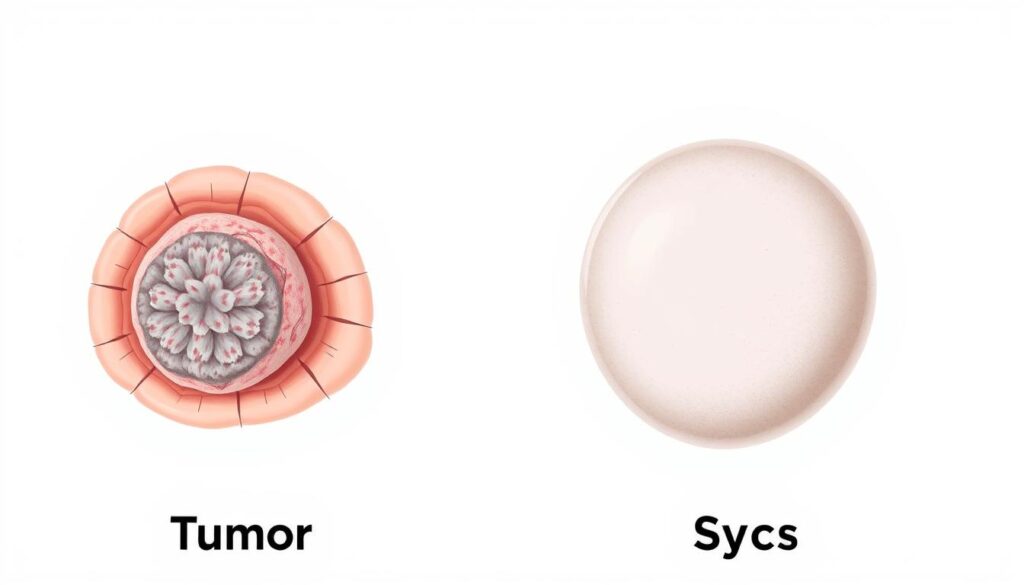
Finding an odd lump on your body can be scary. Knowing if it’s a tumor or cyst is important. These growths may look alike, but they’re quite different1.
A tumor is a mass of tissue from cells growing out of control. It can be harmless or cancerous, depending on how the cells act1. Some tumors stay in one spot, while others can spread2.
Cysts are sacs filled with fluid that can form in many body parts. They’re usually harmless but can sometimes cause problems1. Your body might make cysts due to skin issues or hormone changes2.
Key Takeaways
- Tumors and cysts are distinct medical conditions with unique characteristics
- Not all lumps indicate serious health risks
- Professional medical evaluation is crucial for accurate diagnosis
- Both tumors and cysts can occur in multiple body locations
- Diagnostic tools help distinguish between tumors and cysts
Understanding Tumors vs. Cysts: Basic Characteristics
Tumors and cysts differ in key ways. Knowing these differences is vital for your health. Let’s explore their unique features.
What Defines a Tumor
A tumor is an abnormal tissue mass from uncontrolled cell growth. Oncology classifies tumors into three main types.
- Benign tumors: These growths stay localized and do not spread to other body parts34.
- Premalignant tumors: These have the potential to become cancerous and require close monitoring4.
- Malignant tumors: Cancerous growths that can rapidly spread and form new tumors throughout the body3.
Common benign tumors include lipomas, fibroids, and hemangiomas3. These growths can sometimes press on nearby tissues3.
What Defines a Cyst
A cyst is a fluid-filled sac that can form in various body parts. Most cysts are harmless and may disappear on their own4.
| Cyst Type | Common Location | Typical Cause |
|---|---|---|
| Sebaceous Cyst | Skin | Blocked glands or hair follicles5 |
| Ovarian Cyst | Ovaries | Hormonal changes5 |
| Breast Cyst | Breast tissue | Hormonal fluctuations5 |
“Understanding the nature of growths in your body is the first step towards proactive health management.”
Cysts are usually round, smooth, and movable. Cancerous lumps, however, are often hard and fixed in place5.
Most cysts are harmless, but it’s important to watch for changes. Consult a doctor if you notice anything unusual3.
Tumor vs. Cyst: Diagnostic and Clinical Features
Tumors and cysts differ in important ways. Diagnostic imaging helps doctors identify these growths. Medical evaluation is crucial for understanding their potential risks.
Doctors use various imaging techniques to examine unusual masses. These methods help them see inside the body.
- Ultrasound scans
- CT scans
- MRI scans
- Mammograms
Cysts often look smooth and uniform in images. Tumors, however, may show more complex internal structures.
For a final diagnosis, doctors may suggest a biopsy. This test looks at the cells up close6.
| Type of Growth | Diagnostic Characteristics | Treatment Options |
|---|---|---|
| Functional Cysts | Typically resolve within 2-3 months | Monitoring |
| Pathological Cysts | Abnormal cell growth | Surgical removal if necessary7 |
| Benign Tumors | Non-cancerous growth | Monitoring or surgical removal |
| Malignant Tumors | Potentially cancerous | Aggressive treatment required6 |
Your doctor will suggest treatment options based on the growth’s features. Some cysts may not need treatment.
Others might require surgical removal to avoid problems7. The right approach depends on what the tests show.
Early detection and proper medical evaluation are key to understanding the nature of any unusual growth.
Conclusion
Knowing the differences between tumors and cysts is vital for your health. Self-awareness helps you spot body changes early. Most growths are harmless, but early detection is key89.
Take charge of your health. Do regular self-checks and see your doctor. Tumors can be benign or malignant, each needing special care9.
Cysts are usually harmless and don’t spread. This knowledge can ease your worries10.
Doctors suggest routine check-ups for full health monitoring. Know your risk factors like genes, lifestyle, and environment. This helps you make smart health choices8.
Stay informed and work with your healthcare team. This approach helps you face health challenges confidently.
Only a doctor can give you a correct diagnosis. If you see strange growths or have ongoing symptoms, get checked. Use thorough diagnostic methods for answers10.
Your health journey is unique. Proactive care is your best tool for staying healthy.
FAQ
What is the main difference between a tumor and a cyst?
Tumors are abnormal tissue masses from uncontrolled cell growth. They can be benign or malignant. Cysts are sac-like structures filled with fluid, air, or other materials.
Cysts are typically benign and soft to touch. Tumors show abnormal cell growth, while cysts contain fluid or other substances.
Are all tumors cancerous?
No, not all tumors are cancerous. Tumors fall into three main types: benign, premalignant, and malignant. Benign tumors grow locally and don’t spread.
Premalignant tumors might become cancerous and need monitoring. Malignant tumors are cancerous and can spread through metastasis.
How do doctors diagnose whether a growth is a tumor or a cyst?
Doctors use various methods to tell tumors from cysts. These include diagnostic imaging like ultrasounds, CT scans, MRI scans, and mammograms.
Biopsies involve removing tissue for microscopic examination. Fine needle aspiration samples fluid from potential cysts. Imaging shows cysts as smooth, while tumors may have complex solid parts.
What are some common types of cysts?
Common cysts include epidermoid, sebaceous, breast, and ovarian cysts. Most are benign and may resolve on their own. They often feel soft and movable under the skin.
Treatment may not be needed unless they cause discomfort or become infected.
When should I be concerned about a lump or growth?
Seek medical help if you notice a persistent lump or changes in size or appearance. Watch for pain, discomfort, rapid growth, or texture changes associated with the lump.
Pay attention to unusual symptoms accompanying the growth. Only a healthcare professional can provide an accurate diagnosis and proper treatment plan.
What treatment options are available for tumors and cysts?
Treatment depends on the specific diagnosis. Cysts are often monitored or left untreated if they cause no symptoms. Benign tumors may be watched or surgically removed if problematic.
Malignant tumors usually need more aggressive treatments like surgery, radiation therapy, or chemotherapy. The approach varies based on the growth’s type, location, and characteristics.
Can cysts become cancerous?
Most cysts are benign, but rarely, they can develop cancerous traits. Some cysts, especially in organs like ovaries or pancreas, may have higher cancer risk.
It’s crucial to have any persistent or changing cysts checked by a healthcare professional.
Source Links
- Cysts vs. Tumors – Baptist Health – https://www.baptisthealth.com/blog/cancer-care/cysts-vs-tumors
- Cyst vs. tumor: Conditions, differences, and diagnosis – https://www.medicalnewstoday.com/articles/321881
- Cyst vs Tumor: Differences, Cancer, Diagnosis, and Treatment – https://www.healthline.com/health/cyst-vs-tumor
- Difference Between a Tumor and a Cyst – https://www.massgeneralbrigham.org/en/about/newsroom/articles/difference-between-cyst-and-tumor
- Cyst vs. Tumor: What’s the Difference? What You Need to Know – Ezra – https://ezra.com/blog/cyst-vs-tumor
- Cyst vs. Tumor: What Is the Difference? – https://resources.healthgrades.com/right-care/symptoms-and-conditions/cyst-vs-tumor
- Cysts vs. Cancer: Clearing the Air – https://ocrahope.org/news/science-made-simple-ovarian-cysts-and-ovarian-cancer/
- Cyst vs Tumor: Understanding the Differences & Causes – https://cancercenterforhealing.com/cyst-vs-tumor/
- Tumors: Benign, premalignant, and malignant – https://www.medicalnewstoday.com/articles/249141
- When to Worry: Understanding Breast Cyst Symptoms and Tumor Differences | Advanced Surgical Physicians – https://www.toplinemd.com/advanced-surgical-physicians/blog/when-to-worry-understanding-breast-cyst-symptoms-and-tumor-differences/

