
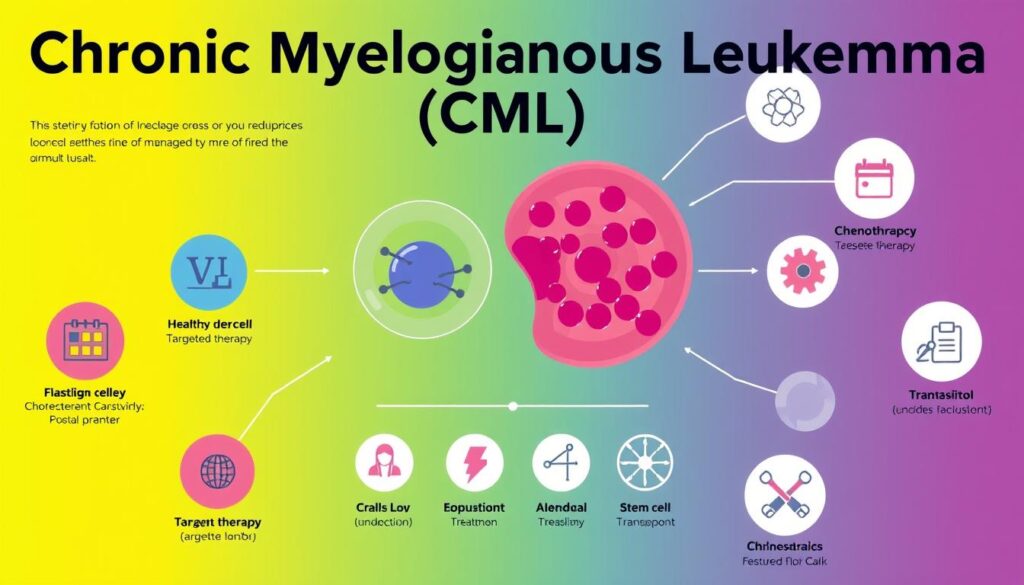
Chronic Myelogenous Leukemia (CML) is a complex blood cancer affecting bone marrow and white blood cells. It develops slowly, offering chances for effective management1. CML can occur at any age, but it’s more common in older adults1.
Your CML risk rises with age and certain genetic factors. Men are slightly more likely to get CML than women1. About 8,000 new cases appear yearly in the U.S., making up 15% of adult leukemias2.
The Philadelphia chromosome is crucial in CML, showing up in 90% of patient blood cells1. This genetic change causes abnormal white blood cell growth. Thanks to modern treatments, CML has become a manageable chronic disease3.
Key Takeaways
- CML is a slow-progressing blood cancer affecting bone marrow
- Predominantly diagnosed in adults over 65 years old
- The Philadelphia chromosome is present in 90% of CML cases
- Modern treatments have significantly improved patient outcomes
- Risk factors include age, radiation exposure, and genetic predisposition
What is Chronic Myelogenous Leukemia
Chronic Myelogenous Leukemia (CML) is a complex blood disorder affecting bone marrow and blood cell production4. It mainly impacts middle-aged adults, but can occasionally occur in children4. CML disrupts normal blood cell balance in your body.
Understanding the Philadelphia Chromosome
The Philadelphia chromosome is a genetic mutation central to CML. It occurs when parts of chromosomes 9 and 22 swap places. This creates an abnormal BCR-ABL gene, triggering overproduction of white blood cells.
Signs and Symptoms to Watch For
CML often presents subtle yet significant symptoms. These can go unnoticed at first.
- Persistent fatigue
- Unexplained weight loss
- Recurrent night sweats
- Fever
- Pain or fullness below the left rib cage
How CML Affects Your Body
Abnormal white blood cells crowd out healthy ones in your bone marrow. This leads to serious health issues.
- Anemia due to reduced red blood cell count
- Increased infection risk
- Easy bruising or bleeding
CML progresses through different phases, with the chronic phase potentially lasting months or years with minimal symptoms4.
Modern targeted medicines like tyrosine kinase inhibitors have greatly improved CML treatment. Many patients now achieve long-term remission4. These treatments offer hope for those battling this complex blood disorder.
Diagnosis and Treatment Options for CML
Chronic Myelogenous Leukemia (CML) diagnosis starts with thorough medical tests. Your doctor will likely begin with blood tests to assess your condition5. Many patients are diagnosed during routine checks, with half showing no symptoms6.
- Complete blood count (CBC)
- Bone marrow biopsy
- Genetic testing for Philadelphia chromosome
Advanced techniques like fluorescence in situ hybridization (FISH) and polymerase chain reaction (PCR) may be recommended. These tests detect specific genetic markers5. They help determine the CML stage, which can be chronic, accelerated, or blastic6.
CML treatment has made huge strides with targeted therapy. Tyrosine kinase inhibitors (TKIs) have turned this once deadly disease into a manageable condition. Drugs like imatinib, dasatinib, and nilotinib block the abnormal BCR-ABL gene protein6.
“Modern treatments have dramatically improved survival rates for CML patients.”
Your treatment plan depends on your age, health, and CML phase5. About 75% of patients respond well to imatinib-based treatments6.
While TKIs are the main treatment, other options may include:
- Chemotherapy
- Immunotherapy
- Stem cell transplantation
Conclusion
CML treatment has advanced significantly with targeted therapies like tyrosine kinase inhibitors. These new treatments have greatly improved long-term outlook for patients. You can now maintain an excellent quality of life with CML7.
Median survival for CML patients now approaches normal life expectancy. This progress allows for a more optimistic outlook on your diagnosis. Advanced medical research continues to enhance patient outcomes8.
Regular monitoring is essential in managing CML. Blood tests and bone marrow exams help track disease progress and treatment effectiveness. Modern therapies offer strong solutions to challenges like mutations and treatment resistance.
About 93% of chronic phase patients show progression-free survival after six years of targeted treatment8. Your active involvement in treatment is crucial. Work with your healthcare team and follow prescribed protocols carefully.
Stay informed about new research developments in CML treatment. Understanding your genetic profile, like Philadelphia chromosome status, can help predict treatment response7. A proactive approach can help you effectively manage CML and maintain good quality of life.
The future of CML treatment looks bright. Ongoing research is developing more advanced therapies for better patient outcomes. Stay engaged, keep a positive outlook, and trust in medical progress for managing CML.
FAQ
What is Chronic Myelogenous Leukemia (CML)?
CML is a slow-progressing blood and bone marrow disease. It causes overproduction of white blood cells. A genetic mutation called the Philadelphia chromosome typically causes CML.
This mutation creates an abnormal protein. It leads to excessive production of immature white blood cells.
What causes the Philadelphia chromosome?
The Philadelphia chromosome occurs when parts of chromosomes 9 and 22 switch places. This creates a fusion gene called BCR-ABL. It’s not inherited but develops during a person’s lifetime.
This chromosome is present in about 95% of CML cases.
What are the common symptoms of CML?
Common symptoms include fatigue, unexplained weight loss, night sweats, and fever. Pain below the left ribs due to an enlarged spleen is also common.
Some patients may experience no symptoms, especially in early stages.
How is CML diagnosed?
Diagnosis involves blood tests, bone marrow examination, and genetic testing. A complete blood count often shows high white blood cell levels.
Genetic tests like FISH and PCR detect the Philadelphia chromosome and BCR-ABL gene.
What are the treatment options for CML?
The main treatment is targeted therapy using tyrosine kinase inhibitors (TKIs). These drugs block the action of the abnormal BCR-ABL protein.
Examples include imatinib, dasatinib, and nilotinib. Sometimes, doctors may consider chemotherapy, immunotherapy, or stem cell transplantation.
What are the phases of CML?
CML progresses through three phases: chronic, accelerated, and blast crisis. Each phase represents the disease becoming more advanced.
As CML advances, it can become more challenging to treat.
Can CML be cured?
CML isn’t typically considered completely curable. However, modern treatments have transformed it into a manageable chronic condition.
Many patients achieve long-term remission with proper treatment. They can lead relatively normal lives with ongoing monitoring.
How does CML affect the body?
CML causes bone marrow to produce too many immature white blood cells. These crowd out healthy blood cells, leading to various health issues.
Patients may experience anemia, increased infection risk, and easy bruising. Low platelet counts can also cause bleeding problems.
Is CML hereditary?
No, CML is not inherited. The Philadelphia chromosome mutation occurs spontaneously during a person’s lifetime.
Parents do not pass this mutation to their children.
What is the prognosis for CML patients?
Modern targeted therapies have significantly improved the outlook for CML patients. Many can manage the disease long-term with proper care.
Treatment focuses on controlling symptoms and preventing disease progression. This approach helps patients maintain a good quality of life.
Source Links
- Chronic myelogenous leukemia – Symptoms and causes – https://www.mayoclinic.org/diseases-conditions/chronic-myelogenous-leukemia/symptoms-causes/syc-20352417
- Chronic Myelogenous Leukemia | Dana-Farber Cancer Institute – https://www.dana-farber.org/cancer-care/types/chronic-myelogenous-leukemia
- Chronic Myeloid Leukemia (CML) | Learn What Is CML – https://www.lls.org/leukemia/chronic-myeloid-leukemia
- Chronic myelogenous leukemia (CML): MedlinePlus Medical Encyclopedia – https://medlineplus.gov/ency/article/000570.htm
- Chronic Myelogenous Leukemia Treatment – https://www.cancer.gov/types/leukemia/patient/cml-treatment-pdq
- Diagnosis and Treatment of Chronic Myeloid Leukemia (CML) in 2015 – https://pmc.ncbi.nlm.nih.gov/articles/PMC5656269/
- Chronic Myeloid Leukemia Treatment (PDQ®) – https://www.cancer.gov/types/leukemia/hp/cml-treatment-pdq
- Chronic Myelogenous Leukemia: Treatment and Monitoring – https://pmc.ncbi.nlm.nih.gov/articles/PMC2835925/

