
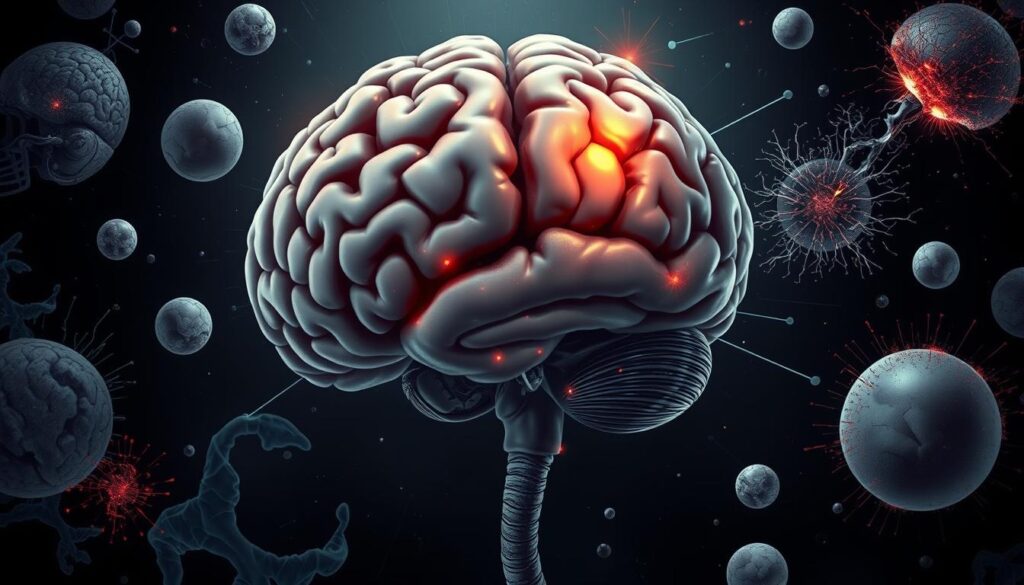
Chronic Traumatic Encephalopathy (CTE) is a complex brain disease caused by repeated head impacts. It affects people in contact sports, military service, and other risky activities1. The damage builds up over time, often without noticeable symptoms for years2.
CTE changes how the brain works. It can affect a person’s mood, behavior, thinking, and movement1. Boxers and football players face a higher risk of getting this disease1.
Knowing about CTE helps us spot risks and prevent harm. While it’s hard to diagnose, being aware can lead to better care. People can get help managing brain trauma effects if they know the signs.
Key Takeaways
- CTE results from repeated head impacts in sports, military, and other high-risk environments
- Symptoms can emerge decades after initial brain trauma
- Affects mood, behavior, cognitive, and motor functions
- Currently only definitively diagnosable through postmortem analysis
- Professional athletes are at higher risk of developing the condition
What is Chronic Traumatic Encephalopathy (CTE)?
Chronic Traumatic Encephalopathy (CTE) is a serious brain condition caused by repeated head injuries. It affects people in high-contact activities like sports and military service. CTE leads to progressive brain damage over time3.
Understanding the Condition
Dementia pugilistica, once called punch drunk syndrome, is a brain disorder. It involves tau protein buildup in the brain. Athletes in combat and contact sports have the highest risk3.
Key Characteristics of CTE
- Progressively develops after multiple head injuries3
- Characterized by widespread tau protein buildup4
- Impacts cognitive and behavioral functions
Disease Progression
CTE progresses through four stages. Each stage shows more severe symptoms4:
| Stage | Primary Symptoms |
|---|---|
| Stage I | Mild memory issues and depression |
| Stage IV | Advanced language deficits, psychotic symptoms, motor impairments |
Diagnostic Challenges
CTE can only be confirmed after death through brain examination. Scientists are working on new ways to detect it in living patients. They’re developing PET scans to find tau protein buildup3.
Understanding CTE requires ongoing research and comprehensive medical investigation.
CTE affects about 30% of people with multiple head injuries. This shows how important prevention and early treatment are3.
Causes and Risk Factors of CTE
Chronic Traumatic Encephalopathy (CTE) stems from repeated head injuries and possible brain inflammation. Knowing its causes helps you spot risks linked to this tricky brain condition.
Repetitive Head Injuries: The Primary Trigger
CTE forms due to ongoing head impacts, with or without diagnosed concussions. Each hit can cause tiny brain damage, possibly leading to long-term problems5.
Key factors include how often and hard the head is hit. The total brain injury over time also matters.
- Frequency of head impacts
- Intensity of trauma
- Cumulative brain injury over time
Common Sports Linked to CTE
Contact sports raise CTE risks. Some athletes face higher danger:
| Sport | CTE Risk Level |
|---|---|
| American Football | Extremely High |
| Boxing | High |
| Ice Hockey | Moderate to High |
| Rugby | Moderate |
Other Potential Contributors
Military personnel risk CTE from blast injuries and repeated head trauma6. Genes might play a role too, making some people more prone to brain damage7.
Understanding your personal risk factors is crucial for prevention and early intervention.
Not everyone with head impacts gets CTE. But brain damage risk is real. Protect your brain with safety measures and stay informed5.
Diagnosis and Assessment of CTE
Chronic traumatic encephalopathy (CTE) diagnosis is complex for doctors. It requires advanced methods beyond typical exams. Let’s explore the intricate process of identifying this brain condition.
Medical Imaging Techniques
Neuroimaging is crucial for assessing CTE-related brain changes. MRI is the main tool, offering detailed soft tissue views. Advanced techniques provide more insights.
- Diffusion tensor imaging (DTI) reveals white matter tract integrity8
- Functional MRI (fMRI) demonstrates altered brain activation patterns8
- Susceptibility weighted imaging (SWI) highlights microhemorrhages8
Neuropsychological Testing
Cognitive tests help evaluate brain trauma’s functional impact. These exams check key areas:
- Memory function
- Attention span
- Executive decision-making
- Emotional regulation
Importance of Early Intervention
Early CTE detection can greatly improve patient outcomes9. Current methods are limited, so thorough evaluation is vital. No single test exists for CTE diagnosis.
A multi-faceted approach is essential9. Spotting subtle changes early can help manage potential brain risks.
Identifying subtle changes early can help manage potential neurological risks before they progress.
| Diagnostic Method | Key Characteristics |
|---|---|
| MRI | Detailed soft tissue visualization |
| DTI | White matter tract analysis |
| Neuropsychological Testing | Cognitive and behavioral assessment |
Remember, comprehensive assessment remains the most reliable approach in understanding potential CTE risks.
Treatment and Management Options for CTE
CTE management requires a comprehensive approach to neurodegenerative disease care. There’s no definitive cure yet. However, you can work with doctors to address your specific symptoms10.
Cognitive enhancers like Aricept and Namenda may help with memory loss. These medications can also assist with confusion linked to suspected CTE11.
Current Treatment Approaches
Your treatment plan will focus on your individual needs. Behavioral therapies can effectively manage emotional challenges like mood swings and depression11.
Doctors may suggest medications for specific cognitive and behavioral symptoms10. Lifestyle changes are crucial in managing CTE. Regular exercise, mental engagement, and a healthy diet are key11.
Role of Supportive Care
Support is vital in managing CTE. A multidisciplinary care approach includes family education and comprehensive resources11.
The Mayo Clinic recommends specialized medical care to create a personalized strategy. Consider joining support groups and connecting with CTE-experienced professionals10.
Future Research Directions
Research advances offer hope for those affected by CTE. The National Institute of Neurological Disorders and Stroke is exploring potential breakthrough treatments10.
Scientists are studying disease progression and developing new diagnostic techniques. They’re also working on potential disease-modifying therapies for the future11.
FAQ
What exactly is Chronic Traumatic Encephalopathy (CTE)?
CTE is a rare brain disorder linked to repeated head injuries. It causes brain damage and affects thinking, behavior, and movement. CTE is unique because doctors can only confirm it after death through brain examination.
Who is most at risk for developing CTE?
Contact sport athletes face the highest risk of CTE. This includes football players, boxers, and hockey players. Military veterans exposed to blast injuries are also at risk.
People with a history of multiple concussions are more likely to develop CTE. The condition is tied to repeated head impacts over time.
Can CTE be diagnosed in living patients?
Diagnosing CTE in living people is tricky. Scientists are working on new ways to spot it. These include special brain scans and mental tests.
However, doctors can only confirm CTE by examining the brain after death. This makes early detection challenging for now.
What are the primary symptoms of CTE?
CTE symptoms include problems with thinking, mood changes, and unusual behavior. People may also have trouble with movement as the condition worsens.
These signs often show up years after the head injuries. This delay makes it hard to catch CTE early.
Is there a cure for CTE?
There’s no cure for CTE yet. Treatment focuses on managing symptoms and improving daily life. This can include therapy, behavior management, and specific medications.
Support from family and education about CTE are crucial. These help patients cope with the ongoing changes.
How does CTE progress over time?
CTE worsens through four stages. Each stage shows more severe brain changes and symptoms. The brain develops harmful protein buildup and tissue damage.
Over time, this affects a person’s ability to think and move normally.
Can CTE be prevented?
Preventing CTE involves reducing head impacts in sports. This includes better safety gear and changing game rules. Limiting exposure to brain trauma is key.
Ongoing research aims to understand and lower CTE risks. Scientists are working to find more ways to protect people.
Are some people more genetically predisposed to CTE?
Some studies suggest genes may play a role in CTE risk. For example, people with the ApoE4 gene might have worse outcomes after brain injury.
However, we need more research to fully understand genetic links to CTE. Scientists are still exploring this area.
Source Links
- Current Understanding of Chronic Traumatic Encephalopathy – https://pmc.ncbi.nlm.nih.gov/articles/PMC4255271/
- Chronic Traumatic Encephalopathy – https://memory.ucsf.edu/dementia/chronic-traumatic-encephalopathy
- Chronic traumatic encephalopathy – https://en.wikipedia.org/wiki/Chronic_traumatic_encephalopathy
- Chronic Traumatic Encephalopathy: A Brief Overview – https://pmc.ncbi.nlm.nih.gov/articles/PMC6616127/
- Chronic traumatic encephalopathy – Symptoms and causes – https://www.mayoclinic.org/diseases-conditions/chronic-traumatic-encephalopathy/symptoms-causes/syc-20370921
- Chronic traumatic encephalopathy – https://www.nhs.uk/conditions/chronic-traumatic-encephalopathy/
- Chronic Traumatic Encephalopathy (CTE): Symptoms & Treatment – https://my.clevelandclinic.org/health/diseases/17686-chronic-traumatic-encephalopathy-cte
- Chronic traumatic encephalopathy: Diagnostic updates and advances – https://pmc.ncbi.nlm.nih.gov/articles/PMC9826753/
- Chronic traumatic encephalopathy diagnosis? • AMN • Academy for Multidisciplinary Neurotraumatology – https://brain-amn.org/chronic-traumatic-encephalopathy-diagnosis/
- Chronic Traumatic Encephalopathy (CTE) – https://www.alz.org/alzheimers-dementia/what-is-dementia/related_conditions/chronic-traumatic-encephalopathy
- Suspected CTE Treatments | Concussion Legacy Foundation – https://concussionfoundation.org/cte-resources/treatments/

