
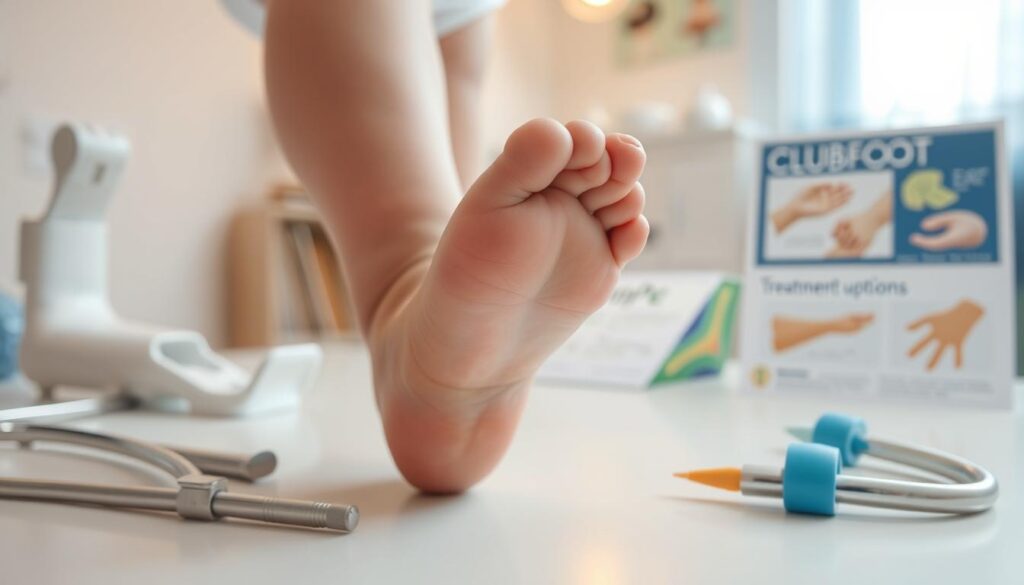
Clubfoot is a foot deformity affecting newborns’ foot alignment and development. It impacts about one in 1,000 babies, with varying severity12. Early detection and treatment can greatly improve outcomes for affected children.
This condition presents unique challenges for families. Boys are twice as likely to have clubfoot compared to girls12. Early professional assessment allows for effective management and potential correction.
Parents and healthcare providers should be aware of risk factors. Maternal smoking and genetics can increase clubfoot likelihood12. Quick medical evaluation within two weeks of birth enables timely treatment strategies.
Key Takeaways
- Clubfoot affects approximately 1 in 1,000 babies
- Early detection is critical for successful treatment
- Boys are more likely to develop clubfoot
- Multiple treatment methods exist
- Genetic and environmental factors influence risk
What is Clubfoot and Its Common Types
Clubfoot, or talipes equinovarus, is a complex birth condition affecting a child’s foot. It impacts foot positioning and mobility in newborns. This orthopedic disorder can be challenging for families3.
There are different types of clubfoot, each with unique features. Understanding these types helps parents and doctors choose the best treatment approach4.
Idiopathic Clubfoot: The Most Common Presentation
Idiopathic clubfoot is the most common type, appearing at birth without a known cause. Doctors often use foot casting and bracing to treat this condition3.
- Affects approximately 1 to 4 babies per 1,000 births3
- Boys are twice as likely to be affected3
- Can impact one or both feet3
Neurogenic and Syndromic Variations
Clubfoot can also be neurogenic or syndromic. Neurogenic clubfoot links to conditions like spina bifida or cerebral palsy. Syndromic clubfoot occurs with other clinical syndromes3.
Risk Factors and Early Detection
Advanced screening can detect clubfoot early. Genes play a big role in developing this condition4.
Family history increases the risk of clubfoot. Male children are more likely to have it3.
Doctors can spot potential issues during pregnancy. They use ultrasound screening around the 20th week4.
- Family history increases risk
- Male children are more susceptible3
- Ultrasound screening around the 20th week of pregnancy can identify potential issues4
“Understanding clubfoot early can significantly improve treatment outcomes and long-term mobility for affected children.”
Proper treatment can help children with clubfoot. Foot casting and bracing improve foot alignment and movement5.
Treatment Methods for Clubfoot Management
Clubfoot treatment needs a special approach for proper correction. The Ponseti method is the best non-surgical way to manage this condition6. Treatment usually starts soon after birth, focusing on reshaping the foot’s position7.
- Ponseti method with serial casting
- French method using splinting and taping
- Potential surgical intervention for severe cases
The Ponseti method involves four to eight plaster casts changed weekly. This helps correct the foot’s alignment6. About 90% of babies need a minor procedure called Achilles tenotomy7.
Preventing relapse is key in clubfoot management. After correction, your child will wear special braces for 3 to 4 years. This helps maintain proper foot positioning7.
The first three months are crucial. During this time, braces are worn almost full-time (23 hours daily)7.
Early treatment significantly improves long-term outcomes, allowing children to lead normal, active lives6.
Complex cases might need surgery if non-surgical methods don’t work7. Your healthcare team will help create the best treatment plan for your child’s foot development.
Learn more about clubfoot treatment options
Conclusion
Modern medicine offers hope for treating clubfoot. Pediatric orthopedics has made great progress in managing this condition through advanced treatment methods. Early intervention and consistent care can help your child overcome clubfoot challenges8.
Following medical advice is key to treatment success. Clubfoot affects about 174,000 children worldwide each year8. Most can achieve normal mobility with proper care.
The Ponseti method has improved outcomes for many children. It allows them to join in sports, dance, and daily activities9.
Genetic and environmental factors play a role in clubfoot. Family history is important, as genes can influence its occurrence10. Regular check-ups with specialists help monitor progress and address issues.
Every child’s journey is different. Medical expertise, parental support, and dedicated treatment are crucial. With these, children with clubfoot can lead active, fulfilling lives.
Your commitment to understanding and addressing clubfoot is vital. It’s the first step towards your child’s successful recovery. Stay positive and focused on the goal of normal foot function.
FAQ
What is clubfoot?
Clubfoot is a common birth defect that twists a baby’s foot out of position. It affects about one in 1,000 babies. The most common type is idiopathic clubfoot, present at birth due to a short Achilles tendon.
How is clubfoot diagnosed?
Clubfoot can be spotted in ultrasounds as early as 12 weeks into pregnancy. However, doctors usually confirm it through a physical exam at birth. They check the foot’s position and flexibility, as well as any family history or related conditions.
What are the main types of clubfoot?
There are three primary types of clubfoot:
– Idiopathic clubfoot: The most common type, present at birth without a known cause
– Neurogenic clubfoot: Associated with neurological conditions like spina bifida or cerebral palsy
– Syndromic clubfoot: Occurs alongside other clinical conditions related to an underlying syndrome
What is the primary treatment method for clubfoot?
The Ponseti method is the most widely used treatment for clubfoot. It involves gentle manipulations and serial casting over 2-3 months to correct the foot’s position. An Achilles tenotomy is often done before the final cast.
After casting, children use a bracing system to maintain correction and prevent relapse.
When should treatment for clubfoot begin?
Treatment should start within the first two weeks of life. Early intervention is key for the best results. The sooner treatment begins, the better the chances of fixing the foot and avoiding long-term issues.
Can children with treated clubfoot lead normal lives?
Yes, with proper treatment, children with clubfoot can lead active, normal lives. A well-corrected clubfoot looks just like a normal foot. Kids can play sports, dance, and wear regular shoes.
The key is following the treatment plan and attending regular check-ups with an orthopedic specialist.
What are the risk factors for clubfoot?
Key risk factors include:
– Having a parent or sibling with clubfoot
– Maternal smoking during pregnancy
– Being male
– Certain underlying genetic or neurological conditions
Are there alternative treatment methods to the Ponseti method?
The French method is an alternative that uses daily splinting and taping instead of casting. In severe cases that don’t respond to non-surgical treatments, surgery may be needed to fix the foot’s position.
Source Links
- Clubfoot – https://www.hopkinsmedicine.org/health/conditions-and-diseases/clubfoot
- Clubfoot – Symptoms and causes – https://www.mayoclinic.org/diseases-conditions/clubfoot/symptoms-causes/syc-20350860
- Boston Children’s Hospital – https://www.childrenshospital.org/conditions/clubfoot
- Clubfoot (for Parents) – https://kidshealth.org/en/parents/clubfoot.html
- Clubfoot (Talipes Equinovarus): Symptoms, Diagnosis and Treatment – https://www.nationwidechildrens.org/conditions/clubfoot-talipes-equinovarus
- Clubfoot Treatment Options | HSS Lerner Children’s Pavilion – https://www.hss.edu/condition-list_clubfoot.asp
- Clubfoot – OrthoInfo – American Academy of Orthopaedic Surgeons – https://orthoinfo.aaos.org/en/diseases–conditions/clubfoot/
- Clubfoot treatment in 2015: a global perspective – https://gh.bmj.com/content/3/4/e000852
- Assessing public awareness of clubfoot and knowledge about the importance of early childhood treatment: a cross-sectional survey – BMC Pediatrics – https://bmcpediatr.biomedcentral.com/articles/10.1186/s12887-019-1740-z
- Congenital talipes equinovarus (clubfoot): a disorder of the foot but not the hand – https://pmc.ncbi.nlm.nih.gov/articles/PMC1571059/

