
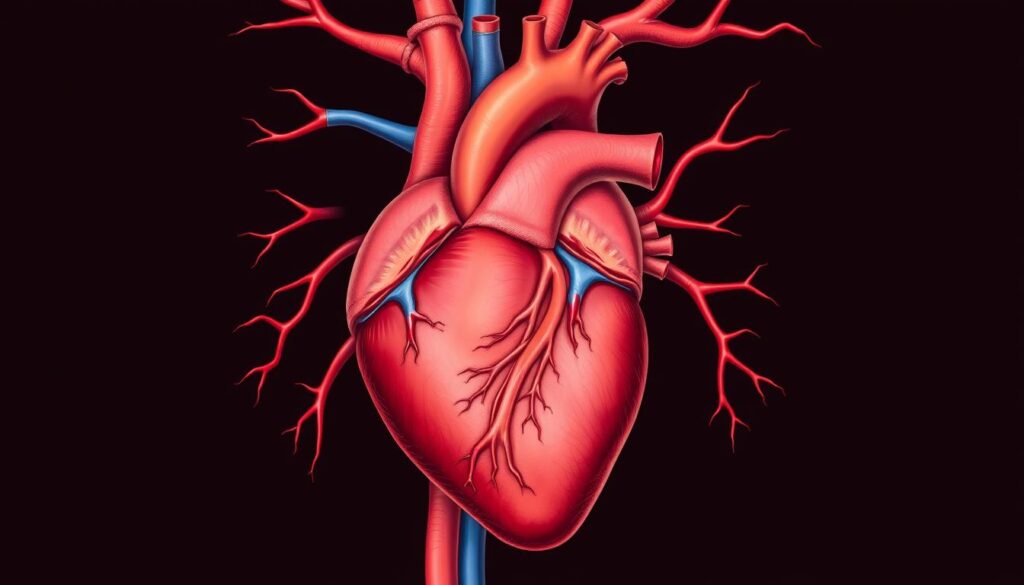
Your heart is an amazing organ that keeps you alive. It pumps blood throughout your body with incredible efficiency1. Every day, your heart beats about 100,000 times, moving nearly 2,000 gallons of blood1.
Knowing your heart’s structure is key to good health. Your heart has four chambers that work together to move blood23. These chambers are two atria and two ventricles.
The heart’s design is compact yet powerful. It’s about the size of your fist and weighs around 10 ounces in adults3. This small organ gets nutrients from coronary arteries to keep working3.
Key Takeaways
- The heart pumps 2,000 gallons of blood daily
- Heart beats approximately 100,000 times per day
- Four chambers work together to circulate blood
- Heart size is comparable to an adult’s fist
- Understanding heart structure helps maintain cardiovascular health
The Basic Structure of Heart Chambers and Valves
Your heart is a remarkable organ with a complex design. Its internal structure keeps you alive and healthy. Understanding it helps you appreciate this vital muscle.
The human heart has four distinct chambers that work together. These chambers are divided into two upper atria and two lower ventricles4.
Understanding the Upper Chambers (Atria)
Your heart’s atria play a crucial role in blood circulation. The right atrium receives deoxygenated blood from systemic veins. The left atrium receives oxygenated blood from pulmonary veins4.
These chambers act as receiving areas. They prepare blood for the next stage of circulation.
Exploring the Lower Chambers (Ventricles)
Ventricles are powerful pumping chambers in your heart. The right ventricle pumps blood to the lungs for oxygenation. The left ventricle pumps oxygenated blood to the entire body5.
The Role of Heart Valves in Blood Flow
Heart valves are critical for maintaining proper blood flow direction. The four main valves ensure blood moves correctly and prevent backflow6.
- Tricuspid valve
- Pulmonary valve
- Mitral valve
- Aortic valve
Regular heart valves typically have three leaflets (flaps). The mitral valve is unique, having only two leaflets6.
“The heart is an incredible machine, with each valve and chamber working in perfect harmony.” – Cardiac Specialist
How Blood Flows Through Your Heart’s Chambers
Your heart is an amazing organ that keeps blood flowing through your body. It’s about the size of your fist. Learning about cardiac circulation helps you grasp how your heart works.
Blood moves through four distinct heart chambers. Your heart has two upper chambers (atria) and two lower chambers (ventricles)7. Let’s explore how blood travels through these chambers.
- Oxygen-poor blood enters the right atrium from the vena cavae8
- Blood moves to the right ventricle
- Right ventricle pumps blood to the lungs through pulmonary arteries7
- Oxygenated blood returns to the left atrium
- Blood flows to the left ventricle
- Left ventricle pumps blood to the body through the aorta7
“The heart beats around 100,000 times daily, pumping about 2,000 gallons of blood”1
Your heart’s valves are vital for proper blood flow. Four main valves control circulation: tricuspid, pulmonary, mitral, and aortic7. These valves open and close precisely.
They ensure blood moves efficiently through the chambers. This keeps your circulation running smoothly.
| Heart Chamber | Blood Type | Primary Function |
|---|---|---|
| Right Atrium | Oxygen-poor | Receive blood from body |
| Right Ventricle | Oxygen-poor | Pump to lungs |
| Left Atrium | Oxygenated | Receive blood from lungs |
| Left Ventricle | Oxygenated | Pump to body |
Each heartbeat has two phases: diastole (relaxation) and systole (contraction)8. This rhythm keeps blood flowing. It delivers oxygen to your entire body.
Common Heart Chamber and Valve Disorders
Heart disorders can impact your cardiovascular health. Your heart’s complex system can develop issues affecting blood flow and function9.
Understanding these problems is key to maintaining a healthy heart. Regular check-ups can help catch issues early.
Understanding Arrhythmias
Arrhythmias are irregular heartbeats that disrupt normal electrical rhythm. These disorders come in two main types:
- Supraventricular arrhythmias: Including atrial fibrillation
- Ventricular arrhythmias: Such as ventricular fibrillation
Valve Disease Conditions
Valve diseases can greatly affect your heart’s performance. Common conditions include mitral valve prolapse and aortic stenosis.
These conditions may lead to improper blood flow9. Early detection is crucial for preventing serious complications.
“Early detection of valve diseases can prevent serious complications” – Cardiovascular Specialists
Endocarditis and Its Impact
Endocarditis is a serious infection of your heart’s inner lining. It affects both chambers and valves.
This condition needs immediate medical care. Quick action can prevent potential heart damage10.
| Condition | Potential Treatment |
|---|---|
| Valve Regurgitation | Surgical Repair |
| Valve Stenosis | Valve Replacement |
Treatments for heart disorders vary widely. Options range from medications to surgery10.
Your doctor can help choose the best approach. They’ll consider your specific condition and overall health.
Conclusion
Understanding your heart’s structure is vital for top-notch cardiovascular care. The heart has four chambers that pump blood throughout your body1112. Your proactive approach can greatly impact your long-term heart health.
Regular check-ups are key to monitoring your heart’s performance. Tests like electrocardiograms can catch potential issues early. About 35% of people with congenital heart conditions may have valve problems11.
A thorough evaluation can reveal subtle changes in heart function. Your doctor can help create personalized prevention strategies. Treatment options range from lifestyle changes to medical procedures.
Knowing how heart valves work can reduce risks of cardiac disorders11. Explore heart health resources to make smart choices. Your heart’s pumping efficiency depends on valve function and cardiac cycle health12.
Take a holistic approach to heart care. Listen to your body and maintain a healthy lifestyle. Seek professional help when needed. Prevention and early detection are your best tools for optimal heart health.
FAQ
What are the four chambers of the heart?
The heart has four chambers: two upper atria and two lower ventricles. The right atrium gets deoxygenated blood from the body. The left atrium receives oxygenated blood from the lungs.
The right ventricle pumps blood to the lungs. The left ventricle sends blood to the entire body.
How do heart valves work?
Heart valves act like gates, ensuring blood flows correctly. The four valves are aortic, mitral, tricuspid, and pulmonary. They open and close precisely to prevent backflow and maintain efficient circulation.
Each valve has two key functions. It opens to empty blood and closes to direct forward flow.
What is the blood flow pattern through the heart?
Blood enters the right atrium from the body. It moves to the right ventricle and is pumped to the lungs. After oxygenation, it returns to the left atrium.
From there, it flows to the left ventricle. Finally, it’s pumped out to the body through the aorta.
What are common heart valve disorders?
Common heart valve disorders include aortic stenosis and tricuspid regurgitation. These conditions can disrupt proper blood flow. They may lead to heart failure symptoms.
Some valve diseases prevent proper opening or closing. This can greatly impact heart function and overall cardiovascular health.
What are arrhythmias?
Arrhythmias are irregular heartbeats caused by electrical system problems. There are two main types: supraventricular and ventricular arrhythmias. These conditions can disrupt the heart’s normal rhythm.
Atrial fibrillation is a supraventricular arrhythmia. Ventricular fibrillation is a ventricular arrhythmia. Medical intervention may be needed for these conditions.
How can I maintain heart health?
Schedule regular check-ups and discuss your family history with healthcare providers. Undergo diagnostic tests like EKGs and echocardiograms. Treatment options vary based on the specific condition.
Lifestyle changes, medications, or surgery may be recommended. The choice depends on the condition’s severity.
What is endocarditis?
Endocarditis is a serious infection of the heart’s inner lining. It affects the chambers and valves. This condition requires prompt medical attention.
If left untreated, it can damage the heart’s internal structures. People with existing heart conditions or artificial valves are at higher risk.
Source Links
- How Blood Flows Through Your Heart & Body – https://my.clevelandclinic.org/health/articles/17060-how-does-the-blood-flow-through-your-heart
- Heart Valves, Anatomy and Function – https://www.columbiadoctors.org/treatments-conditions/heart-valves-anatomy-and-function
- Your Heart: Powerhouse of the Body – https://my.clevelandclinic.org/health/body/21704-heart
- Structure of the Heart | SEER Training – https://training.seer.cancer.gov/anatomy/cardiovascular/heart/structure.html
- How the Normal Heart Works – https://www.chop.edu/centers-programs/cardiac-center/how-normal-heart-works
- Anatomy and Function of the Heart Valves – https://www.urmc.rochester.edu/Encyclopedia/content.aspx?ContentTypeID=90&ContentID=P03059
- Mapping Blood Flow Through the Body – https://www.verywellhealth.com/blood-flow-through-the-heart-3156938
- How the Heart Works | UCSF Department of Surgery – https://cardiacbiomechanicslab.ucsf.edu/condition/how-heart-works
- Heart Valve Diseases – https://www.hopkinsmedicine.org/health/conditions-and-diseases/heart-valve-diseases
- What Is Heart Valve Disease? – https://my.clevelandclinic.org/health/diseases/17639-what-you-need-to-know-heart-valve-disease
- Anatomy and Function of the Heart Valves – https://www.nationwidechildrens.org/conditions/health-library/anatomy-and-function-of-the-heart-valves
- The Heart’s Chambers and Valves – https://www.verywellhealth.com/the-hearts-chambers-and-valves-1745389

