
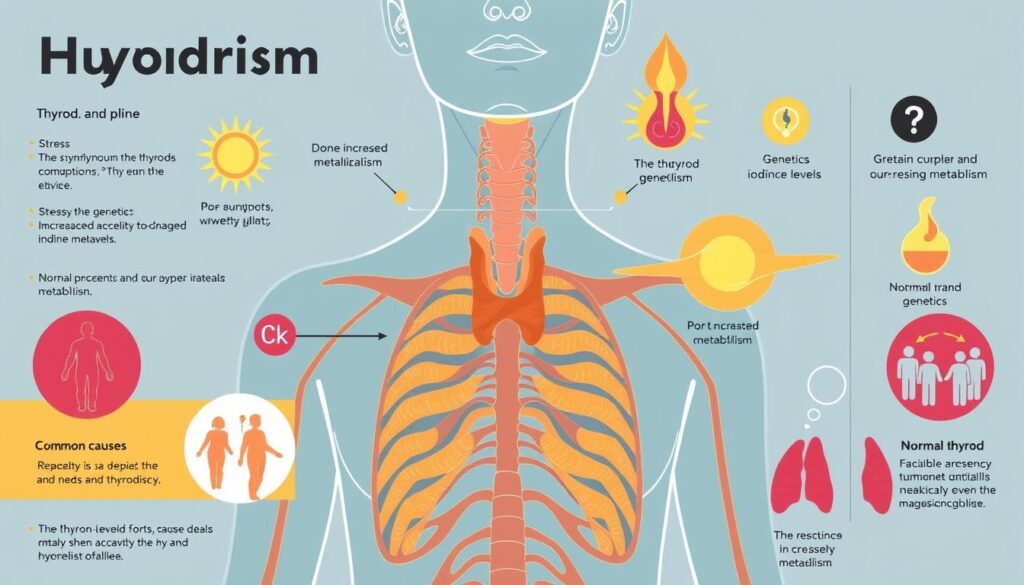
Hyperthyroidism is a thyroid disorder that impacts your body’s metabolism and overall well-being. About 1 in 100 Americans have this overactive thyroid condition. Women and people over 60 are more likely to develop this hormone imbalance1.
Your thyroid gland is vital for regulating body functions. An overactive thyroid can cause various symptoms that disrupt daily life. Graves’ disease, thyroid nodules, and thyroid inflammation are common causes1.
Recognizing signs early helps manage this disorder effectively. Watch for unexpected weight loss, rapid heartbeat, and nervousness. If you notice these symptoms, consult a doctor2.
Key Takeaways
- Hyperthyroidism affects metabolism and overall health
- Women and older adults are more susceptible
- Multiple factors can trigger an overactive thyroid
- Early detection is crucial for effective management
- Treatment options include medications and other interventions
What is Hyperthyroidism?
Your thyroid gland regulates your body’s metabolism, energy, and overall health. This small butterfly-shaped gland sits at the base of your neck. When overactive, it can cause hyperthyroidism.
Understanding the Thyroid Gland
The thyroid gland makes hormones that control how your body uses energy. An overactive thyroid leads to thyrotoxicosis. This means excess thyroid hormones circulate in your bloodstream3.
Key Characteristics of Hyperthyroidism
Common Thyroid Symptoms
Hyperthyroidism can cause several distinctive symptoms:
- Unexpected weight loss
- Rapid or irregular heartbeat
- Increased nervousness
- Persistent sweating
- Potential goiter development4
Potential Complications
| Condition | Associated Risk |
|---|---|
| Heart Rhythm Disorders | Atrial fibrillation4 |
| Bone Health | Risk of osteoporosis4 |
| Eye Health | Potential thyroid eye disease4 |
Understanding your thyroid’s function is the first step toward managing your health effectively.
Graves’ disease remains the most prevalent cause of hyperthyroidism3. Early detection and proper medical consultation are crucial for managing this condition.
Causes of Hyperthyroidism
Hyperthyroidism has various causes. These range from autoimmune disorders to inflammation and structural changes. Understanding these causes is key for proper treatment.
Autoimmune Disorders and Graves’ Disease
Graves’ disease is the main cause of hyperthyroidism. It affects more women than men56. This condition occurs when the immune system attacks the thyroid gland.
Genetics play a big role in Graves’ disease. Environmental factors also contribute to its onset5. The attack triggers the gland to produce too much hormone.
Nodular Thyroid Disease
Thyroid nodules can greatly affect thyroid function. Benign nodules may become toxic, leading to hyperthyroidism56. These nodules can form for many reasons.
Careful medical evaluation is needed for nodules. They can cause the thyroid to produce excess hormones.
- Toxic adenomas
- Multinodular goiter
- Overactive thyroid tissue
Thyroiditis and Additional Causes
Thyroiditis is inflammation of the thyroid gland. It can cause temporary or permanent hyperthyroidism5. Other potential triggers include:
“Understanding your body’s unique thyroid challenges is the first step toward effective management.”
| Cause | Prevalence |
|---|---|
| Graves’ disease | Over 70% of cases6 |
| Thyroid nodules | 20-30% of hyperthyroidism cases |
| Thyroiditis | Varies by individual |
Diagnosis of Hyperthyroidism
Diagnosing hyperthyroidism involves a thorough approach. Your doctor will carefully assess your condition through several steps. This ensures an accurate diagnosis7.
Medical History and Physical Examination
Your doctor starts with a detailed medical history review and physical exam. They look for signs that might suggest an overactive thyroid. NYU Langone doctors recommend starting with a comprehensive exam and blood testing7.
Thyroid Blood Tests and Function Assessment
Thyroid blood tests are crucial for diagnosing hyperthyroidism. The Thyroid Stimulating Hormone (TSH) test is the most sensitive indicator7. Blood tests typically show high T-4 hormone and low TSH levels.
These tests are especially important for older adults. They might not show typical hyperthyroidism symptoms8.
Imaging Tests and Scans
If blood tests suggest hyperthyroidism, your doctor might recommend advanced imaging. Two main tests are thyroid ultrasound and thyroid scan.
- Thyroid ultrasound: Visualizes thyroid gland structure
- Thyroid scan: Evaluates thyroid function and identifies potential nodules7
The radioactive iodine uptake test can provide more insights into your thyroid’s function7.
“Accurate diagnosis is the first step towards effective treatment” – Endocrinology Experts
Multiple diagnostic tests might be needed based on initial blood results8. The aim is to find the underlying cause and create a tailored treatment plan.
Treatment Options for Hyperthyroidism
Hyperthyroidism treatment is tailored to your specific health needs. Your doctor will guide you through various strategies to control thyroid hormone production. These approaches aim to ease your symptoms effectively.
Medications and Their Effects
Anti-thyroid medications are often the first treatment for hyperthyroidism. You may need to take these for 12 to 18 months or longer. However, they can cause side effects like nausea and headaches.
Radioactive Iodine Therapy
Radioiodine therapy is a highly effective treatment for hyperthyroidism. Most patients need just one session. This method is common in the United States for managing thyroid problems.
After treatment, avoid close contact with kids and pregnant women for about three weeks9.
Surgical Options
Thyroid surgery may be needed if other treatments don’t work. Doctors might remove part or all of your thyroid gland. This is often done for large goiters or suspicious nodules10.
Surgery can stop symptoms from coming back. But you’ll likely need lifelong medication like levothyroxine9.
Lifestyle Changes to Support Treatment
Your treatment goes beyond medical care. Reducing stress and eating well can help your recovery. Regular check-ups are also important. Work closely with your doctors to find the best treatment plan for you11.
FAQ
What is hyperthyroidism?
Hyperthyroidism occurs when your thyroid gland makes too many hormones. This speeds up your body’s metabolism. Symptoms include weight loss, fast heartbeat, and tremors. It affects 1% of Americans, mostly women and older adults.
What are the most common symptoms of hyperthyroidism?
Common signs are unexplained weight loss and increased appetite. You might also have a rapid heartbeat, tremors, and excessive sweating. An enlarged thyroid, or goiter, may appear at your neck’s base.
Older adults may lose appetite or withdraw socially. These symptoms differ from those in younger people.
What causes hyperthyroidism?
Graves’ disease is the main cause. It’s an autoimmune disorder attacking the thyroid gland. Other causes include overactive thyroid nodules and thyroid inflammation.
Risk factors involve family history of thyroid issues and recent pregnancy. Chronic illnesses like pernicious anemia can also play a role.
How is hyperthyroidism diagnosed?
Doctors use a mix of methods to diagnose hyperthyroidism. They start with your medical history and a physical exam. Blood tests measure thyroid hormone levels (TSH, T3, and T4).
Imaging tests like thyroid scans and ultrasounds may be used. These help visualize the thyroid and spot any problems.
What are the treatment options for hyperthyroidism?
Treatment aims to lower thyroid hormone production and ease symptoms. Options include anti-thyroid drugs like methimazole and beta-blockers for symptom control.
Radioactive iodine therapy can destroy overactive thyroid cells. In some cases, surgery removes part or all of the gland. Lifestyle changes and regular check-ups are crucial.
Is hyperthyroidism a serious condition?
Untreated hyperthyroidism can lead to severe problems. These include heart issues, weak bones, and a rare but dangerous condition called thyroid storm.
Early diagnosis and proper care help most people control symptoms. With treatment, many maintain a good quality of life.
Can hyperthyroidism be cured?
Some cases can be permanently resolved through certain treatments. These include radioactive iodine therapy or surgery. Other cases may need ongoing management.
Your treatment plan depends on the cause and symptom severity. Some patients need long-term medication or regular check-ups.
Are there any lifestyle changes that can help manage hyperthyroidism?
Yes, you can support your treatment with lifestyle changes. Managing stress and eating a balanced diet are helpful. Regular exercise and avoiding too much iodine also help.
Getting enough sleep and staying hydrated are important. Work closely with your doctor to manage symptoms and boost overall health.
Source Links
- Hyperthyroidism (Overactive Thyroid) – NIDDK – https://www.niddk.nih.gov/health-information/endocrine-diseases/hyperthyroidism
- Hyperthyroidism – https://www.hopkinsmedicine.org/health/conditions-and-diseases/hyperthyroidism
- Hyperthyroidism | Graves’ Disease | Overactive Thyroid | MedlinePlus – https://medlineplus.gov/hyperthyroidism.html
- Hyperthyroidism – Symptoms and causes – https://www.mayoclinic.org/diseases-conditions/hyperthyroidism/symptoms-causes/syc-20373659
- Hyperthyroidism: Causes, Symptoms, Treatment, Diagnosis & More – https://www.healthline.com/health/hyperthyroidism
- Hyperthyroidism: Symptoms, treatment, causes, and diet – https://www.medicalnewstoday.com/articles/9153
- Diagnosing Hyperthyroidism – https://nyulangone.org/conditions/hyperthyroidism/diagnosis
- Hyperthyroidism – Diagnosis and treatment – https://www.mayoclinic.org/diseases-conditions/hyperthyroidism/diagnosis-treatment/drc-20373665
- Overactive thyroid (hyperthyroidism) – Treatment – https://www.nhs.uk/conditions/overactive-thyroid-hyperthyroidism/treatment/
- Patient education: Hyperthyroidism (overactive thyroid) (Beyond the Basics) – https://www.uptodate.com/contents/hyperthyroidism-overactive-thyroid-beyond-the-basics/print
- Hyperthyroidism: Diagnosis and Treatment – PubMed – https://pubmed.ncbi.nlm.nih.gov/26926973/

