
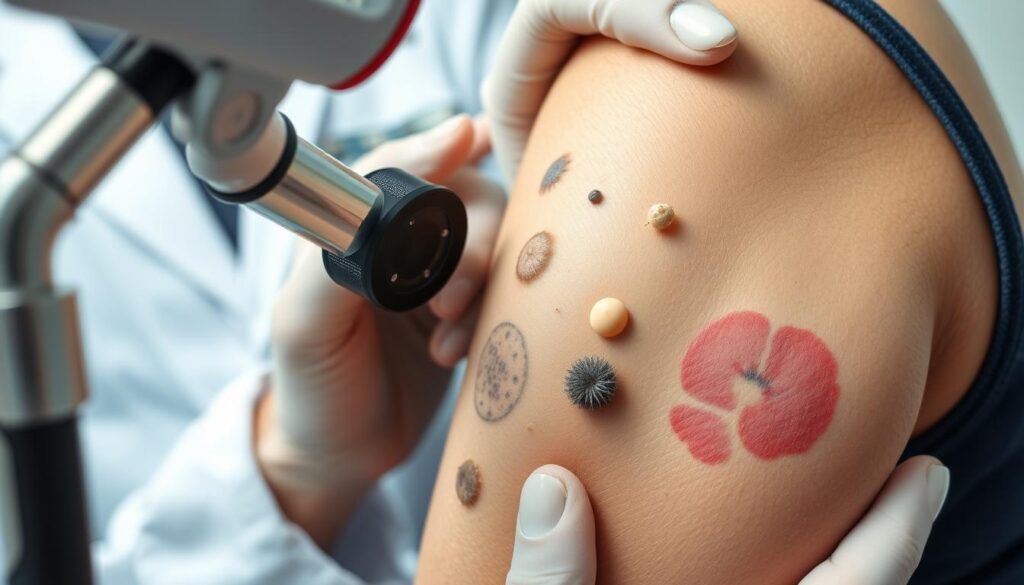
Moles are intriguing skin marks that can pop up anywhere on your body. These small growths, called nevi by doctors, range from harmless to potentially concerning. Most adults have at least one mole, with up to 40 being normal1.
Knowing your skin’s patterns is key for good health. While most moles are safe, some need a doctor’s look. About one in 100 babies are born with moles2.
Moles can grow throughout your life in various colors and shapes1. Skin experts suggest regular checkups to keep an eye on these spots. Getting yearly skin exams by your early 20s helps catch issues early2.
Protecting your skin from the sun is vital. It helps prevent possible skin cancer2. Remember, not all moles are risky, but watching them is smart.
Key Takeaways
- Moles are common skin growths that can appear at any age
- Most adults have multiple moles, which is considered normal
- Annual skin checkups are recommended for early detection
- Sun protection is crucial for preventing skin damage
- Not all moles are dangerous, but monitoring is essential
What Are Moles and Their Different Types
Moles are common skin growths that come in various forms. They play a crucial role in your skin’s health story. Knowing mole types helps you monitor your skin better.
There are three main mole categories: congenital, acquired, and atypical. Each type has unique features that set them apart. These differences can reveal important details about your skin’s condition.
Congenital Moles: Birthmarks of Uniqueness
Congenital moles appear at birth in about 1% of newborns. They can vary in size, shape, and color. Their texture may be flat or raised.
- Size and shape
- Color intensity
- Texture (flat or raised)
Acquired Moles: Developing Throughout Life
Acquired moles develop after birth, often due to sun exposure and genetics. People with fair skin tend to get these moles more often3.
Atypical Moles: When Vigilance Matters
Atypical moles, or dysplastic nevi, need extra attention. They have unique features that set them apart from other moles.
- Irregular borders
- Multiple color variations
- Larger size compared to typical moles
Tip: If you have over 50 moles or a family history of melanoma, see a dermatologist3.
Most moles are harmless, but always watch for changes in appearance4.
Regular skin checks help catch potential issues early. Dermatologists suggest monthly self-exams to track mole changes3.
Recognizing Signs of Potentially Dangerous Moles
Identifying dangerous moles can be lifesaving. The ABCDE rule helps detect skin cancer and melanoma early5. This method reveals warning signs of serious dermal nevi conditions.
Here’s what to look for when performing mole mapping and self-examination:
- Asymmetry: One half of the mole doesn’t match the other
- Border: Irregular, jagged, or blurred edges
- Color: Multiple colors or uneven color distribution
- Diameter: Larger than 6mm (size of a pencil eraser)5
- Evolution: Changes in size, shape, or color over time
Not all melanomas follow the ABCDE rule, especially on darker skin tones6. Some skin cancers may appear differently. Regular professional checks are crucial7.
“Early detection is key to successful treatment of skin cancer.”
Your risk increases if you have:
- Fair skin
- Multiple moles
- Family history of skin cancer
Survival rates highlight the importance of early detection:
| Detection Stage | Survival Rate |
|---|---|
| Early Detection | 99% |
| Spread to Lymph Nodes | 74% |
| Spread to Distant Organs | 35% |
Schedule yearly dermatologist check-ups for best results. Perform monthly self-exams to catch potential skin cancer early7.
Conclusion
Keeping an eye on your skin health is vital. It helps catch potential issues early. Moles are often harmless, but they need careful watching8.
Skin cancer prevention isn’t just about occasional checks. It requires a full approach to dermatology and sun protection8. Your skin’s health needs constant care and expert advice.
Watch for changes in your moles. Look for odd shapes, edges, or colors. If you spot these, get a pro to check them out8.
Do mole checks every few months. This helps spot skin issues early8. Shield yourself from too much UV light to prevent mole problems8.
Use high SPF sunscreen and wear sun-safe clothes. Avoid direct sunlight when possible. Book a yearly skin exam for peace of mind8.
Your actions can keep your skin healthy. Trust skin doctors with your concerns. Don’t wait to have odd moles checked by experts8.
FAQ
What exactly are moles?
Moles are common skin growths that appear anywhere on your body. They come in various colors like brown, red, pink, tan, and even blue or white. Most moles are harmless, but it’s crucial to watch for changes.
How many types of moles are there?
There are three main types of moles: congenital, acquired, and atypical. Congenital moles affect about 1 in 100 babies at birth. Acquired moles often develop due to sun exposure later in life.
Atypical moles have irregular borders and mixed colors. They carry a higher risk of becoming cancerous.
When should I be concerned about a mole?
Use the ABCDE rule to check your moles. Look for Asymmetry, Border irregularity, Color variations, Diameter larger than 6mm, and Evolution over time.
Warning signs include rapid growth, itching, bleeding, or oozing. If you notice these changes, see a dermatologist right away.
Who is at higher risk for mole-related skin cancer?
People with fair skin, multiple moles, or a family history of melanoma are at increased risk. Those with familial atypical multiple mole melanoma syndrome (FAMMM) also face higher risks.
Remember, skin cancer can occur in people of all skin colors. It may appear differently on darker skin tones.
How can I protect myself from mole-related skin issues?
Use broad-spectrum sunscreen with at least SPF 30 and wear protective clothing. Avoid tanning beds and do regular self-exams. Schedule yearly dermatologist check-ups and consider mole mapping.
Can moles be removed?
Yes, but only a medical professional should remove moles. Dermatologists can evaluate moles and perform biopsies or removals if needed. This ensures proper technique and allows testing for potentially cancerous cells.
Do all moles need to be removed?
No, most moles are benign and don’t require removal. However, if a mole shows suspicious changes, your dermatologist might suggest removal. They may also recommend further investigation to rule out skin cancer.
How often should I check my moles?
Do self-exams monthly, looking for changes in size, shape, color, or texture. Schedule a yearly professional skin check with a dermatologist. This is especially important if you have multiple moles or higher skin cancer risk.
Source Links
- Skin Moles | Types and the Risks of Skin Cancer | Beaumont – https://www.beaumont.org/conditions/skin-moles
- What Are Skin Moles? Types, Causes, and More – https://www.healthline.com/health/skin-moles
- Moles: What They Are, Causes, Types & Examination – https://my.clevelandclinic.org/health/diseases/4410-moles
- Understanding the different types of moles – https://www.spotcheck.clinic/different-types-of-moles/
- Signs of Melanoma Skin Cancer | Symptoms of Melanoma – https://www.cancer.org/cancer/types/melanoma-skin-cancer/detection-diagnosis-staging/signs-and-symptoms.html
- Symptoms of melanoma skin cancer – https://www.cancerresearchuk.org/about-cancer/melanoma/symptoms
- Melanoma Warning Signs and Images – https://www.skincancer.org/skin-cancer-information/melanoma/melanoma-warning-signs-and-images/
- Skin Moles to Worry About – High Valley Dermatology – https://www.highvalleydermatology.com/skin-moles-to-worry-about/

