
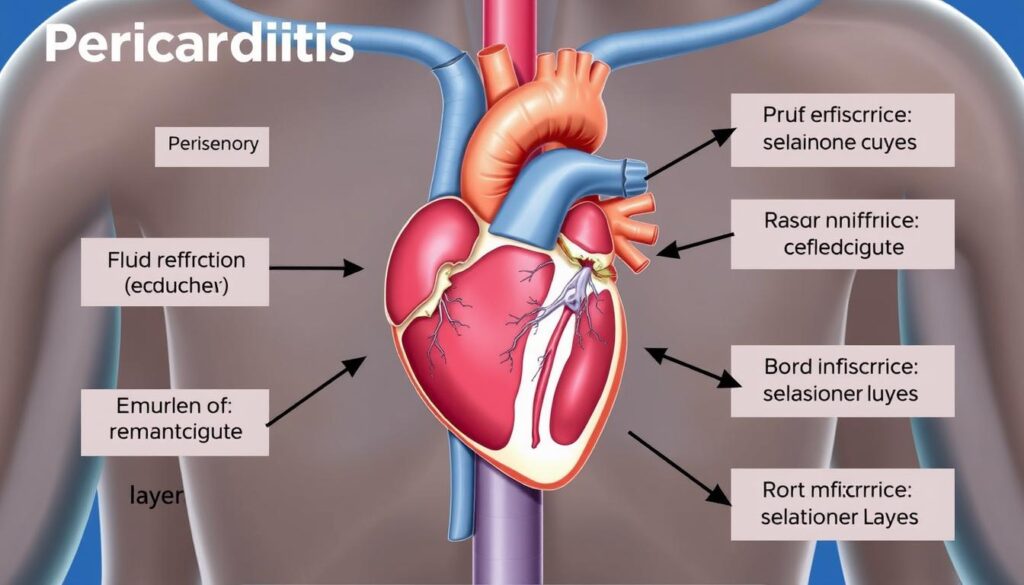
Pericarditis is a tough heart condition that can really affect your health. It’s when the sac around your heart gets inflamed. This can cause sharp chest pain that feels like a heart attack1.
Your heart’s protective layer can swell up for many reasons. These include viral infections and autoimmune disorders2. Acute pericarditis usually lasts less than four to six weeks31.
Some people might have it come back again and again. That’s why it’s important to know the signs. If you spot them, get medical help right away.
Medicines are key in treating pericarditis. Doctors often give ibuprofen or high-dose aspirin for pain and swelling3. In worse cases, they might suggest colchicine to control symptoms and prevent future episodes3.
Key Takeaways
- Pericarditis is an inflammation of the heart’s protective sac
- Symptoms can mimic a heart attack, causing sharp chest pain
- Multiple types exist, including acute and chronic forms
- Treatment primarily involves medication and monitoring
- Early detection is crucial for effective management
What is Pericarditis and Its Common Symptoms
Pericarditis is inflammation of the protective membrane around your heart4. It can cause discomfort and serious issues if not treated. Left untreated, it may lead to complications.
The main sign of pericarditis is sharp chest pain. This pain gets worse when lying down or breathing deeply5. It usually occurs in the middle or left side of the chest.
Recognizing Key Symptoms
Pericarditis shows up in different ways. Here are some common signs:
- Chest pain that may worsen with movement
- Fever4
- Heart palpitations5
- Shortness of breath
- Muscle aches4
- Weakness and fatigue
Types of Pericarditis
There are several forms of pericarditis. Each type has its own features:
| Type | Duration | Key Characteristics |
|---|---|---|
| Acute Pericarditis | Less than 4-6 weeks | Sudden onset, intense symptoms4 |
| Recurrent Pericarditis | Occurs 4-6 weeks after initial episode | Symptoms reappear after initial recovery4 |
| Incessant Pericarditis | 4-6 weeks but less than 3 months | Continuous symptoms |
| Chronic Constrictive Pericarditis | Over 3 months | Potential heart compression5 |
Note: If you experience persistent chest pain or multiple symptoms, consult a healthcare professional for proper diagnosis and treatment.
Common Causes and Risk Factors of Pericarditis
Pericarditis stems from various underlying conditions. Knowing these causes helps spot potential risks and get proper medical care. Men between 20 and 50 are more likely to get this heart inflammation6.
The primary causes of pericarditis include:
- Viral infections that trigger inflammatory responses
- Autoimmune disorders like lupus and rheumatoid arthritis
- Complications following a heart attack
- Bacterial or fungal infections
- Chest injuries or trauma
Some health issues raise the risk of idiopathic pericarditis. Kidney failure, cancer, and radiation therapy can lead to this heart problem6.
About 15 to 30 percent of patients have recurring episodes. This makes ongoing care very important7.
| Risk Category | Contributing Factors |
|---|---|
| Infectious Triggers | Viral infections, bacterial infections |
| Medical Conditions | Autoimmune disorders, kidney failure |
| Cardiac Events | Previous heart attack, chest trauma |
“Understanding your risk factors is the first step in preventing and managing pericarditis.” – Cardiac Health Experts
Long-term pericardium swelling can cause serious issues like constrictive pericarditis. This may lead to heart failure symptoms6.
Spotting early signs and talking to doctors can help reduce these risks.
Treatment Options and Medical Interventions
Pericarditis treatment depends on its cause and severity. Your doctor will create a personalized plan to manage your symptoms. They’ll consider your specific type of pericarditis through a thorough medical evaluation.
Medication-Based Approaches
The main goal is to control inflammation and pain. Nonsteroidal anti-inflammatory drugs (NSAIDs) are often used first for acute pericarditis8.
Your doctor might prescribe different medications. These can include ibuprofen for pain and colchicine to reduce swelling8.
For severe cases, prednisone may be needed. If an infection is found, antibiotics will be given.
- Ibuprofen for pain relief
- Colchicine to reduce inflammation8
- Prednisone for more severe cases
- Antibiotics if an infection is detected
Advanced Medical Interventions
Sometimes, medications aren’t enough. In these cases, medical procedures become necessary. Doctors might use pericardiocentesis to drain extra fluid around the heart9.
For complex situations, a pericardial window or pericardiectomy might be recommended. These procedures help manage serious complications.
| Procedure | Purpose |
|---|---|
| Pericardiocentesis | Drain fluid buildup |
| Pericardial Window | Create drainage pathway |
| Pericardiectomy | Remove restrictive pericardium |
Remember, early and appropriate treatment can prevent long-term complications and promote complete recovery10.
Every treatment plan is different. Work closely with your doctor to find the best approach for you9.
Conclusion
Pericarditis management requires a balanced approach of medical care and personal attention11. Recovery times vary widely. Acute cases may resolve in weeks, while complex conditions could take months12.
Understanding this heart condition is key for successful treatment and prevention. Prevention strategies are crucial in managing pericarditis. Good health and close work with doctors can lower risks13.
Regular check-ups, up-to-date vaccinations, and avoiding viral infections help protect heart health. Proactive medical guidance is essential for cardiovascular well-being.
Early detection, proper treatment, and ongoing monitoring are vital for recovery. Some patients may have recurring episodes11. It’s crucial to follow your doctor’s advice carefully.
Your treatment plan may include medicines, lifestyle changes, and regular check-ups. These steps ensure optimal heart health12. Each case of pericarditis is different.
Stay informed and follow medical advice to manage this condition effectively. Your commitment to understanding pericarditis is your best tool for recovery12.
FAQ
What is pericarditis?
Pericarditis inflames the protective sac around your heart. It causes sharp chest pain and can be acute or chronic. Some cases are mild, while others need medical help.
What are the main symptoms of pericarditis?
Sharp chest pain is the primary symptom. It worsens when coughing, lying down, or breathing deeply. Sitting up or leaning forward often eases the pain.
Other symptoms may include fever, fatigue, and cough. Leg swelling, pounding heartbeat, and shortness of breath can also occur.
What causes pericarditis?
The cause is often hard to pinpoint, resulting in idiopathic pericarditis. Viral infections and immune responses after heart damage are common triggers.
Bacterial or fungal infections, injuries, and autoimmune disorders can also cause it. Some medications, kidney failure, cancer, and radiation therapy increase the risk.
How is pericarditis typically treated?
Treatment focuses on managing pain and inflammation with medications. NSAIDs like ibuprofen are common, while colchicine helps in severe cases.
Steroids may be used, and antibiotics treat infections. In serious cases, procedures like pericardiocentesis might be needed.
Who is most at risk for developing pericarditis?
Men between 16 and 65 are more likely to get pericarditis. Those with autoimmune disorders or recent heart damage face higher risks.
Viral infections and certain medical treatments also increase the chances. The condition can recur in 15-30% of cases.
Can pericarditis be prevented?
There’s no guaranteed prevention, but you can lower your risk. Practice good hygiene and stay current with vaccinations.
Avoid contact with infected people. Regular check-ups and addressing health issues can help minimize your chances.
How long does recovery from pericarditis take?
Recovery time varies based on the type and severity. Mild cases may heal in a week, while severe ones take months.
Proper medical care, rest, and following doctor’s orders are key to full recovery.
Source Links
- Pericarditis – Symptoms and causes – https://www.mayoclinic.org/diseases-conditions/pericarditis/symptoms-causes/syc-20352510
- What Is Pericarditis? – https://www.heart.org/en/health-topics/pericarditis/what-is-pericarditis
- Pericarditis: Causes, Symptoms and Treatment – https://my.clevelandclinic.org/health/diseases/17353-pericarditis
- Pericarditis – https://www.healthdirect.gov.au/pericarditis
- Symptoms and Diagnosis of Pericarditis – https://www.heart.org/en/health-topics/pericarditis/symptoms-and-diagnosis-of-pericarditis
- Pericarditis | Aurora Health Care – https://www.aurorahealthcare.org/services/heart-vascular/conditions/pericarditis
- Patient education: Pericarditis (Beyond the Basics) – https://www.uptodate.com/contents/pericarditis-beyond-the-basics
- Acute Pericarditis: Diagnosis and Management – https://www.aafp.org/pubs/afp/issues/2014/0401/p553.html
- Pericarditis: What Is It, Symptoms, Causes and Treatment – http://www.medparkhospital.com/en-US/disease-and-treatment/pericarditis
- Management of Acute and Recurrent Pericarditis – American College of Cardiology – https://www.acc.org/Latest-in-Cardiology/ten-points-to-remember/2020/01/07/10/59/Management-of-Acute-and-Recurrent-Pericarditis
- Management of acute pericarditis: treatment and follow-up – https://www.escardio.org/Journals/E-Journal-of-Cardiology-Practice/Volume-15/Management-of-acute-pericarditis-treatment-and-follow-up
- Pericarditis – Types, Symptoms, Causes, Treatment and Prevention – https://www.apollohospitals.com/diseases-and-conditions/pericarditis-types-symptoms-causes-treatment-and-prevention/
- Diagnosis of acute pericarditis – https://www.escardio.org/Journals/E-Journal-of-Cardiology-Practice/Volume-15/Diagnosis-of-acute-pericarditis

